Chakra symbolism refers to the meanings attached to chakra centers, colors, shapes, and energy practices. Today, many Americans connect chakras with balance, mindfulness, personal growth, and spiritual awareness.
The idea has deep roots in Indian religious and philosophical traditions. However, modern American culture has also reshaped how people understand and use chakra imagery. You may see it in meditation spaces, jewelry, tattoos, artwork, wellness products, and social media.
Chakras can represent different parts of human experience, from stability and emotion to communication and higher awareness. Their symbolism can therefore feel both spiritual and personal.
Quick Answer
Chakra symbolism in the USA commonly represents balance, self-awareness, personal growth, and the connection between physical and spiritual life. More broadly, chakra traditions associate different energy centers with qualities such as stability, creativity, communication, intuition, and consciousness.
TL;DR
- Chakras are traditionally described as subtle energy centers in Indian traditions.
- Modern American culture often connects them with balance and personal growth.
- Seven-chakra systems commonly use colors from red through violet.
- Each chakra has its own symbolic themes and traditional associations.
- Chakra imagery appears widely in wellness, jewelry, tattoos, and home decor.
- Modern interpretations sometimes simplify or commercialize older spiritual traditions.
What Is Chakra Symbolism?
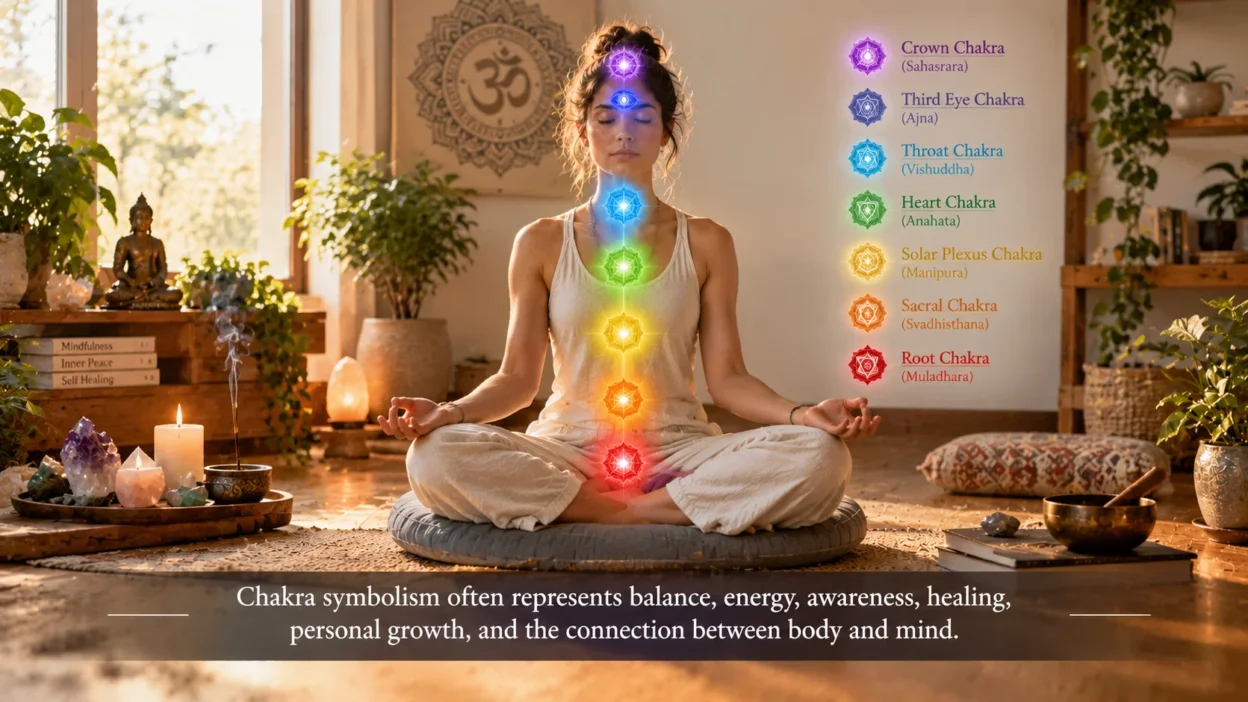
Chakra symbolism combines colors, body locations, sacred imagery, and spiritual ideas. For American readers, it often appears as a vertical sequence of colored circles along the body.
The Seven Common Chakras
The modern seven-chakra model usually places centers from the base of the spine to the crown of the head. Each one is connected with particular qualities and symbolic themes.
| Chakra | Common Color | Common Symbolic Themes | Typical Body Area |
| Root | Red | Stability, safety, grounding | Base of spine |
| Sacral | Orange | Creativity, emotion, pleasure | Lower abdomen |
| Solar Plexus | Yellow | Confidence, will, identity | Upper abdomen |
| Heart | Green | Love, compassion, connection | Chest |
| Throat | Blue | Communication, truth, expression | Throat |
| Third Eye | Indigo | Intuition, insight, awareness | Brow |
| Crown | Violet or white | Consciousness, spirituality, transcendence | Top of head |
These associations are common in modern Western presentations. However, chakra traditions have varied across historical texts and lineages.
Why Colors Matter
Color gives chakra symbolism much of its modern visual appeal. Red often suggests grounding, while violet can suggest spiritual awareness.
However, these color pairings are not a complete description of historical Indian chakra systems. The familiar rainbow arrangement became especially influential through modern Western interpretations.
What Is the History of Chakra Symbolism?
The history of chakra symbolism reaches back into Indian religious and philosophical traditions. However, the familiar seven-color system seen today developed through several later interpretations.
Ancient Indian Roots
The Sanskrit word chakra is commonly translated as “wheel” or “disc.” Early Indian traditions used the concept in different philosophical and spiritual contexts.
References to subtle centers appear in later Hindu and tantric texts. Buddhist tantric traditions also developed their own systems involving channels, winds, and energetic centers.
Importantly, there was never just one universal chakra system. Different texts and practices described different numbers, locations, symbols, and functions.
From Traditional Systems to Modern Interpretations
During the nineteenth and twentieth centuries, Western writers increasingly encountered Indian spiritual ideas. Some adapted chakra concepts for new audiences interested in mysticism and alternative spirituality.
Later, yoga, meditation, New Age movements, and wellness culture helped spread chakra imagery throughout the United States. As a result, today’s popular version combines traditional concepts with modern psychological and wellness language.
What Do the Seven Chakras Symbolize?
The seven chakras are often presented as a symbolic journey from physical security toward expanded awareness. For many Americans, this makes the system useful as a framework for self-reflection.
Root Chakra
The root chakra is commonly associated with grounding, security, survival, and belonging. Its red color reinforces ideas of strength, physical presence, and stability.
People may use root imagery when thinking about home, family, financial security, or feeling settled. However, these modern associations shouldn’t be treated as universal religious rules.
Sacral and Solar Plexus Chakras
The sacral chakra is often connected with creativity, emotions, pleasure, relationships, and movement. Orange gives this center a warm and energetic visual identity.
The solar plexus chakra is usually associated with confidence, willpower, identity, and personal agency. Its yellow color can suggest warmth, optimism, visibility, and inner strength.
Heart, Throat, Third Eye, and Crown
The heart chakra commonly represents compassion, love, connection, and emotional openness. Green frequently symbolizes growth and harmony.
The throat chakra is linked with speech, expression, and truth. The third eye often represents intuition and insight, while the crown is associated with consciousness and spiritual connection.
What Does Chakra Symbolism Mean in America?
In the USA, chakra imagery has become strongly connected with wellness, mindfulness, self-development, and alternative spirituality. Its meaning often depends on where and how people encounter it.
Everyday American Associations
You might find chakra designs in yoga studios, meditation spaces, bookstores, jewelry shops, spas, and wellness communities. Some people also use chakra imagery simply because they enjoy its colors and visual balance.
For others, the symbols express a personal interest in spirituality without belonging to a particular religious institution.
Common American associations include:
• Personal balance and emotional awareness
• Meditation and mindful living
• Personal growth and self-discovery
• Connection between body, mind, and spirit
• Calmness, intention, and inner reflection
• Alternative and holistic spirituality
Chakra Imagery in Popular Culture
American media has helped turn chakra colors into recognizable visual shorthand. A row of rainbow-colored circles can quickly suggest meditation, spirituality, or wellness.
However, popular culture sometimes removes the symbols from their historical setting. This can make a complex tradition appear simpler than it really is.
What Is the Spiritual Meaning of Chakras?
Spiritually, chakras are often understood as subtle centers connected with consciousness and human experience. Their meaning varies according to religious tradition, teacher, and historical system.
Hindu and Tantric Traditions
Within Hindu traditions, chakra concepts can appear alongside ideas about subtle channels, kundalini, meditation, and spiritual transformation. These teachings are diverse rather than completely uniform.
Tantric traditions may connect chakras with mantras, deities, elements, geometric forms, and other sacred concepts. Therefore, modern rainbow chakra charts represent only one simplified interpretation.
Buddhist Traditions
Some Buddhist tantric systems also describe subtle-body practices. However, their frameworks and goals can differ significantly from popular Western chakra charts.
This distinction matters because “chakra symbolism” doesn’t describe one single religious belief. It covers a broad collection of traditions and modern interpretations.
What Do Chakra Colors Mean?
Chakra colors provide an easy visual language for expressing different qualities. In modern American culture, the colors are often arranged like a rainbow.
Red Through Yellow
Red is commonly linked with grounding, survival, strength, and stability. Orange often represents creativity, emotion, pleasure, and movement.
Yellow tends to suggest confidence, identity, optimism, and personal power. Together, these colors are often presented as symbols of physical and emotional development.
Green Through Violet
Green is commonly associated with love, compassion, growth, and connection. Blue often represents communication, honesty, calmness, and expression.
Indigo is frequently linked with intuition and inner vision. Violet or white is commonly connected with consciousness, spirituality, and transcendence.
What Do Chakras Symbolize Emotionally and Psychologically?
Chakra symbolism can give people a simple language for discussing feelings and personal experiences. It can also encourage reflection on areas of life that feel balanced or neglected.
A Symbolic Map of the Self
Someone might think about the root chakra when feeling unsettled or disconnected. Another person may use heart or throat imagery when reflecting on relationships and communication.
These interpretations can work as personal metaphors. However, they shouldn’t automatically be treated as medical or psychological diagnoses.
Identity and Personal Growth
Chakra imagery often appeals to people who see personal growth as an ongoing journey. The movement from lower to higher centers can symbolize a gradual expansion of awareness.
For example, someone may wear a chakra necklace as a reminder to remain grounded while pursuing creativity, confidence, compassion, and spiritual awareness.
How Are Chakras Used in Modern Life?
Chakra symbolism has moved far beyond religious and philosophical texts. Today, it appears throughout American wellness and lifestyle culture.
Tattoos and Jewelry
Chakra tattoos may feature seven circles, individual symbols, lotus designs, or colored energy centers. Some people choose one chakra to represent a specific personal value.
Jewelry can serve a similar purpose. Chakra necklaces and bracelets often use colorful stones or beads arranged according to the familiar seven-color sequence.
Home Decor and Social Media
Chakra art appears in bedrooms, meditation corners, yoga spaces, and wellness studios. Rainbow chakra posters are especially recognizable in contemporary spiritual decor.
On social media, chakra imagery can communicate interests in meditation, mindfulness, yoga, self-reflection, or alternative spirituality. Sometimes, however, the imagery is used mainly as an aesthetic.
Holidays and Personal Rituals
Chakra colors may appear in meditation events, wellness gatherings, retreats, and personal rituals. They can also become part of intention-setting practices.
The meaning usually comes from the person’s intention rather than the colors alone.
How Does Chakra Symbolism Appear Across Cultures?
Chakra ideas belong primarily to Indian religious and philosophical traditions, but similar concepts of subtle energy appear elsewhere. These systems should not be treated as identical.
Different Ideas of Energy
Various cultures have developed ideas about life force, breath, spirit, or subtle energy. These include concepts such as prana in Indian traditions and other culturally specific ideas found around the world.
However, similarities don’t mean these traditions share the same history. Each system deserves to be understood within its own cultural setting.
Modern Global Spirituality
Today, chakra imagery has become part of global wellness culture. Yoga studios, meditation communities, artists, and spiritual practitioners may use the symbols in different ways.
For American audiences, this creates a blend of traditional references and modern personal spirituality. That blend can be meaningful, but it can also blur historical differences.
Are Chakras Religious Symbols?
Chakras have important connections to religious traditions, but modern chakra imagery isn’t always used religiously. Context is therefore essential.
Sacred and Secular Uses
A person may study chakras as part of Hindu or Buddhist traditions. Another person may use chakra colors during meditation without identifying with a specific religion.
Neither use automatically explains the entire tradition. Chakra symbolism can be religious, spiritual, philosophical, artistic, or wellness-oriented depending on context.
Respecting Cultural Origins
Because chakra concepts have roots in Indian traditions, it helps to acknowledge their history. Treating them only as colorful wellness accessories can overlook their deeper cultural background.
At the same time, modern users don’t necessarily intend disrespect. Understanding the history allows people to engage with the imagery more thoughtfully.
What Are Common Misunderstandings About Chakra Symbolism?
Chakra symbolism is often simplified online. The most common misunderstanding is the belief that one fixed seven-chakra system has existed unchanged for thousands of years.
The Seven-Chakra Model Is Not Universal
Different historical traditions described different chakra systems. Some included more or fewer centers, while others used different locations and associations.
Therefore, a modern chart shouldn’t automatically be presented as the only authentic system.
Symbolism Is Not Medical Diagnosis
Modern wellness discussions sometimes describe blocked or unbalanced chakras. These phrases are usually spiritual or metaphorical rather than established medical diagnoses.
People can use chakra language for reflection without assuming it replaces professional health care.
Commercialization and Cultural Context
Chakra designs appear on clothing, candles, posters, jewelry, and wellness products. Commercial use isn’t automatically harmful, but it can sometimes remove sacred ideas from their original context.
A respectful approach recognizes both the traditional roots and the many ways people use the imagery today.
How Has Chakra Symbolism Changed Over Time?
Chakra symbolism has changed as ideas moved between religious traditions, teachers, cultures, and modern wellness communities. Its history is therefore better understood as an evolving story.
From Sacred Philosophy to Popular Wellness
Earlier chakra teachings were often connected with meditation, spiritual practice, ritual, and philosophical ideas. Modern American culture frequently emphasizes emotional balance and self-development instead.
The shift doesn’t erase the older meanings. Instead, it shows how symbols can acquire new layers as they enter different social settings.
From Complex Systems to Simple Color Charts
Modern rainbow charts make chakra symbolism easy to recognize. They also make complicated historical traditions easier to explain.
However, simplicity comes with a tradeoff. A seven-color diagram can represent a modern interpretation without capturing the full range of traditional teachings.
Why Do People Find Chakra Symbols Meaningful?
Chakra symbolism gives people a visual way to think about invisible experiences. Colors and body locations can turn abstract ideas into something easy to remember.
A Personal Reminder
Someone may use a chakra symbol as a reminder to slow down, communicate honestly, or remain grounded. The symbol can become connected to a personal goal or life transition.
For example, a person beginning meditation may choose a chakra bracelet as a daily reminder of their intention.
Read More: Prayer Symbolism: Meaning, History, and Modern Uses
A Language for Balance
The idea of balance is one reason chakra imagery remains popular in the USA. Modern life often divides attention between work, relationships, technology, health, and personal goals.
Chakra symbolism offers a simple framework for asking where attention might be needed. Its value can therefore come from reflection as much as belief.
FAQs
What does chakra symbolism represent?
Chakra symbolism commonly represents balance, energy, awareness, personal growth, and spiritual development. In the USA, it is also strongly associated with mindfulness, yoga, wellness, and self-reflection.
What do the seven chakra colors mean?
The seven colors are commonly linked with different qualities, from grounding and stability to communication, intuition, and spiritual awareness. These color associations are especially common in modern Western presentations.
Are chakras part of Hinduism?
Chakra concepts have important roots in Hindu traditions, especially tantric and related philosophical systems. However, chakra teachings vary across traditions and aren’t limited to one single historical model.
What does a chakra tattoo mean?
A chakra tattoo can symbolize balance, personal growth, spirituality, self-awareness, or a meaningful life transition. The exact meaning depends on the person and the design.
What does a blocked chakra mean?
In modern spiritual language, a blocked chakra usually describes a perceived area of emotional or energetic imbalance. It isn’t a medical diagnosis and shouldn’t be confused with an established physical condition.
Why are chakras shown as a rainbow?
Modern Western chakra systems commonly use a sequence of colors from red to violet. The rainbow arrangement creates an easy visual connection between the seven commonly presented centers.
Conclusion
Chakra symbolism connects color, body imagery, spirituality, and personal reflection. In 2026, it commonly represents balance, self-awareness, growth, communication, and the search for deeper meaning. Its history is more varied than the familiar seven-color chart suggests. Still, that modern image has become a powerful part of American wellness, art, jewelry, tattoos, and personal spirituality. Whether you approach chakras as a spiritual tradition, a cultural symbol, or a personal metaphor, their imagery invites reflection. The most meaningful interpretation often begins with understanding both where the symbols came from and what they mean to you today.