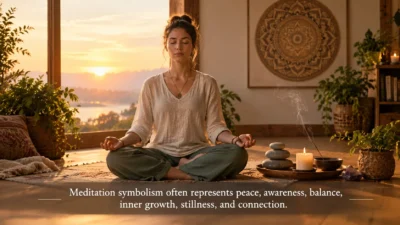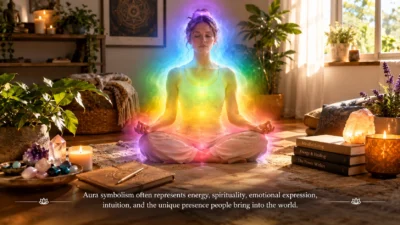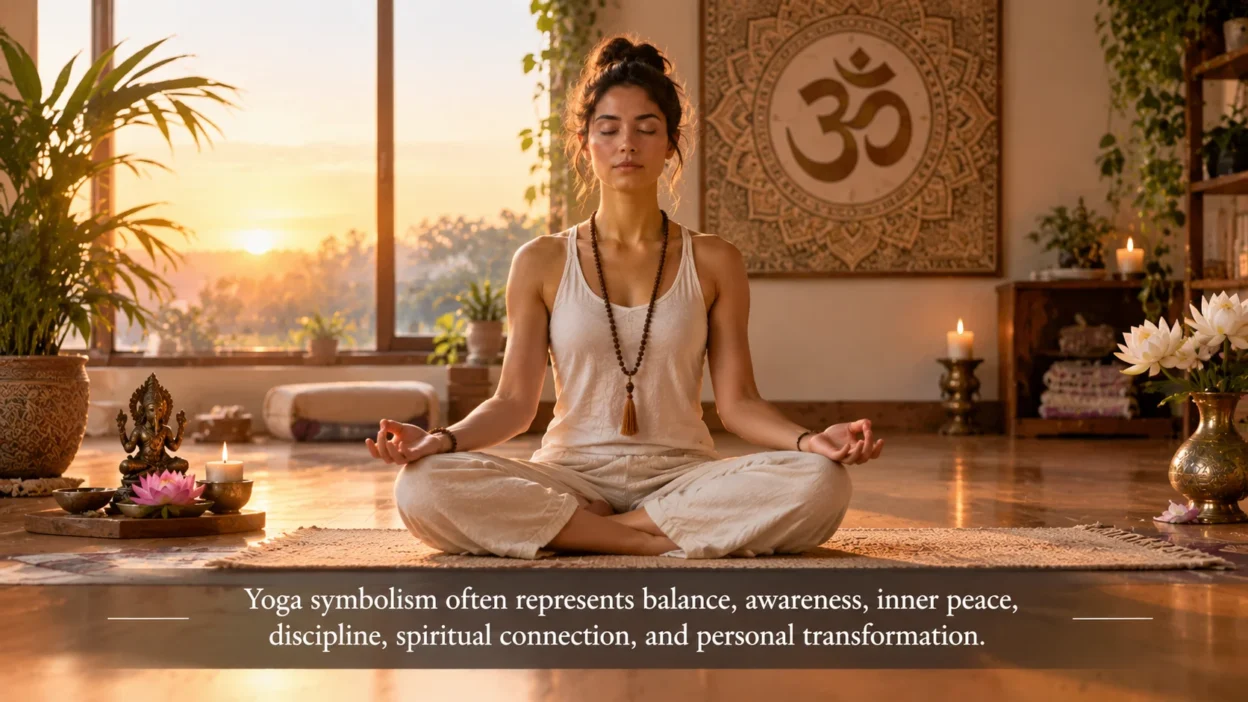
Yoga symbolism brings together ideas of balance, awareness, discipline, inner peace, and transformation. It isn’t one single symbol. Instead, yoga uses a family of images, gestures, sounds, postures, and ideas that have developed over centuries.
In 2026, yoga is often seen in studios, gyms, wellness spaces, homes, tattoos, clothing, and social media. For many Americans, it represents a calmer lifestyle and a mindful approach to everyday stress. However, yoga has much deeper roots than modern fitness culture suggests. Its history reaches into ancient South Asian religious and philosophical traditions, where meditation, breath, ethical practice, and disciplined attention were closely connected.
Understanding these layers helps explain why familiar images like the Om symbol, lotus, meditation posture, and chakra designs can carry different meanings. A symbol may suggest spirituality to one person and wellness or personal growth to another.
Quick Answer
Yoga symbolism usually represents balance, mindfulness, self-discipline, inner peace, spiritual awareness, and personal transformation in the United States. More broadly, yoga traditions connect these ideas with meditation, consciousness, ethical living, and the search for deeper understanding.
TL;DR
- Yoga symbolism represents balance, awareness, discipline, and inner transformation.
- Ancient yoga developed through South Asian philosophical and religious traditions.
- Americans often associate yoga with wellness, mindfulness, and stress reduction.
- Om, lotus imagery, chakras, and meditation postures have distinct meanings.
- Modern yoga blends traditional symbolism with fitness and lifestyle culture.
- Meanings can shift when symbols move between religious and commercial settings.
What Does Yoga Symbolize?
Yoga symbolizes a disciplined relationship between body, mind, attention, and inner life. Although modern classes may emphasize physical postures, traditional yoga includes a much wider range of practices.
For American readers, this distinction matters because yoga can mean several things at once. Someone may practice yoga for exercise while another person approaches it as meditation or spiritual discipline.
Balance and Integration
The word yoga is connected with ideas of joining or bringing together. This makes connection and integration important symbolic themes.
Yoga can therefore suggest:
- Balance between physical movement and mental awareness
- Connection between breath, body, and attention
- Discipline developed through repeated practice
- Awareness of thoughts without immediate reaction
- Personal growth through patience and consistency
The meaning depends heavily on context. A yoga pose in a fitness advertisement communicates something different from a meditation image in a spiritual setting.
The Ancient Roots of Yoga Symbolism
Yoga’s history is long and complex, and it cannot be traced to one single founding moment. Early ideas associated with yoga developed within the religious and philosophical cultures of ancient South Asia.
The earliest layers are connected with ancient Indian traditions, including material associated with the Vedas and Upanishads. Later texts developed increasingly detailed approaches to meditation, disciplined practice, consciousness, and liberation.
From Ritual to Inner Practice
Early Indian traditions placed importance on ritual, contemplation, breath, sacrifice, and relationships between the individual and the larger cosmic order. Over time, some traditions increasingly emphasized inward attention.
The Upanishads, composed over several centuries beginning in the first millennium BCE, explored concepts involving the self, consciousness, ultimate reality, and liberation.
Later traditions expanded these ideas. Yoga became associated with systematic practices involving concentration, meditation, ethical behavior, breath, and physical discipline.
Classical Yoga
The Yoga Sutras, traditionally associated with Patanjali, became an influential source for what is often called classical yoga.
This tradition presents yoga as a disciplined path involving several interconnected practices. Physical postures are important in later yoga traditions, but they were not the entire system.
What Is the Om Symbol in Yoga?
The Om symbol is one of the most recognizable images associated with yoga. It represents a sacred sound and carries important meanings within several Indian religious and philosophical traditions.
In American yoga culture, Om is often used to suggest peace, meditation, spiritual awareness, and connection. However, its traditional meaning is considerably richer than a simple wellness logo.
Meaning of Om
Om, also written Aum, is traditionally treated as a sacred syllable. It appears in Hindu traditions and has important philosophical associations with ultimate reality and consciousness.
The written symbol is visually distinctive, with curved forms and a small crescent-like element and dot. Its exact interpretation varies among traditions.
Because Om has religious significance, using it as decoration can sometimes feel very different from using it as part of a spiritual practice.
Lotus Symbolism in Yoga
The lotus is another powerful image associated with yoga and meditation. Its roots in water and its emergence into open air make it a natural metaphor for growth and transformation.
For American audiences, lotus imagery often communicates calmness, resilience, renewal, and spiritual development. It also appears frequently in meditation spaces, jewelry, tattoos, artwork, and wellness branding.
Why the Lotus Matters
The lotus has a long history across South Asian religious traditions. Its ability to rise from muddy water while producing a beautiful flower encouraged associations with purity, awakening, and transcendence.
In yoga-related imagery, a lotus can therefore suggest movement from confusion toward clarity. It can also represent the possibility of remaining grounded while developing greater awareness.
Yoga Symbolism in America
Yoga became increasingly visible in the United States during the 20th century. Teachers, writers, spiritual movements, and cultural exchanges helped introduce different yoga traditions to American audiences.
By the late 20th and early 21st centuries, yoga had also become part of mainstream fitness and wellness culture. Today, American yoga can range from physically demanding classes to quiet meditation practices.
The American Meaning of Yoga
In the United States, yoga commonly suggests:
| Context | Meaning in the USA | Common Associations | Notes |
| Yoga studio | Balance and mindful movement | Breath, flexibility, calm | May combine fitness and meditation |
| Home practice | Personal wellness | Routine, privacy, reflection | Often adapted to individual needs |
| Clothing | Healthy lifestyle | Comfort, movement, mindfulness | Can also function as fashion |
| Tattoos | Personal transformation | Growth, peace, identity | Meaning depends on the chosen symbol |
| Workplace wellness | Stress management | Focus, relaxation, balance | Often presented in secular language |
American culture has therefore expanded yoga’s symbolic range. The same practice may function as exercise, meditation, community activity, or personal ritual.
Spiritual Meaning of Yoga
Yoga has significant spiritual dimensions, particularly within Hindu traditions and related South Asian philosophies. It has also interacted historically with Buddhism, Jainism, and other Indian traditions.
However, there isn’t one universal spiritual interpretation. Different schools understand the self, consciousness, liberation, devotion, and ultimate reality in different ways.
Yoga and Inner Awareness
Traditional yoga can involve a movement from external activity toward greater awareness of the mind. Meditation and concentration are especially important in many traditional approaches.
Some practitioners understand this process spiritually. Others use similar techniques in a secular setting without adopting religious beliefs.
That difference is important in America. Modern yoga classes can preserve traditional practices while presenting them through contemporary wellness language.
Chakra Symbolism and Yoga
Chakra imagery frequently appears alongside modern yoga symbolism. Chakras are described in certain Indian tantric and yogic traditions as subtle centers associated with the body, consciousness, and spiritual practice.
Modern popular culture often presents seven chakras arranged along the body. Their common colors and associations have become widely recognized in Western wellness culture.
Common Chakra Associations
Popular modern presentations often connect the seven major chakras with:
- Root chakra — grounding, stability, and security
- Sacral chakra — creativity, pleasure, and emotional flow
- Solar plexus chakra — confidence, will, and personal power
- Heart chakra — love, compassion, and connection
- Throat chakra — communication and authentic expression
- Third-eye chakra — insight, awareness, and intuition
- Crown chakra — spirituality, consciousness, and transcendence
These simplified associations are widespread today, but chakra traditions have developed through different historical systems. The modern seven-color model shouldn’t be treated as the only traditional interpretation.
Yoga Poses as Symbols
Yoga postures can carry symbolic meanings beyond their physical appearance. A posture may communicate stability, openness, strength, surrender, concentration, or balance.
For example, Tree Pose is often interpreted symbolically through its connection to rootedness and growth. A standing body reaches upward while one foot remains grounded.
Common Symbolic Postures
Lotus Pose often suggests meditation, stillness, and focused attention.
Mountain Pose can represent stability, presence, and grounded awareness.
Tree Pose commonly suggests balance, resilience, and growth.
Warrior poses can evoke strength, courage, determination, and disciplined effort.
The symbolic meaning isn’t fixed. A pose’s meaning depends on the teacher, tradition, intention, and cultural setting.
The Emotional and Psychological Meaning of Yoga
Yoga symbolism often appeals because it gives visual form to feelings people want to cultivate. Calmness, resilience, balance, and self-awareness are difficult to photograph directly.
Instead, people use familiar images to represent these inner qualities.
What Yoga Can Communicate
For many Americans, yoga imagery can suggest:
- A desire for greater calm during stressful periods
- Commitment to personal growth and self-reflection
- Acceptance of change and imperfect progress
- A connection between physical and emotional well-being
- Patience with gradual personal development
- A preference for mindful living over constant distraction
These meanings are symbolic rather than universal psychological rules. A yoga tattoo, for example, may represent one person’s recovery while representing another person’s spiritual journey.
Yoga Symbolism in Tattoos and Body Art
Yoga-inspired tattoos have become a way for people to express personal values. Common designs include Om, lotus flowers, mandalas, chakras, meditation figures, and Sanskrit-inspired lettering.
However, tattoo choices can carry cultural and religious considerations. A person may choose a design for its appearance without realizing that it has a sacred meaning for another community.
Popular Yoga-Inspired Designs
The lotus often represents growth, resilience, and awakening.
The Om symbol can represent spirituality, consciousness, or meditation.
A mandala may suggest wholeness, order, balance, or contemplation.
Meditating figures often communicate stillness, discipline, or inner peace.
Before permanently using a sacred symbol, learning its traditional context can make the choice more thoughtful.
Yoga in Fashion, Decor, and Social Media
Yoga symbolism has moved well beyond the studio. Lotus flowers, Om symbols, meditation silhouettes, mandalas, and chakra designs appear on clothing, posters, jewelry, home decor, journals, and digital content.
On social media, yoga imagery often presents an ideal of calm living. Sunrise poses, quiet rooms, natural landscapes, and meditation scenes can symbolize a slower and more intentional lifestyle.
Modern Lifestyle Symbolism
A yoga mat can symbolize personal routine and self-care. A lotus print may suggest renewal, while a meditation image can communicate calmness without necessarily expressing a religious belief.
However, commercial use can simplify complex traditions. A symbol that once carried deep philosophical meaning may become a general image for relaxation or wellness.
Yoga, Cultural Exchange, and Misunderstandings
Yoga’s popularity in America reflects a long history of cultural exchange. At the same time, this movement has created discussions about cultural appropriation, commercialization, and the separation of yoga from its historical roots.
These debates aren’t about one simple definition of “correct” yoga. Different communities have different views about which practices should be preserved, adapted, taught, or commercialized.
Why Context Matters
Using a lotus flower in home decor is not automatically disrespectful. Likewise, practicing yoga for exercise doesn’t necessarily erase its spiritual history.
Problems can arise when sacred traditions are presented inaccurately, stripped of context, or marketed as exotic commodities. Learning the background of a symbol can help people approach it with greater respect.
How Yoga Symbolism Has Changed Over Time
Yoga symbolism has never had one completely fixed meaning. Its associations have developed as yoga moved through different historical, religious, philosophical, and cultural settings.
Ancient traditions often emphasized liberation, consciousness, disciplined practice, and relationships between self and ultimate reality. Modern American culture frequently adds ideas such as fitness, stress relief, flexibility, lifestyle balance, and personal wellness.
Read More: Chakra Symbolism: Meanings, History, and Modern Use
From Spiritual Discipline to Lifestyle Symbol
This doesn’t mean modern yoga has replaced traditional yoga. Instead, several meanings now exist alongside one another.
A single lotus tattoo might represent spiritual awakening, personal recovery, beauty, or simply a love of yoga. Its meaning comes from the person and context.
That flexibility is one reason yoga imagery remains powerful in contemporary American culture.
FAQs
What Does Yoga Symbolism Represent?
Yoga symbolism commonly represents balance, mindfulness, discipline, inner peace, and transformation. Specific symbols can add meanings involving spirituality, growth, protection, or consciousness.
What Does the Om Symbol Mean in Yoga?
Om is a sacred syllable with deep roots in Indian religious and philosophical traditions. In modern yoga settings, it often represents consciousness, spiritual awareness, meditation, or connection.
What Does the Lotus Mean in Yoga?
The lotus commonly symbolizes growth, purity, awakening, and transformation. Its imagery comes from a much broader South Asian symbolic tradition.
What Does Yoga Symbolize in America?
In America, yoga commonly symbolizes wellness, mindfulness, physical balance, self-care, and personal growth. It can also retain spiritual meanings for practitioners who approach yoga through traditional or religious frameworks.
Is Yoga a Religious Symbol?
Yoga itself isn’t simply one religious symbol. It developed through several South Asian philosophical and religious traditions, while modern American yoga can be practiced in secular, spiritual, or religious contexts.
What Does a Yoga Tattoo Mean?
A yoga tattoo can represent peace, transformation, discipline, spiritual awareness, balance, or a personal connection to yoga. The exact meaning depends on the chosen image and the person wearing it.
Conclusion
Yoga symbolism brings together ideas of balance, awareness, discipline, connection, inner peace, and transformation. Its most familiar images, including the lotus, Om, chakras, and meditation postures, each have their own histories and meanings. Whether you encounter yoga imagery in a studio, tattoo, home, or social media post, its meaning often depends on intention. A little historical context can reveal much more beneath the familiar image.