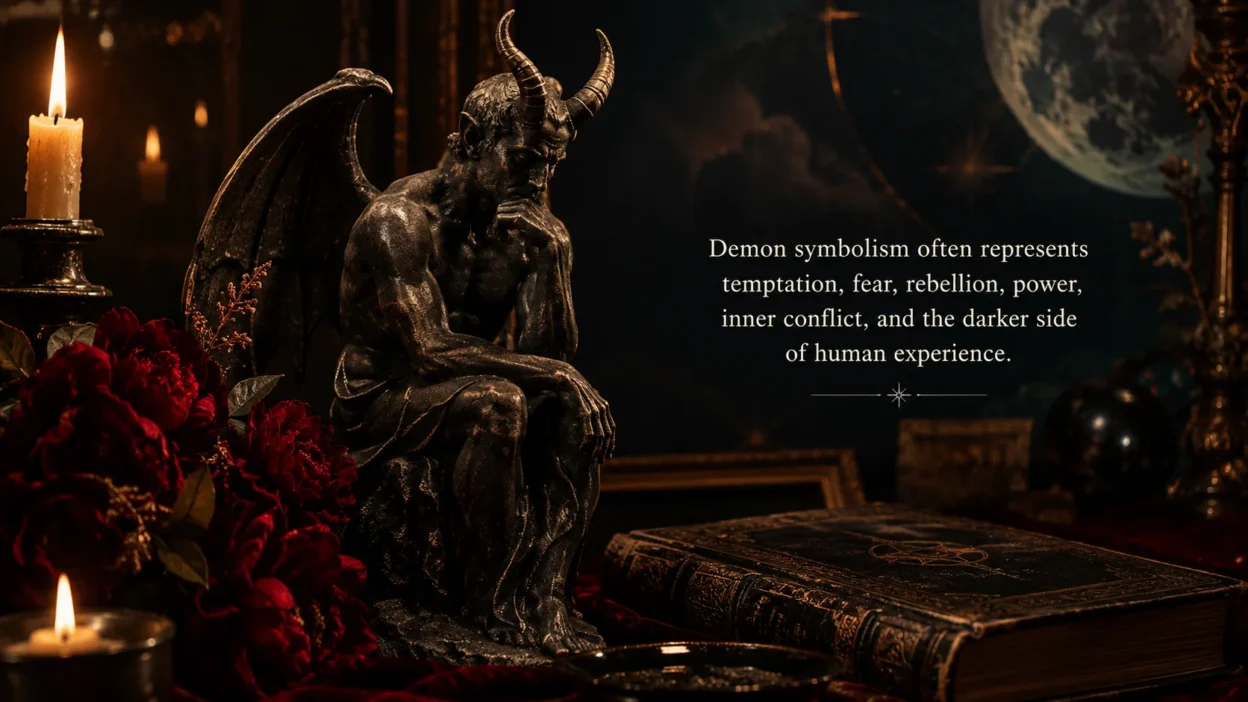
Demon Symbolism explores how people use demonic figures to represent fear, temptation, rebellion, power, danger, and hidden parts of human nature. These figures can appear with horns, wings, claws, tails, dark colors, or supernatural settings.
In the21st century, demons are strongly connected with religious stories, Halloween, horror movies, fantasy, tattoos, heavy metal, and internet culture. However, their meaning isn’t always simply “evil.” Context can turn the same image into a warning, a character, a joke, or a symbol of personal rebellion.
Across history, ideas about demons have changed greatly. Ancient spirits, medieval religious imagery, modern psychology, and popular entertainment have all shaped the meanings people recognize today.
Quick Answer
Demon Symbolism in the USA commonly represents temptation, fear, rebellion, danger, power, and inner conflict. In broader traditions, demons may also represent spiritual challenges, destructive forces, supernatural beings, or parts of human experience that people struggle to understand.
TL;DR
- Demons often symbolize temptation, fear, danger, and rebellion.
- Ancient cultures had many kinds of spirits and supernatural beings.
- Medieval art strongly shaped the modern Western demon image.
- American media expanded demons into horror and fantasy characters.
- Tattoos can use demons to express strength, independence, or personal struggle.
- Modern meanings depend heavily on context and personal interpretation.
What Does Demon Symbolism Mean?
Demon imagery is one of the most recognizable forms of supernatural symbolism in Western culture. However, its meaning depends on the figure, setting, story, and person using it.
For American readers, the image often carries several ideas at once. A horned figure can suggest danger, while a rebellious character can suggest independence.
Common Meanings
Demonic imagery can represent:
• Temptation and the struggle between desire and restraint
• Fear of the unknown, dangerous, or uncontrollable
• Rebellion against rules, authority, or social expectations
• Inner conflict involving guilt, anger, fear, or desire
• Power that feels dangerous, mysterious, or difficult to control
The symbol can therefore work as both a warning and a statement of identity.
How Did Demon Symbolism Begin?
The history of demons is much older than modern horror movies. Ancient societies described many supernatural beings, although they didn’t always classify them as purely evil.
This distinction matters because the modern Western idea of a demon developed gradually. Different cultures gave supernatural beings different roles, personalities, and moral qualities.
Ancient Roots
In ancient Mesopotamia, supernatural beings could be associated with illness, protection, misfortune, storms, or other forces. Some were feared, while others could serve protective roles.
Ancient Greek and Roman traditions also included spirits and supernatural beings with complicated characteristics. The word “demon” eventually developed from Greek daimōn, which originally referred more broadly to a supernatural or divine power.
Religious Transformation
Later Jewish and Christian traditions developed more specific ideas about evil spirits and spiritual opposition. Over centuries, religious teaching and artistic traditions increasingly connected demonic figures with temptation and wrongdoing.
However, the modern horned demon wasn’t created from one ancient source. Instead, artists combined features from different myths, religious images, animals, and medieval imagination.
Why Do Demons Have Horns, Wings, and Tails?
The familiar demon often looks like a mixture of human and animal features. These details make an invisible supernatural idea easier to recognize visually.
For American audiences, these features now function almost like visual shorthand. A horned creature immediately signals something supernatural, dangerous, rebellious, or frightening.
Horns and Animal Features
Horns can suggest wildness, strength, aggression, or a connection with animals. Their association with demons was also influenced by historical artistic traditions and the reuse of older imagery.
Tails, claws, sharp teeth, and unusual skin colors add another layer. They make the figure appear less human and therefore more threatening.
Wings and Fire
Wings can suggest supernatural power or movement between different realms. Fire can symbolize punishment, destruction, passion, or dangerous energy.
Because of horror and fantasy media, these features now work independently of their original religious contexts.
Demon Symbolism in the United States
In the USA, demon imagery exists across religion, entertainment, art, fashion, holidays, and personal identity. The meaning can change dramatically depending on where you encounter it.
For example, a demon on a Halloween decoration usually carries a playful horror meaning. A demon tattoo may instead represent personal strength or overcoming hardship.
American Cultural Associations
| Context | Meaning in the USA | Common Associations | Notes |
| Halloween | Fear and playful darkness | Costumes, decorations, haunted houses | Often intentionally theatrical |
| Horror | Threat and supernatural danger | Movies, games, novels | Usually emphasizes fear |
| Tattoos | Rebellion or personal struggle | Strength, identity, transformation | Highly individual |
| Fantasy | Character and supernatural power | Games, comics, fiction | Not always connected with evil |
| Religious imagery | Spiritual temptation or opposition | Faith, morality, warning | Meaning depends on tradition |
American culture has therefore broadened the symbol beyond strictly religious interpretation.
Demons in Popular Entertainment
Movies, television, comics, games, and novels have made demons familiar characters. Some are villains, while others become antiheroes, companions, tragic figures, or humorous personalities.
This shift is important because many Americans now encounter demon imagery primarily through entertainment rather than religious education.
What Is the Spiritual Meaning of Demons?
Spiritual interpretations vary widely, so there isn’t one universal meaning. Some traditions view demons as harmful supernatural beings, while other systems use different categories for spirits that don’t fit a simple good-versus-evil model.
For many religious readers, demonic imagery represents spiritual danger, temptation, disorder, or opposition to sacred values.
Religious Interpretations
In Christian contexts, demons are commonly associated with evil, temptation, spiritual conflict, and separation from God. Jewish and Islamic traditions also contain discussions of supernatural beings and spiritual dangers, although their concepts and terminology differ.
It’s important not to treat these traditions as identical. Their teachings developed in different historical and cultural settings.
Broader Spiritual Interpretations
Outside formal religious traditions, people may use demons symbolically rather than literally. A “personal demon,” for example, can describe guilt, addiction, trauma, fear, anger, or another difficult part of life.
Here, the demon becomes a metaphor for something a person is trying to understand or overcome.
What Do Demons Represent Psychologically?
Psychologically, demon imagery can provide a powerful way to represent difficult emotions. Instead of showing fear or anger directly, people can give those feelings a recognizable form.
This doesn’t mean every person who uses demon imagery has the same psychological experience. Personal history and cultural background matter greatly.
The Shadow Side
People sometimes use a demon as a symbol for their “dark side.” This can refer to emotions or qualities they usually hide from others.
For example, an artist might draw a demon to represent anger. Someone else might use the same figure to represent resilience after surviving a difficult period.
Fear and Control
Demons can also represent fears that seem larger than the individual. Giving that fear a visible shape can make the idea easier to discuss.
However, symbolic expression doesn’t automatically reveal someone’s beliefs or personality. Context remains essential.
What Does a Demon Tattoo Symbolize?
Demon tattoos can have very different meanings. Some people choose them for their dramatic appearance, while others connect them with personal experiences or ideas about strength.
The meaning can also depend on the demon’s expression, posture, colors, and surrounding symbols.
Common Tattoo Meanings
• Rebellion against expectations or authority
• Strength gained through difficult experiences
• Acceptance of complicated parts of identity
• Protection through a fierce symbolic character
• Personal transformation after hardship
• Interest in horror, fantasy, or gothic art
Some people deliberately choose frightening imagery because it communicates confidence rather than fear.
Demons in Fashion, Art, and Social Media
Modern demon imagery appears frequently in gothic fashion, graphic art, album artwork, gaming communities, tattoos, and social media aesthetics. In these settings, the figure may function primarily as a visual style.
Dark red, black, gray, and metallic tones are especially common. Sharp shapes, horns, flames, wings, and exaggerated facial expressions can create a dramatic appearance.
Digital Culture
Online, demon emojis, illustrations, memes, avatars, and fantasy characters can have playful meanings. A demonic face might communicate mischief rather than serious religious belief.
Likewise, creators sometimes use demonic imagery to challenge traditional ideas about beauty, innocence, or acceptable self-expression.
Why Are Demons Connected With Rebellion?
Demons have become symbols of rebellion partly because they represent opposition to established moral or social boundaries. Modern entertainment has strengthened this interpretation.
However, rebellion doesn’t always mean hostility toward religion. Someone may use a demon image simply to express independence, nonconformity, or a preference for unconventional art.
From Villain to Antihero
Modern fiction often gives supernatural villains more complex personalities. A demon may have loyalty, humor, compassion, or a personal code.
This storytelling trend makes demonic characters less predictable. As a result, the image can symbolize complexity rather than simple wickedness.
Demon Symbolism and Halloween
Halloween is one of the clearest American examples of demon imagery becoming part of popular culture. Demons appear in costumes, decorations, haunted attractions, movies, and seasonal artwork.
However, Halloween demon imagery is usually theatrical. People often use it to create suspense, humor, surprise, or a spooky atmosphere.
A Seasonal Symbol
During October, demon figures can appear alongside:
• Pumpkins and jack-o’-lanterns
• Skeletons and ghosts
• Witches and supernatural creatures
• Haunted houses and horror decorations
• Black cats, bats, and dark forests
These combinations create a shared visual language of mystery and fear.
What Are Common Misunderstandings About Demon Symbolism?
Demon imagery can be misunderstood when people assume every use has the same meaning. A religious symbol, fictional character, Halloween decoration, and tattoo can communicate very different ideas.
The safest approach is to examine the context before interpreting the image.
Symbol Versus Belief
Using a demon in artwork doesn’t necessarily mean the creator believes in demons. Similarly, wearing a demon-themed shirt doesn’t automatically indicate a person’s religious views.
Popular culture frequently separates supernatural imagery from literal belief.
Negative Appropriations
Demonic imagery can also be used provocatively or abusively. In some settings, people intentionally use it to mock religious beliefs or shock an audience.
That use exists, but it shouldn’t automatically be assigned to every demonic symbol. Historical context, stated intent, and surrounding imagery all matter.
How Has Demon Symbolism Changed Over Time?
Demon symbolism has moved through several major stages. Ancient supernatural beings were often more varied than the modern idea of a single evil creature.
Later religious traditions gave demonic imagery stronger moral meanings. Medieval and Renaissance art then helped establish visual features that remain familiar today.
From Spirit to Symbol
In modern America, the demon has increasingly become a flexible cultural symbol. It can represent evil in one story and personal freedom in another.
Today, demons can appear in religious discussions, horror, fantasy, comedy, fashion, tattoos, and psychological metaphors. Their meaning has become more dependent on context than ever.
What Does a Demon Mean in Dreams and Personal Symbolism?
People sometimes interpret demons in dreams as symbols of fear, conflict, guilt, temptation, or something they feel unable to control. However, dream symbolism isn’t universal or scientifically fixed.
Personal experiences usually matter more than a single dictionary-style meaning.
Read More: Devil Symbolism: Meaning, History, and Modern Uses
Personal Associations
For one person, a demon might represent fear. For another, it might represent survival or strength.
Instead of asking only, “What does a demon mean?” it can help to ask what the figure means within the person’s own story.
FAQs
Is Demon Symbolism Always Negative?
No. Demons have strong negative associations in many religious and horror contexts, but modern art often uses them differently. They can symbolize rebellion, strength, complexity, humor, or personal struggle.
What Does a Demon Symbolize in America?
In the USA, demons commonly symbolize fear, temptation, danger, rebellion, and supernatural power. Popular culture has also made them common fantasy and entertainment characters.
Why Are Demons Shown With Horns?
Horns became associated with demonic imagery through a long history of religious art, mythology, animal symbolism, and artistic development. The modern horned demon is therefore the result of many influences rather than one original design.
What Does a Demon Tattoo Mean?
A demon tattoo can symbolize rebellion, strength, personal struggle, transformation, or an interest in dark fantasy. Its specific meaning depends on the person’s design and personal story.
Are Demons the Same in Every Religion?
No. Different religious traditions describe supernatural beings in different ways. Their roles, names, moral qualities, and meanings should be understood within their individual traditions.
What Does a Demon Represent Psychologically?
A demon can represent difficult emotions, fears, temptation, anger, or a hidden part of identity. However, symbolic interpretations are personal and shouldn’t be treated as universal psychological facts.
Conclusion
Demon Symbolism has developed from ancient ideas about supernatural beings into a flexible modern symbol. Today, it can represent temptation, fear, danger, rebellion, power, inner conflict, or transformation. Understanding the symbol means looking beyond the horns and dark colors. Sometimes the demon represents fear itself, while at other times it becomes a way to explore the complicated parts of being human.