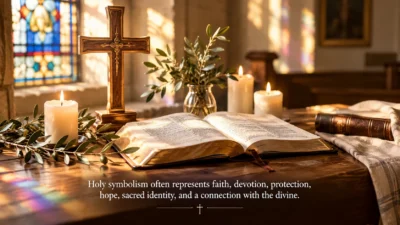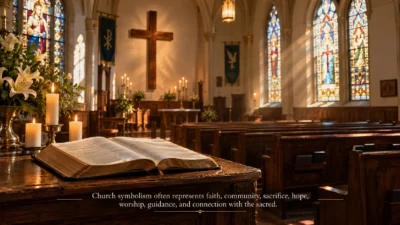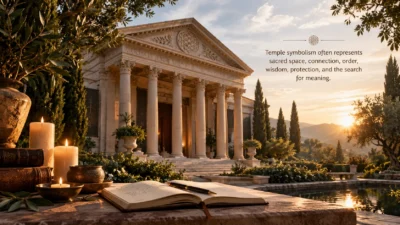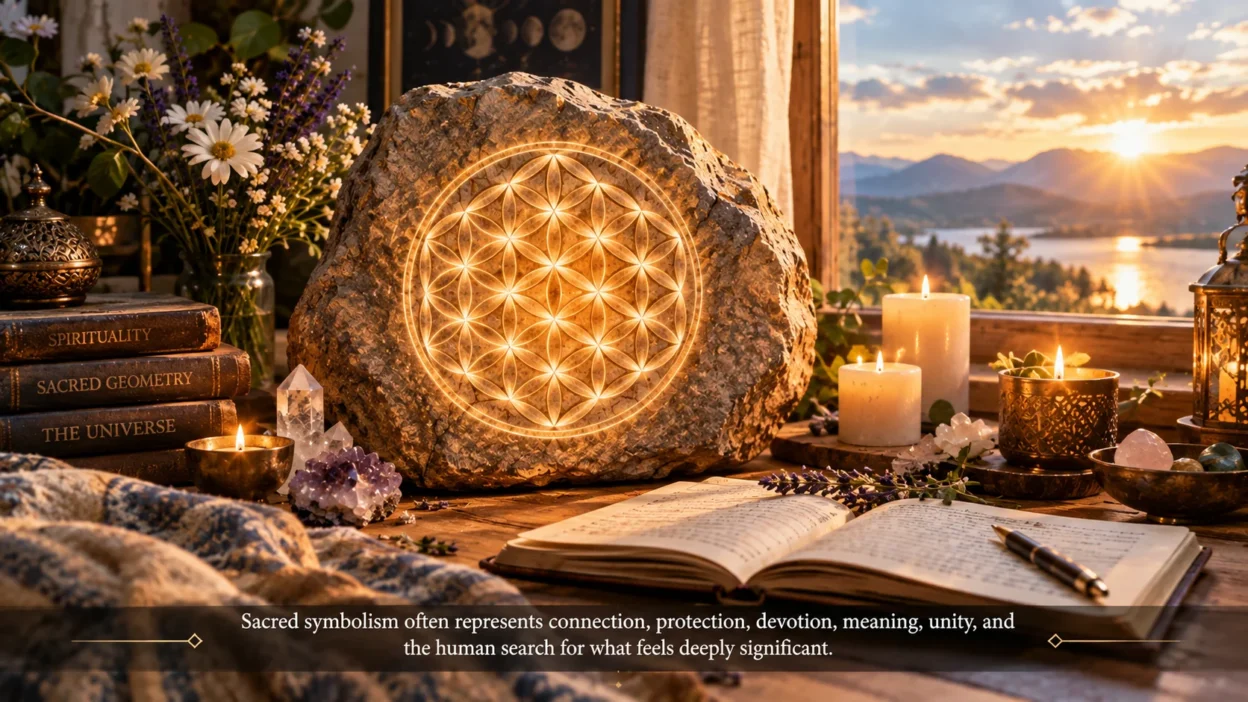
Sacred symbolism refers to images, objects, shapes, colors, gestures, and places that carry a special spiritual or religious meaning. Sacred symbolism can appear in temples, churches, homes, jewelry, artwork, clothing, memorials, and personal rituals.
In 21st century, sacred symbols are part of both religious life and everyday culture. People may wear a cross, display a meaningful pendant, keep prayer objects at home, or use geometric designs to express spirituality.
However, sacred symbols aren’t limited to formal religion. They can also represent love, protection, identity, hope, mystery, or a connection to something greater. Their meanings often change with context, history, and personal experience.
Quick Answer
Sacred symbolism in the USA commonly represents faith, protection, connection, devotion, and spiritual meaning. More broadly, sacred symbols help people express ideas about the divine, life, death, nature, morality, and belonging.
TL;DR
- Sacred symbols give spiritual or deeply meaningful ideas a visible form.
- Common examples include crosses, circles, stars, trees, light, and sacred geometry.
- Ancient cultures used symbols to express cosmic order and spiritual beliefs.
- American culture blends religious traditions with personal and artistic symbolism.
- Modern uses include jewelry, tattoos, home decor, memorials, and digital art.
What Is Sacred Symbolism?
Sacred symbolism turns an invisible idea into something people can see, touch, or recognize. A symbol may represent God, the soul, protection, creation, death, renewal, or a spiritual relationship.
The same image can also have different meanings in different settings. For example, a circle may suggest eternity in one context and unity or wholeness in another.
Sacred Symbols and Meaning
A sacred symbol usually gains meaning from tradition, community, ritual, or personal belief.
Some symbols are strongly connected to particular religions. Others are older or broader and appear across several cultures.
Common Forms of Sacred Symbols
Sacred symbolism can appear through many visual elements:
• Crosses can represent Christian faith, sacrifice, and salvation.
• Circles often suggest unity, eternity, wholeness, or cycles.
• Light commonly represents hope, truth, purity, or divine presence.
• Trees can symbolize life, growth, connection, and renewal.
• Stars may represent guidance, heaven, creation, or spiritual direction.
History of Sacred Symbols
Sacred symbols are much older than modern religious institutions. Early human communities used images, objects, animals, natural forces, and patterns to express ideas that were difficult to explain through ordinary language.
Ancient people often connected the heavens, seasons, animals, rivers, mountains, and trees with forces beyond everyday human life.
Ancient Roots
Archaeological evidence shows that prehistoric communities used repeated shapes, markings, burial objects, and artistic images with possible symbolic purposes. However, researchers can’t always determine exactly what these ancient signs meant.
Later civilizations developed more recognizable religious iconography. Ancient Egypt, Mesopotamia, Greece, Rome, India, China, and many other societies used symbols within rituals and sacred art.
From Ancient Worlds to Organized Religion
As religious traditions developed, symbols became more structured. Certain images became connected with specific stories, deities, teachings, or rituals.
Christianity, Judaism, Islam, Hindu traditions, Buddhism, and other religions developed distinctive visual languages. At the same time, some older symbols continued to appear in new forms.
Symbols Keep Changing
A symbol’s meaning isn’t permanently fixed. Political events, religious movements, migration, art, literature, and popular culture can all influence interpretation.
For American readers, this history explains why a familiar symbol can carry several layers of meaning at once.
Sacred Symbolism in the United States
American culture contains many religious and spiritual traditions. As a result, sacred symbolism appears in public spaces, private homes, celebrations, art, clothing, and personal objects.
The United States also has a long history of religious diversity. Immigration brought symbols and traditions from many parts of the world.
Religious Life
Churches, synagogues, mosques, temples, and other religious communities use visual symbols to create a sense of identity and belonging.
Common American examples include:
• Crosses displayed in churches, homes, jewelry, and memorials.
• Stars associated with Jewish identity and religious tradition.
• Prayer beads used within several religious and spiritual traditions.
• Sacred architecture using light, geometry, art, and repeated patterns.
• Religious clothing and objects expressing devotion or community membership.
Everyday American Culture
Sacred symbols also appear outside formal worship. A person may wear a religious pendant because it reminds them of family, childhood, or personal values.
Similarly, a symbol can become part of an American holiday tradition. Christmas crosses, nativity scenes, candles, Easter imagery, and other objects may carry both religious and cultural meanings.
Spiritual Meaning of Sacred Symbols
Sacred symbols often help people express ideas about realities they consider larger than ordinary life. These ideas may involve God, the universe, nature, the soul, ancestors, or spiritual transformation.
However, spirituality doesn’t always follow one organized religion. Some Americans use sacred-looking symbols as personal reminders of peace, mindfulness, gratitude, or inner growth.
Connection and Transcendence
A sacred symbol can create a bridge between everyday experience and a deeper idea.
For example, light can suggest spiritual awareness. A mountain can represent closeness to heaven, endurance, or a journey toward wisdom.
Nature as Sacred Symbolism
Nature has inspired sacred imagery across many traditions.
Trees, rivers, mountains, fire, stars, the sun, and the moon have all been used to represent ideas about life and existence. Their meanings vary greatly by culture and religion.
Sacred Symbols Across Cultures
Sacred symbolism isn’t limited to one civilization or belief system. Similar visual ideas can appear in different places, although their meanings aren’t necessarily identical.
For example, circles appear in many traditions because their shape naturally suggests continuity and completeness.
Shared Symbolic Ideas
Some broad themes frequently appear across cultures:
| Symbolic Form | Meaning in the USA | Common Associations | Important Context |
| Circle | Unity and eternity | Wholeness, cycles | Meanings vary by tradition |
| Light | Hope and spiritual guidance | Truth, purity, renewal | Common in religious ceremonies |
| Tree | Life and connection | Growth, family, nature | Appears in many traditions |
| Water | Renewal and transformation | Cleansing, life, movement | Often connected with ritual |
| Mountain | Spiritual journey | Strength, elevation, mystery | Meaning depends on tradition |
These similarities don’t mean that every culture shares the same beliefs. Instead, they show how humans often use familiar parts of nature to communicate abstract ideas.
Respecting Cultural Context
A symbol should be understood within its own tradition whenever possible. Removing an image from its original setting can simplify or distort its meaning.
This matters especially when sacred designs become fashion trends or decorative patterns.
Emotional Meaning of Sacred Symbols
Sacred symbols can create strong emotional responses because people often connect them with important experiences. A symbol may remind someone of family, prayer, childhood, loss, hope, or personal transformation.
The emotional response also depends on the individual. Two people can see the same symbol and experience completely different feelings.
Common Emotional Associations
Sacred imagery may suggest:
• Comfort during difficult periods.
• Hope during uncertainty or change.
• Protection during moments of fear.
• Belonging within a religious or cultural community.
• Peace during reflection or meditation.
• Memory after the loss of someone important.
Why Symbols Feel Powerful
Symbols compress complicated ideas into simple visual forms. A small pendant can carry years of family history, while a single image can recall an entire belief system.
Because of this, sacred symbolism often works through memory as much as through visual appearance.
Sacred Symbolism and Identity
People frequently use symbols to communicate something important about themselves. Jewelry, clothing, artwork, tattoos, and personal objects can all become symbolic statements.
In America, this can involve religious identity, family heritage, personal spirituality, or a meaningful life experience.
Jewelry and Personal Objects
A cross necklace, religious medal, meaningful ring, prayer beads, or symbolic bracelet can become a private reminder.
The object doesn’t have to be publicly explained. Its importance may exist mainly between the person and their own memories or beliefs.
Tattoos and Body Art
Sacred imagery is also common in American tattoo culture. People may choose symbols connected with faith, protection, family, remembrance, or personal transformation.
However, sacred tattoos can carry cultural responsibilities. Understanding the original meaning of an unfamiliar symbol can help prevent accidental misuse.
Sacred Symbols in Art and Home Decor
Sacred imagery has influenced painting, sculpture, architecture, photography, and interior design for centuries. Today, similar ideas appear in American homes through artwork, candles, wall decorations, statues, and geometric designs.
Modern decor sometimes removes a symbol from its original religious setting. That can create a purely aesthetic meaning.
Traditional and Modern Decor
A religious image in a home may represent active faith. Meanwhile, a geometric design inspired by spiritual traditions may simply create a feeling of calm or balance.
Context matters.
Sacred Geometry
Sacred geometry refers to the use of geometric forms in spiritual, philosophical, and religious contexts. Circles, symmetrical patterns, repeated shapes, and complex designs can suggest order and harmony.
Modern wellness culture has helped make these patterns popular in artwork, clothing, meditation spaces, and tattoos.
Sacred Symbols in Holidays and Celebrations
American holidays provide many examples of sacred imagery moving between religious and cultural settings.
Christmas, Easter, Hanukkah, Ramadan, Diwali, and other observances involve symbols, colors, objects, foods, clothing, or rituals that communicate important ideas.
Religious and Cultural Layers
A holiday symbol can have both sacred and cultural meanings. For some people, a Christmas cross or nativity scene is deeply religious. For others, holiday imagery may primarily represent family tradition.
The same pattern can occur with candles, stars, flowers, seasonal foods, and decorative colors.
Family Traditions
Families often create their own symbolic traditions. An ornament, heirloom, photograph, candle, or piece of jewelry may become sacred in a personal sense because of the memories attached to it.
Sacred Symbolism in Social Media and Popular Culture
Sacred imagery is increasingly visible online. People use religious symbols, celestial designs, spiritual quotes, geometric patterns, and symbolic photography in profiles and posts.
However, digital use can change how symbols are understood.
Digital Expression
Online, a sacred symbol may communicate identity quickly. A small icon can signal faith, spirituality, remembrance, or personal values without requiring a long explanation.
Popular Culture
Movies, music, fashion, games, and television also use sacred imagery. Creators may use halos, wings, crosses, temples, candles, angels, demons, or celestial designs to create specific moods.
These uses don’t always reflect the original religious meaning. Sometimes they are artistic devices.
Misuse and Controversies Around Sacred Symbols
Sacred symbols can become controversial when people use them outside their traditional context. The issue isn’t always the symbol itself. Context, intent, history, and audience can change how an image is understood.
Some symbols have also been adopted by groups or movements whose later use differs sharply from their older religious or cultural meanings.
Context Changes Meaning
A symbol traditionally associated with peace or spirituality may acquire a different meaning through political or extremist use.
That doesn’t automatically erase its earlier history. Instead, it creates multiple layers of meaning that readers need to distinguish.
Cultural Appropriation
Using sacred imagery as decoration can sometimes raise concerns about cultural appropriation. This usually involves questions about whether an important cultural or religious symbol has been removed from its context or treated as a costume.
Respectful use begins with learning where a symbol comes from and what it means to the people who traditionally use it.
How Sacred Symbolism Has Changed Over Time
Sacred symbols rarely remain completely unchanged. Their meanings can expand, narrow, disappear, or return in new forms.
A symbol once understood mainly through religion may later become part of art or popular culture. Another symbol may experience renewed interest as people explore ancestry, spirituality, or traditional practices.
From Community to Individual Meaning
Historically, communities often shared established interpretations of sacred imagery. Today, individuals may combine traditional meanings with personal experiences.
For example, someone might use a traditional symbol because it represents both family heritage and personal resilience.
Revival and Reinvention
Modern interest in meditation, spirituality, ancient history, and traditional crafts has revived many symbolic designs.
However, modern interpretations aren’t always identical to historical ones. Separating documented tradition from newer interpretations helps keep the symbolism clear.
Why Sacred Symbols Still Matter
Sacred symbols remain powerful because humans naturally use images to communicate ideas that words sometimes struggle to capture.
A symbol can represent love, death, hope, protection, identity, or mystery within a single visual form.
Read More: Demon Symbolism: Meaning, History, and Modern Uses
Meaning Depends on Context
The most useful question isn’t always, “What does this symbol mean?”
Instead, ask:
• Who uses the symbol?
• Where does the symbol appear?
• What tradition does it come from?
• What does it mean to the individual using it?
• Has its meaning changed in modern culture?
This approach helps avoid treating sacred symbolism as a universal dictionary.
FAQs
What does sacred symbolism mean?
Sacred symbolism refers to images, objects, shapes, colors, or actions carrying spiritual or deeply meaningful associations. The meaning usually comes from religious tradition, cultural history, personal belief, or a combination of these.
What are common examples of sacred symbols?
Common examples include crosses, circles, stars, trees, light, water, candles, religious objects, and sacred geometric patterns. Their specific meanings depend on the tradition and context.
Why are sacred symbols important?
Sacred symbols make complex ideas easier to recognize and remember. They can also create feelings of belonging, comfort, devotion, identity, or connection.
Can a symbol have both sacred and secular meanings?
Yes. A symbol can begin in a religious setting and later become common in art, fashion, architecture, or popular culture. Its meaning can change depending on how and where it’s used.
Is sacred symbolism the same across all religions?
No. Some broad themes appear across cultures, but individual symbols have distinct histories and meanings. Similar shapes don’t necessarily represent identical beliefs.
Why do people use sacred symbols in tattoos?
People may choose sacred tattoos to express faith, family heritage, protection, remembrance, or personal transformation. However, it’s useful to understand a symbol’s original cultural or religious context before adopting it.
Conclusion
Sacred symbolism gives visible form to ideas about faith, connection, protection, identity, hope, and the unknown. Across American culture, these symbols can appear in religious spaces, family traditions, artwork, jewelry, tattoos, holidays, and personal rituals. Their meanings aren’t frozen in history. They continue to change as people reinterpret old traditions through modern American life and personal experience. When you encounter a sacred symbol, consider its history, context, and the person using it. That simple approach can reveal how one image can carry generations of meaning while still becoming something deeply personal.