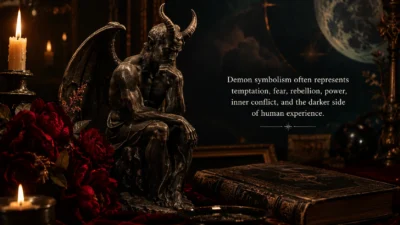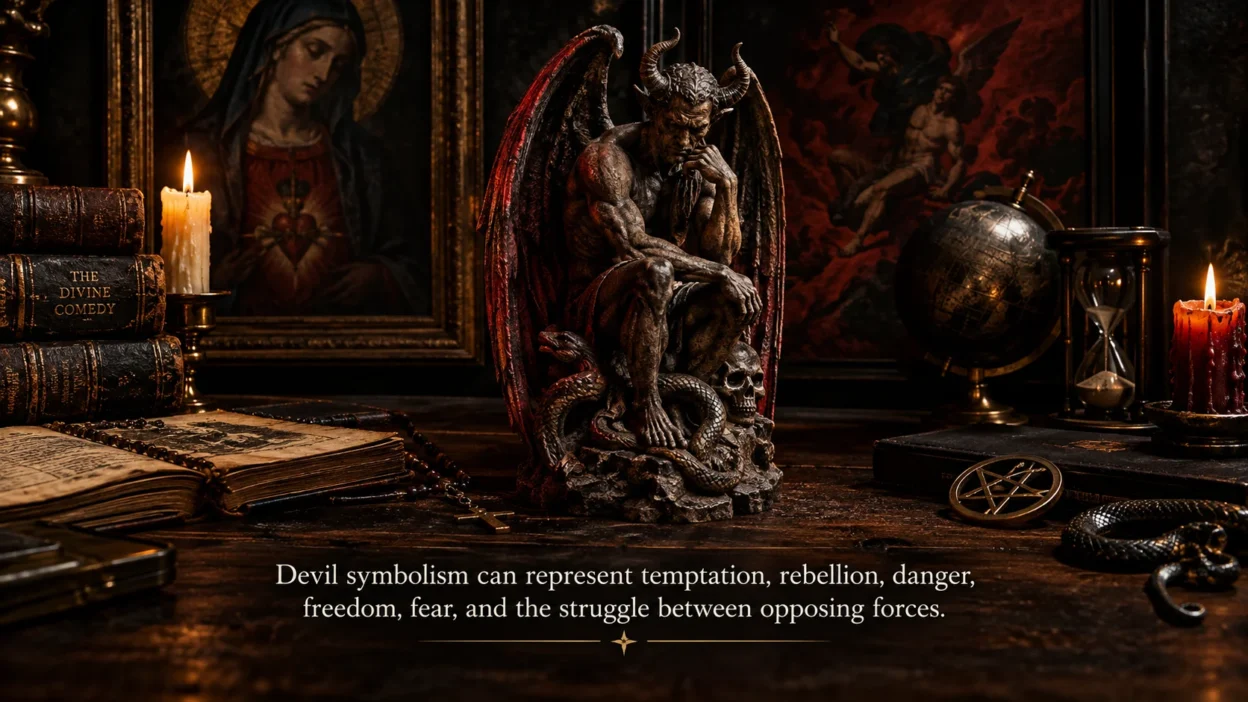
Devil symbolism has a long and complicated history. In the United States, the devil often appears as a figure of temptation, rebellion, danger, or forbidden freedom. However, the meaning can change greatly depending on the setting.
The familiar image of a devil with horns, a pointed tail, red skin, and a pitchfork developed over centuries. It combines religious ideas, folklore, medieval art, older mythic images, and later popular culture.
Today, people may use devil imagery in tattoos, Halloween decorations, music, fashion, memes, and entertainment. For some, it represents evil or spiritual danger. For others, it suggests independence, humor, confidence, or resistance to authority.
Quick Answer
Devil symbolism in the USA commonly represents temptation, rebellion, danger, and moral conflict. More broadly, the devil can symbolize evil, forbidden desire, fear, personal freedom, or the struggle between opposing forces.
TL;DR
- The devil often symbolizes temptation, danger, rebellion, and moral conflict.
- Horns, red coloring, tails, and pitchforks became familiar visual features over time.
- American culture uses devil imagery in religion, Halloween, music, art, and entertainment.
- Some modern uses are playful, rebellious, or humorous rather than religious.
- Different cultures have distinct ideas that shouldn’t be treated as identical.
- Devil imagery can carry very different meanings depending on context.
What Does the Devil Symbolize?
The devil is one of the most recognizable symbolic figures in Western culture. Its appearance often signals something dangerous, forbidden, rebellious, or morally challenging.
However, the symbol doesn’t always mean literal evil. Context matters because the same image can represent fear in one setting and playful rebellion in another.
Core Meanings
Common associations include:
- Temptation and forbidden desire
- Evil and moral corruption
- Rebellion against authority
- Danger and destruction
- Freedom from social restrictions
- Inner conflict between opposing choices
The devil therefore works as a powerful symbol of boundaries. It often appears where people are confronting something considered dangerous, forbidden, or socially unacceptable.
What Does the Devil Look Like?
Modern American images of the devil follow a fairly consistent visual pattern. These features developed gradually rather than appearing together from one ancient source.
The most familiar version has red skin, horns, a pointed tail, a pitchfork, and sometimes cloven hooves. Artists and storytellers have repeatedly used these features because they make the figure immediately recognizable.
Common Visual Features
- Red color suggesting fire, danger, anger, or passion
- Horns suggesting wildness, power, or otherness
- A pitchfork associated with punishment and the underworld
- A pointed tail emphasizing an animal-like appearance
- Dark clothing suggesting mystery, danger, or secrecy
- Flames representing destruction, punishment, or intense emotion
These features are cultural shorthand. They don’t necessarily describe how every religious tradition understands the devil.
Ancient Roots of Devil Imagery
The history of devil symbolism reaches further back than the familiar Christian image. Ancient cultures had many different beings associated with disorder, wilderness, death, temptation, or supernatural danger.
However, these figures weren’t simply “the devil” in the modern sense. Their roles were often much more complicated.
Pre-Christian Influences
Ancient Mediterranean art included horned or animal-like divine figures. Pan, for example, was connected with nature, wilderness, music, sexuality, and the countryside.
Later European artists sometimes used animal features when portraying supernatural evil. This helped create visual connections between wilderness, uncontrolled desire, and demonic imagery.
From Many Figures to One Symbol
Over time, different religious and cultural traditions developed their own ideas about evil beings and spiritual opposition. In Christian Europe, several traditions and artistic influences eventually contributed to the familiar Western devil image.
This process was gradual. The modern red, horned devil wasn’t simply copied from one ancient character.
The Devil in Christian Tradition
Christian ideas about the devil strongly influenced American culture because Christianity shaped much of early European-American religious history.
In Christian scripture and later theology, the devil is associated with temptation, opposition to God, deception, and evil. However, interpretations have varied across denominations and historical periods.
Satan and the Devil
The words “Satan” and “devil” are often treated as interchangeable in popular American culture. Their histories, however, are more complicated.
“Satan” comes from a term associated with an adversary or accuser. “Devil” developed through Greek and Latin terms associated with accusation, slander, or false accusation.
Later Christian traditions increasingly connected these concepts into a more unified figure of evil.
Medieval Visual Culture
During medieval Europe, artists used dramatic imagery to communicate religious ideas to audiences who might not read.
Devils were often shown with distorted bodies, animal features, claws, horns, tails, or frightening faces. These images helped make abstract ideas about sin, punishment, and temptation easier to understand.
Devil Symbolism in the United States
In the USA, devil imagery has several overlapping meanings. Religious communities may use it as a symbol of evil, while popular culture frequently uses it in theatrical or humorous ways.
American entertainment has also transformed the figure into a familiar character. Movies, television, comics, music, advertising, sports culture, and Halloween all contribute to this changing image.
American Cultural Associations
For many Americans, the devil may bring to mind:
- Halloween costumes and decorations
- Religious discussions about sin and temptation
- Horror movies and supernatural fiction
- Heavy metal and rock imagery
- Rebellious fashion and youth culture
- Satire, jokes, and exaggerated cartoon characters
The meaning depends heavily on presentation. A frightening religious painting communicates something very different from a smiling cartoon devil.
The Devil as a Rebel
American culture has a strong tradition of individualism. Because of that, devil imagery sometimes becomes connected with refusing rules or challenging authority.
This doesn’t necessarily mean the person using the image supports evil. Instead, the symbol can function as a dramatic way to say, “I don’t follow the expected path.”
Devil Symbolism in Religion and Spirituality
Religious interpretations remain one of the most important sources of devil symbolism. Yet different religions and spiritual traditions don’t all understand the devil in the same way.
A respectful interpretation therefore requires attention to each tradition’s own beliefs rather than treating every supernatural figure as equivalent.
Christian Spiritual Meaning
Within many Christian traditions, the devil represents opposition to God and the temptation to turn away from moral or spiritual principles.
The figure can therefore symbolize:
- Temptation
- Sin
- Deception
- Spiritual opposition
- Pride
- Moral testing
These meanings are primarily religious interpretations rather than universal psychological facts.
Other Traditions
Jewish, Islamic, and other religious traditions have their own concepts of spiritual opposition, temptation, or destructive forces. These concepts have distinct histories and shouldn’t automatically be treated as identical to the Christian devil.
Folklore around the world also contains tricksters, demons, monsters, and dangerous spirits. Some challenge social rules, while others protect boundaries or punish wrongdoing.
What Does the Devil Mean Psychologically?
Psychologically, devil imagery can represent an internal struggle. It often gives a visible shape to desires, fears, impulses, or choices that conflict with personal values.
This doesn’t mean that seeing a devil symbol reveals someone’s personality. Instead, people can use the image to explore difficult ideas in art, storytelling, or personal expression.
The Inner Conflict
The devil can symbolize the part of a story that says, “Take the forbidden option.”
For example, a character may face a choice between responsibility and immediate pleasure. A devil figure can make that conflict instantly understandable.
Emotional Associations
Depending on context, the image may evoke:
- Fear
- Curiosity
- Excitement
- Rebellion
- Shame
- Humor
- Confidence
- Fascination with the unknown
Because the symbol carries both fear and attraction, it often creates strong emotional reactions.
Devil Symbolism and Temptation
Temptation is one of the oldest and most recognizable meanings connected with the devil. Stories frequently portray the devil as offering something desirable in exchange for a serious cost.
This pattern appears throughout Western literature and storytelling.
The Temptation Pattern
A typical symbolic story includes:
- A person wants something strongly.
- A forbidden opportunity appears.
- A choice must be made.
- The reward carries a hidden cost.
- The character faces the consequences.
The devil therefore represents more than evil itself. It can symbolize the difficult moment when desire challenges values.
“Deal With the Devil”
The phrase “deal with the devil” became a powerful storytelling idea. It describes exchanging something valuable for an immediate reward.
In modern American speech, the phrase can be used metaphorically without any religious meaning. Someone might describe a risky compromise as making a “deal with the devil.”
Devil Symbolism and Rebellion
The devil has also become a symbol of rebellion. This interpretation became especially visible in modern Western popular culture.
Rather than representing literal supernatural evil, the image can communicate resistance to authority, tradition, or social expectations.
Why the Image Feels Rebellious
The devil breaks rules by definition in many traditional stories. As a result, using devil imagery can suggest independence or defiance.
This symbolism appears particularly often in music, fashion, tattoos, and youth-oriented visual culture.
However, rebellion and evil aren’t automatically the same thing. A person can use devil imagery simply because they enjoy its dramatic visual style.
Devil Symbolism in Tattoos and Fashion
Devil imagery is common in American tattoo culture. The design may feature a traditional red devil, horns, flames, a devil’s face, or a more abstract interpretation.
The personal meaning varies widely.
Common Tattoo Meanings
- Rebellion against expectations
- Personal independence
- Surviving difficult experiences
- Humor and playful mischief
- Attraction to dark aesthetics
- A reminder of temptation or personal struggle
Some people choose the symbol because of its cultural history. Others simply like its bold visual qualities.
Fashion and Personal Style
Devil imagery can also appear on shirts, jewelry, album artwork, accessories, and alternative fashion.
In these settings, it may communicate confidence, edginess, humor, or a deliberately provocative style.
Devil Symbolism in Halloween and Popular Culture
Halloween has helped turn the devil into a familiar American cultural character. During October, devil costumes and decorations can appear alongside ghosts, witches, skeletons, and monsters.
The tone is often playful rather than theological.
From Fear to Entertainment
Popular culture frequently softens the devil into a cartoon character. A smiling red figure with tiny horns may represent mischief rather than serious religious evil.
Movies and television take the opposite approach. They may portray the devil as frightening, intelligent, mysterious, seductive, or supernatural.
The result is a wide symbolic range.
| Context | Meaning in the USA | Common Associations | Notes |
| Religion | Spiritual evil or temptation | Sin, deception, moral testing | Meaning depends on tradition |
| Halloween | Mischief and spooky fun | Costumes, decorations, parties | Often playful |
| Tattoos | Rebellion or personal struggle | Independence, darkness, identity | Highly personal |
| Music | Defiance or dramatic darkness | Rock, metal, alternative culture | Often symbolic rather than literal |
| Literature | Temptation and moral conflict | Choices, desire, consequences | Frequently metaphorical |
Devil Symbolism in Art, Music, and Media
Artists have long used the devil because the figure creates instant tension. A devil can represent temptation, fear, corruption, humor, or resistance without requiring a long explanation.
American music and entertainment have expanded these meanings even further.
Music
Devil imagery has appeared in rock, metal, blues, punk, and other musical traditions. Sometimes it emphasizes darkness or rebellion.
At other times, musicians use the image for theatrical effect, cultural commentary, or exaggerated storytelling.
Film and Television
Modern screen portrayals range from terrifying supernatural villains to charming fictional characters.
This shift has made the devil more complex in popular culture. The character may now be presented as a villain, trickster, antihero, metaphor, or source of comedy.
Misunderstandings and Controversies
Devil imagery can be misunderstood because its meaning changes dramatically between contexts.
A religious community may view a devil image as a serious symbol of spiritual danger. A person wearing the same image may see it as a joke, fashion statement, or expression of independence.
Context Matters
The safest way to interpret the symbol is to consider where and how it appears.
A Halloween decoration shouldn’t automatically be treated as a religious statement. Likewise, a religious artwork shouldn’t automatically be reduced to an aesthetic symbol.
Harmful Appropriation
Devil imagery has sometimes been used in hostile or hateful ways against religious communities. In those cases, the meaning comes from the surrounding message and intended target.
It’s important to distinguish ordinary symbolic use from deliberate harassment or abuse.
How Devil Symbolism Has Changed Over Time
The devil has never had only one fixed meaning. Its image has shifted as religion, art, entertainment, and society changed.
In medieval Europe, the figure often emphasized sin and punishment. Later literature explored temptation and moral choice. Modern entertainment added humor, rebellion, sexuality, mystery, and personal identity.
From Religious Figure to Cultural Character
Today, many Americans encounter devil imagery outside religious settings.
A person may see it in a Halloween store, tattoo studio, video game, music album, fashion collection, comic book, or social media post.
That doesn’t erase its religious history. Instead, it shows how symbols can collect new meanings over time.
What Remains Consistent
Despite these changes, several themes remain recognizable:
- Crossing boundaries
- Facing temptation
- Challenging authority
- Confronting fear
- Exploring forbidden ideas
- Struggling between competing choices
Why Devil Symbolism Still Matters Today
The devil remains powerful because it represents conflict. People naturally understand stories about desire, rules, temptation, and consequences.
In American culture, the figure can move between sacred and secular settings with remarkable ease. One image may inspire fear in one context and laughter in another.
A Symbol of Contradiction
The devil can represent both attraction and danger. It can suggest freedom while also warning about consequences.
That contradiction makes the image useful in storytelling and personal expression. It gives people a visual language for complicated emotions.
Modern Identity
For some people, devil imagery communicates an identity built around independence or nonconformity.
For others, it represents an interest in horror, fantasy, history, religious art, or dark aesthetics. The symbol itself doesn’t provide enough information to determine someone’s beliefs.
Read More: Spirit Symbolism: Meaning, History, and Modern Uses
FAQs
Is the devil always a symbol of evil?
No. In many religious contexts, the devil represents evil, temptation, or spiritual opposition. In modern American popular culture, however, the image can also represent rebellion, humor, danger, or dramatic style.
What does a devil tattoo symbolize?
A devil tattoo can symbolize rebellion, independence, temptation, personal struggle, humor, or an interest in dark imagery. Its meaning depends on the person and the design.
Why is the devil associated with red?
Red became strongly connected with devil imagery through Western art and cultural traditions. It can suggest fire, danger, passion, anger, or the underworld.
Why does the devil have horns?
Horns became part of Western devil imagery through centuries of artistic development. Older animal-like and horned figures influenced later European representations of supernatural beings.
What does the devil symbolize in Christianity?
In many Christian traditions, the devil represents opposition to God, temptation, deception, and evil. Specific theological interpretations can differ among Christian communities.
Is devil symbolism always religious?
No. Devil imagery is now common in entertainment, Halloween, fashion, tattoos, music, games, and humor. In these settings, it may have little or no religious intent.
Conclusion
Devil symbolism has developed from ancient images of supernatural danger into one of the most recognizable symbols in Western culture. In the USA, it can represent temptation, evil, rebellion, danger, humor, independence, or moral conflict. Its meaning depends strongly on context. A religious painting, Halloween costume, tattoo, music design, and cartoon devil can all use the same basic image for very different reasons. Understanding Devil Symbolism therefore means looking beyond the horns and red color. The deeper story is about boundaries, choices, desire, fear, and the human fascination with what lies on the other side of the rules.