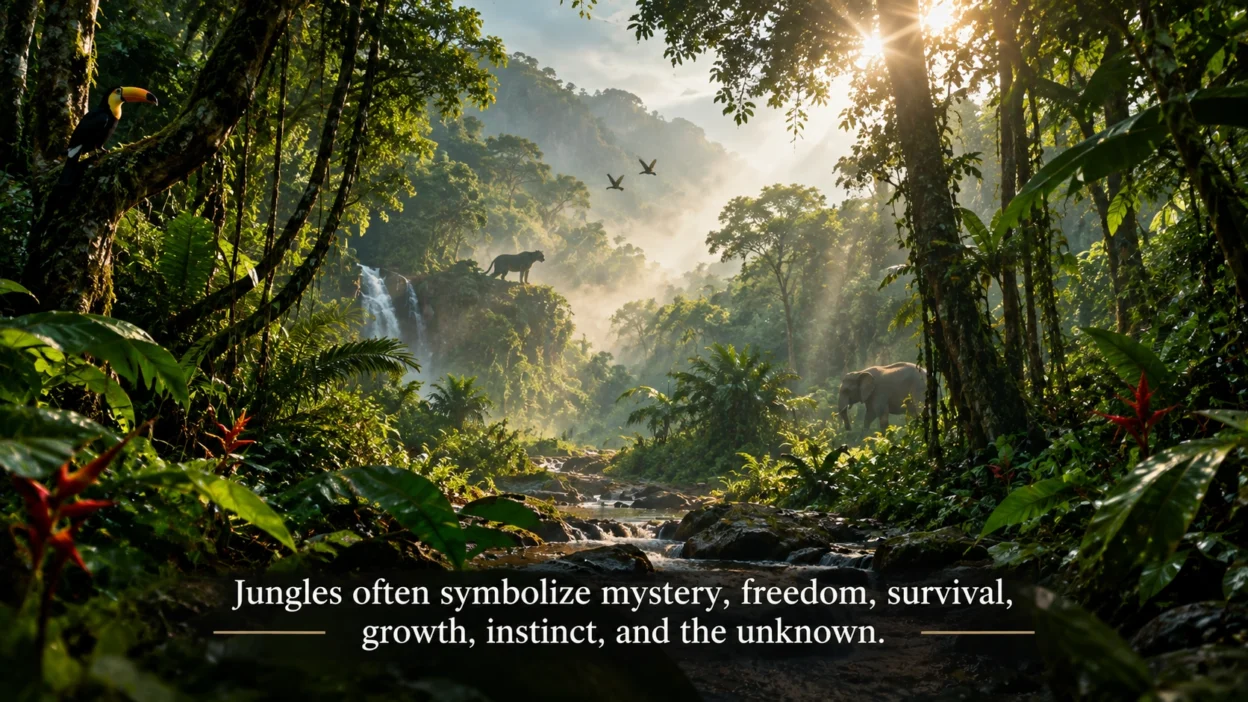
Jungle symbolism connects dense natural landscapes with ideas of mystery, survival, freedom, growth, and the unknown. In the United States, the jungle appears in books, movies, tattoos, artwork, fashion, gardens, and popular culture.
However, a jungle can suggest more than wild nature. Its thick plants, hidden paths, powerful animals, and changing light create a feeling of discovery. For many people, it represents a place where life grows freely beyond ordinary human control.
Today, Americans may use jungle imagery to express adventure, independence, transformation, or a connection with nature. Its meaning can change greatly depending on whether the jungle appears as a peaceful landscape, a dangerous wilderness, or a fantasy setting.
Quick Answer
Jungle symbolism in the USA commonly represents mystery, survival, freedom, exploration, growth, and the untamed side of nature. More broadly, jungles can symbolize transformation, hidden knowledge, instinct, and the journey into the unknown.
TL;DR
- Jungles commonly symbolize mystery, survival, freedom, and natural power.
- Dense vegetation can represent growth, complexity, and hidden possibilities.
- American media often connects jungles with adventure and exploration.
- Spiritual traditions may view wild nature as powerful and transformative.
- Jungle imagery remains popular in tattoos, fashion, decor, and artwork.
What Does the Jungle Symbolize?
Wild Nature and Freedom
A jungle often represents nature without strict human control. Trees, vines, rivers, insects, and animals grow together in complex relationships.
Because of this, jungle imagery can suggest freedom and independence. It may remind people of a world where natural forces follow their own rhythms.
Mystery and Discovery
A jungle can also symbolize something unknown. A narrow path disappearing between trees naturally creates curiosity.
For example, an illustrated jungle may represent a personal journey. The hidden landscape becomes a metaphor for discovering something new about yourself.
Common meanings include:
• Mystery and the unknown
• Freedom from ordinary limits
• Survival through difficult conditions
• Growth and natural abundance
• Adventure and exploration
• Instinct and primal energy
Historical Roots of Jungle Symbolism
Ancient Relationships With Wild Landscapes
The modern word “jungle” has relatively recent linguistic roots, but human symbolism surrounding dense forests is ancient.
Across early societies, forests and wild landscapes often stood outside settled human spaces. They could provide food, medicine, shelter, and materials while also presenting genuine dangers.
As a result, wilderness could inspire both respect and fear. That combination remains central to jungle imagery today.
Myths, Forests, and the Unknown
Ancient myths from different regions frequently placed important events in forests or wild places. These settings could become spaces for testing, transformation, encounters with spirits, or meetings with animals.
However, these traditions were not all describing jungles specifically. It’s more accurate to see them as part of a broader human pattern of giving symbolic meaning to wild landscapes.
From Wilderness to Adventure
Over time, Western literature increasingly treated tropical landscapes as places of exploration. During the 18th and 19th centuries, travel writing, natural history, colonial exploration, and popular adventure stories shaped Western ideas about tropical forests.
These accounts sometimes mixed genuine observations with exaggerated or romanticized portrayals. Modern interpretations therefore need to separate ecological reality from older fictional images.
Jungle Symbolism in America
Adventure and Exploration
In the United States, jungle imagery became strongly connected with adventure. Books, films, television, and games often portray dense tropical landscapes as places filled with hidden dangers and discoveries.
This association helped make the jungle a familiar symbol even for Americans who have never visited one.
A jungle scene can therefore suggest stepping outside familiar surroundings. It often represents a challenge, expedition, or search for something hidden.
Nature and Conservation
American environmental culture has also given wild landscapes another meaning. A jungle can represent biodiversity, ecological complexity, and the importance of protecting natural habitats.
Today, nature photography and environmental education often present tropical forests as valuable ecosystems rather than simply dangerous wilderness.
American Popular Culture
Jungle imagery appears across several forms of American entertainment and design. Adventure stories may emphasize danger, while children’s media often presents jungles as colorful worlds of discovery.
The same visual can therefore carry very different emotional messages. A jungle may feel threatening in one story and joyful in another.
Spiritual Meaning of the Jungle
Nature as a Place of Transformation
Wild landscapes have often been used as settings for spiritual journeys. Entering a forest can represent leaving ordinary life behind and confronting uncertainty.
In this symbolic sense, the jungle becomes a place of inner change. The difficult path can stand for personal growth rather than literal danger.
Indigenous and Local Traditions
Many Indigenous peoples and local communities living in tropical regions have complex relationships with forests. These relationships can include practical knowledge, ancestral traditions, spiritual beliefs, and responsibilities toward the natural world.
However, there is no single “jungle spirituality.” Meanings differ greatly between communities, histories, and belief systems.
A Symbol of Interconnection
The jungle can also represent the idea that life exists through relationships. Plants, animals, fungi, insects, water, soil, and climate all interact.
This makes jungle imagery useful when expressing interconnectedness. It can remind people that individual life exists within a much larger natural system.
Psychological Meaning of Jungle Imagery
The Unknown Mind
Psychologically, a jungle can act as a visual metaphor for complexity. Its hidden paths and dense vegetation resemble experiences that are difficult to understand immediately.
For some people, this makes jungle imagery feel exciting. For others, it can create tension or uncertainty.
Instinct and Inner Strength
Animals moving through dense vegetation can symbolize instinct. The jungle itself may represent the part of life that cannot always be controlled through planning.
However, this doesn’t mean instinct is automatically good or bad. The symbolism depends on the surrounding story and personal interpretation.
Growth Through Difficulty
A jungle can also represent resilience. Plants grow through crowded spaces, changing weather, and competition for light.
This makes the landscape a natural metaphor for overcoming obstacles. A jungle tattoo, for example, might represent someone becoming stronger through complicated experiences.
Jungle Symbolism and Animals
Predators and Power
Large predators can add meanings of strength, courage, independence, and alertness. Their presence often makes jungle imagery feel more dramatic.
However, animals should not automatically be treated as simple symbols. Their meanings vary across cultures and individual stories.
Birds, Insects, and Smaller Creatures
Birds may suggest freedom or perspective, while insects can emphasize persistence and the complexity of ecosystems.
Butterflies and other transforming creatures can introduce ideas of change and renewal. Meanwhile, snakes may represent transformation, danger, healing, or mystery depending on context.
The Jungle as a Living System
The strongest jungle imagery often includes many forms of life together. Instead of focusing on one animal, it shows relationships between species.
This creates a broader symbolism of balance, adaptation, abundance, and interconnected life.
| Context | Meaning in the USA | Common Associations | Notes |
| Dense green forest | Growth and mystery | Nature, discovery | Often used in visual art |
| Jungle animals | Instinct and strength | Courage, freedom | Meaning depends on the animal |
| Hidden jungle path | Exploration | Adventure, uncertainty | Common in storytelling |
| Tropical plants | Abundance and renewal | Life, beauty, growth | Popular in home design |
| Jungle landscape | Escape and freedom | Travel, nature, imagination | Can feel peaceful or dangerous |
Jungle Symbolism in Tattoos
Adventure and Independence
Jungle tattoos often appeal to people who connect with exploration. A dense forest can represent a willingness to enter unfamiliar territory.
Some designs combine jungle leaves with mountains, animals, rivers, or compass imagery. These combinations can create a personal story about travel or independence.
Growth and Transformation
Leaves and vines naturally suggest growth because they spread and develop over time. This makes them suitable for tattoos representing personal change.
A jungle tattoo doesn’t have one fixed meaning. The wearer may connect it with family, resilience, nature, travel, or a major life transition.
Popular Design Elements
Common jungle-inspired tattoo elements include:
• Tropical leaves and layered foliage
• Jaguars, tigers, snakes, and birds
• Waterfalls and winding rivers
• Vines surrounding symbolic objects
• Sunlight breaking through dense trees
• Small insects and colorful flowers
Jungle Imagery in Home Decor and Fashion
Tropical Interior Design
Jungle-inspired decor became especially popular through botanical prints, large leaves, natural textures, and green interiors.
In American homes, these designs can create a feeling of escape. They bring visual references to nature into spaces dominated by walls, furniture, and technology.
Fashion and Artwork
Jungle patterns also appear in clothing, wallpapers, posters, illustrations, and accessories. Designers often use large leaves and animal patterns to create energetic natural imagery.
However, jungle design doesn’t always communicate danger. Soft botanical patterns can instead suggest calmness, freshness, and renewal.
The Modern Nature Connection
For many people, jungle-inspired design offers a symbolic connection to the outdoors. This can be especially appealing in urban environments.
A few plants or a botanical print can create the feeling of bringing a small piece of wild nature indoors.
Jungle Symbolism in Literature and Film
The Jungle as an Unknown World
Stories often use jungles to place characters outside familiar surroundings. Thick vegetation makes movement difficult and hides what comes next.
This creates natural tension. The landscape itself becomes part of the story rather than merely serving as background.
Adventure and Transformation
American adventure fiction has frequently used tropical forests as settings for exploration. Characters may enter searching for treasure, knowledge, rescue, or escape.
The journey through the jungle can then mirror an internal journey. A character who enters uncertain territory may leave with a changed understanding of themselves.
Fiction Versus Reality
Older popular stories sometimes presented tropical regions through simplified or exoticized images. These portrayals don’t necessarily reflect the experiences of people who actually live in tropical forest regions.
Modern readers can enjoy the symbolic power of these stories while recognizing the difference between fiction and real communities.
What Jungle Colors Can Represent
Green
Green is the dominant color in many jungle images. It commonly suggests life, growth, renewal, nature, and abundance.
Different shades can change the mood. Bright green can feel energetic, while deep green may suggest mystery or calm.
Brown and Earth Tones
Brown can connect the jungle with soil, roots, trees, stability, and natural grounding.
These colors make jungle artwork feel more earthy and realistic. They can also soften the dramatic effect of bright tropical colors.
Bright Tropical Colors
Flowers, birds, fruit, and other details may introduce red, yellow, orange, blue, or purple.
These colors can symbolize vitality and diversity. They also emphasize that a jungle contains much more than green vegetation.
Negative and Misunderstood Jungle Meanings
Danger and Fear
The jungle is sometimes portrayed as a place of constant danger. Predators, poisonous plants, difficult terrain, and isolation can create this association.
Yet this is only one symbolic interpretation. Real tropical forests are complex ecosystems rather than simple “danger zones.”
The “Untamed” Idea
Another older interpretation treats the jungle as the opposite of civilization. This language has sometimes been used in ways that unfairly describe tropical regions and their inhabitants.
Modern discussion benefits from separating the symbolic idea of wilderness from judgments about real people or cultures.
Cultural Stereotypes
Popular media has sometimes portrayed tropical societies through exaggerated or simplistic images. These portrayals can distort the history and diversity of communities living in forest regions.
Therefore, respectful jungle symbolism should focus on the landscape, ecology, story, or personal meaning rather than stereotypes about its people.
How Jungle Symbolism Has Changed
From Fear to Fascination
Earlier Western ideas often emphasized the jungle’s danger and unfamiliarity. Over time, fascination with biodiversity and environmental science added new meanings.
Today, jungle imagery can communicate both wildness and ecological importance.
From Escape to Connection
Modern design frequently uses jungle imagery as a way to reconnect with nature. Instead of escaping civilization permanently, people bring natural patterns into everyday spaces.
This shift appears in botanical interiors, wellness spaces, artwork, photography, and fashion.
From Simple Symbol to Personal Meaning
Jungle symbolism has become increasingly flexible. One person may see freedom, while another sees survival or transformation.
The surrounding context matters more than any universal definition. A jungle image gains meaning from its colors, animals, setting, and the story attached to it.
Read More: Desert Symbolism: Meaning, History, and Modern Use
Jungle Symbolism in Social Media and Modern Identity
Aesthetic and Personal Expression
Jungle photographs and botanical imagery are common choices for social profiles, mood boards, travel posts, and creative projects.
They can communicate a love of nature without requiring a detailed explanation. Dense greenery also creates a visually rich background for photography.
Travel and Adventure
For travelers, jungle imagery can represent exploration and memorable experiences. It may suggest curiosity, movement, and a desire to experience unfamiliar places.
However, social media can sometimes turn complex ecosystems into simple aesthetic backdrops. Responsible imagery can also recognize the environmental and cultural realities behind the landscape.
Personal Identity
Some people use jungle motifs to express independence, resilience, creativity, or a desire for freedom.
Because symbolism is personal, the same design can carry very different meanings between individuals.
FAQs
What does a jungle symbolize spiritually?
A jungle can symbolize transformation, mystery, interconnectedness, and a journey into the unknown. Spiritual interpretations vary widely between traditions and shouldn’t be treated as universal beliefs.
What does a jungle symbolize in dreams?
Jungle dreams are often interpreted through themes such as uncertainty, exploration, hidden emotions, or personal challenges. The meaning depends heavily on the dreamer’s experiences and the details of the dream.
What does a jungle tattoo mean?
A jungle tattoo may represent adventure, freedom, resilience, growth, nature, or personal transformation. Animals and other design elements can add more specific meanings.
What does a green jungle symbolize?
A green jungle commonly represents life, renewal, abundance, growth, and natural energy. Darker greens can also create feelings of mystery and depth.
Why is the jungle associated with danger?
Dense vegetation can hide obstacles, animals, and unfamiliar paths, making it a natural setting for suspense. Literature and film have strengthened this association over time.
Is jungle symbolism always positive?
No. Jungle imagery can represent danger, confusion, isolation, or uncertainty as well as growth and freedom. Context determines which meaning becomes strongest.
Conclusion
Jungle symbolism brings together powerful ideas of mystery, growth, freedom, survival, exploration, and natural connection. Its dense vegetation and hidden paths make it an especially strong image for the unknown. Ultimately, jungle symbolism is flexible because people bring their own experiences to it. Whether you see a jungle as a challenge, an escape, or a place of renewal, its deeper message often begins with curiosity about the wild and the possibilities hidden within it.