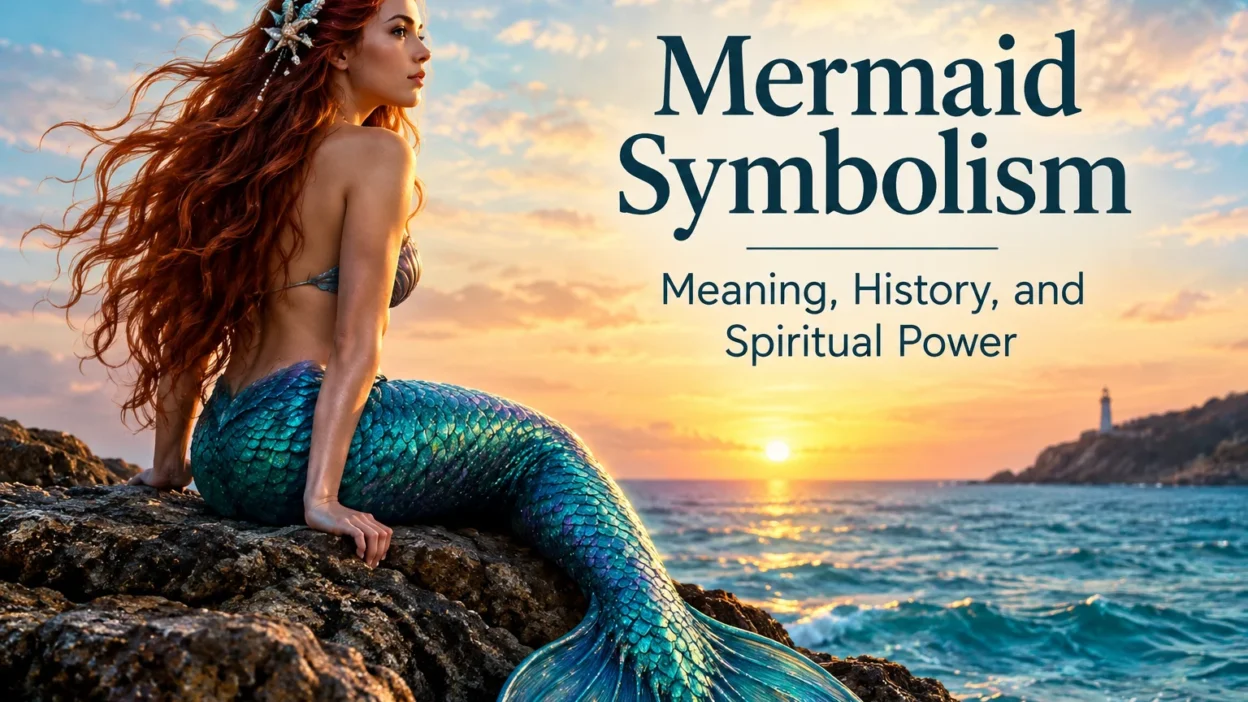
Mermaid symbolism connects the mysteries of the ocean with human emotions, imagination, and the desire for freedom. Mermaids appear in stories as beautiful beings with human upper bodies and fish tails. They often represent mystery, feminine energy, transformation, and the hidden depths of the human mind. However, their meaning changes depending on the story, culture, and setting.
In 2026, mermaids appear in fairy tales, movies, tattoos, coastal art, and nautical traditions. Some people see them as symbols of independence and self-discovery. Others connect them with beauty, temptation, emotional strength, or a deep love of the sea. Their image can feel peaceful and magical, yet it can also suggest danger and uncertainty.
Mermaids remain popular because they represent two worlds at once. They belong to the familiar human world and the mysterious underwater realm. This contrast makes them powerful symbols of identity, change, and the parts of ourselves we are still learning to understand.
Quick Answer
Mermaid symbolism in the United States commonly represents freedom, mystery, feminine power, beauty, and transformation. Across wider traditions, mermaids can also symbolize the ocean’s creative force, emotional depth, temptation, and the unknown.
TL;DR
- Mermaids symbolize mystery, freedom, beauty, and transformation.
- Their connection to water represents emotions, intuition, and hidden knowledge.
- American stories often portray mermaids as magical, independent, or dangerous.
- Mermaid tattoos can express individuality, feminine strength, and a love of the ocean.
- Ancient water spirits helped shape later mermaid legends.
- Modern mermaids represent self-discovery, imagination, and the courage to be different.
What Does a Mermaid Symbolize?
Mermaids combine human features with the body of a fish. This unusual form makes them natural symbols of connection between different worlds. Their meaning often depends on their appearance, actions, and surroundings.
The Main Symbolic Meanings
Mermaids can represent several ideas at once. Their beauty may suggest attraction, while their underwater home points toward mystery and emotional depth.
- Freedom: Living in the ocean suggests independence from ordinary rules.
- Mystery: Hidden underwater worlds represent secrets and unexplored possibilities.
- Transformation: Their mixed form symbolizes movement between different identities or states.
- Feminine power: Many modern depictions celebrate confidence, independence, and self-expression.
- Emotional depth: Water connects mermaids with feelings that are difficult to explain.
- Temptation: Some traditional stories portray their beauty and songs as dangerous distractions.
These meanings aren’t universal. A mermaid in a children’s story may represent wonder, while one in a darker legend may warn against trusting appearances.
What Their Appearance Can Mean
The colors and details of a mermaid image can change its message. Artists often use ocean colors to create a peaceful, magical feeling.
Blue and turquoise suggest calmness, freedom, and a connection to the sea. Green can represent growth, nature, and renewal. Silver and pearl tones may evoke moonlight, elegance, and mystery.
Red hair, sharp features, or stormy seas can create a more dramatic image. In contrast, a smiling mermaid surrounded by coral may communicate friendliness and harmony with nature.
History and Origins of Mermaid Symbolism
Mermaid legends developed through many different cultures and historical periods. Their roots reach back to ancient stories about water deities and supernatural beings, although these figures weren’t always half-human and half-fish.
Ancient Water Spirits
Ancient Mesopotamian traditions included supernatural figures associated with water. One important example is Atargatis, a Syrian goddess whose later legends became associated with a fish-tailed form. Her story is often mentioned when discussing early mermaid-like figures.
However, ancient water beings weren’t all mermaids in the modern sense. Some represented fertility, divine power, protection, or the unpredictable nature of water.
Greek mythology also included the Sirens, creatures known for their enchanting songs. Early Greek art commonly portrayed Sirens as part woman and part bird, not fish. Over time, later European artistic traditions increasingly connected Sirens with mermaids.
Medieval and Early Modern Legends
During the Middle Ages, mermaids appeared in European manuscripts, religious art, maps, and collections of stories about unusual creatures. Their images could communicate beauty, temptation, danger, or the limits of human knowledge.
Sailors also shared stories about strange beings seen at sea. Some accounts may have involved mistaken sightings of marine animals, including manatees or dugongs. However, folklore, imagination, and artistic traditions also shaped these reports.
By the early modern period, mermaids had become familiar figures in European storytelling. Their meanings continued to shift between warnings about temptation and fascination with distant, unexplored worlds.
From Folklore to Fairy Tales
Mermaids became especially recognizable through literary fairy tales. Hans Christian Andersen’s The Little Mermaid, published in 1837, presented a mermaid who longs for a different life and makes painful sacrifices for love and transformation.
Andersen’s story is more bittersweet than many modern adaptations. It explores longing, identity, sacrifice, and the desire to belong somewhere new. Later versions softened or changed parts of the tale, helping mermaids become familiar figures in children’s entertainment.
Mermaid Symbolism in American Culture
In the United States, mermaids are connected with coastal life, popular entertainment, fantasy, and personal identity. Their image can feel playful and welcoming, but it also preserves older associations with danger and mystery.
Mermaids and American Coastal Traditions
American communities near the ocean often use mermaids in local art, souvenirs, festivals, and tourism. They provide a recognizable image for places shaped by beaches, fishing, sailing, and marine life.
For example, Weeki Wachee Springs in Florida became famous for its live underwater mermaid performances. The attraction helped turn mermaids into part of American roadside entertainment and regional identity.
Mermaids also appear in nautical decorations and maritime storytelling. Their presence reflects the long-standing fascination with the ocean as both a source of livelihood and an unpredictable natural force.
Mermaids in American Entertainment
Movies, television, books, and animation have shaped how many Americans understand mermaids. Friendly characters often emphasize curiosity, kindness, romance, and the excitement of discovering another world.
Darker stories, however, portray mermaids as dangerous or difficult to understand. This contrast keeps the symbol flexible, allowing it to appeal to different ages and personalities.
Mermaids can therefore represent both childhood wonder and adult questions about identity. Their stories often ask what people might sacrifice to belong, explore, or become someone new.
What Mermaids Represent in Everyday American Life
| Context | Common American Meaning | Typical Association |
| Beach and coastal decor | Relaxation and connection to nature | Ocean life and summer |
| Fantasy films and books | Wonder and transformation | Imagination and adventure |
| Tattoos and personal art | Independence and individuality | Personal identity |
| Nautical artwork | Mystery and the unpredictable sea | Maritime heritage |
| Children’s celebrations | Playfulness and magic | Make-believe and creativity |
These associations can overlap, but the surrounding context usually guides the interpretation. A mermaid on a beach souvenir may simply celebrate coastal life, while a detailed tattoo may express a more personal story.
Spiritual Meaning of Mermaids
Mermaids can carry spiritual meaning for people who connect the ocean with intuition, renewal, and the unseen parts of life. However, mermaids don’t have one universally accepted spiritual meaning, and beliefs vary widely.
Water as a Spiritual Symbol
Water often represents life, cleansing, renewal, and emotional change in spiritual traditions. Because mermaids live underwater, people may interpret them as guides through feelings or periods of personal transformation.
For some, a mermaid symbolizes learning to trust intuition. For others, it represents the need to respect powerful emotions rather than suppress them.
These are personal interpretations, not universal religious teachings. Someone may find spiritual inspiration in mermaid imagery without believing that mermaids exist as supernatural beings.
Intuition, Mystery, and Inner Growth
Mermaids live in a world that humans cannot naturally inhabit. This makes them useful symbols for exploring unfamiliar parts of ourselves.
Their underwater setting can represent memories, dreams, or feelings that remain hidden beneath everyday awareness. Their ability to move between land and sea can suggest adapting to change without losing one’s identity.
A mermaid may therefore symbolize the journey toward greater self-understanding. Its meaning depends on the person’s experiences and the beliefs they bring to the image.
Mermaid Symbolism Across Cultures
Stories about mermaid-like beings appear in different parts of the world. However, these traditions developed in distinct historical settings, so their meanings shouldn’t be treated as interchangeable.
European Mermaids and Sirens
European mermaids often combine beauty, danger, romance, and the unknown. In some stories, they help humans or fall in love with them. In others, their songs lure sailors toward disaster.
Sirens have a related but distinct history. In ancient Greek mythology, they were associated with irresistible songs and dangerous temptation. Their later connection with mermaids reflects centuries of changing art and storytelling.
African and African Diaspora Traditions
Mami Wata is a water spirit associated with various African and African diaspora traditions. Depictions and beliefs differ by community, but the figure can be connected with beauty, wealth, healing, spiritual power, and danger.
Mami Wata is not simply another name for a European mermaid. The traditions surrounding this spirit have their own histories, meanings, and religious importance. Treating the two as identical can erase important cultural differences.
Asian Water Beings
Several Asian traditions include supernatural beings connected with water. In Japanese folklore, for example, the ningyo is a strange aquatic creature that differs from the familiar Western mermaid.
Stories about such beings may involve unusual powers, warnings, longevity, or misfortune. Their meanings depend on the particular tale and shouldn’t be reduced to one general interpretation.
A Shared Fascination With the Unknown
Despite their differences, many water-being stories explore humanity’s relationship with the natural world. Oceans, rivers, and lakes can provide food and transportation while also creating danger.
Mermaid-like figures give these forces a recognizable shape. They allow people to tell stories about beauty, fear, desire, and the limits of human knowledge.
The Psychological Meaning of Mermaids
Mermaids can appeal to people because they bring together familiar human traits and an unfamiliar environment. Psychologically, this combination can suggest the challenge of understanding ourselves while adapting to changing circumstances.
Identity and Belonging
A mermaid often belongs to two worlds without fitting completely into either one. This can reflect the experience of people who feel different from those around them.
For example, someone moving to a new country might connect with a mermaid’s search for belonging. Another person may see the symbol as a reminder that they don’t need to fit into a single category.
The image doesn’t prove anything about a person’s personality. Instead, it provides a way to express feelings that may be difficult to explain directly.
Emotions and the Unconscious
The ocean’s depth makes it a natural symbol for feelings, memories, and thoughts that remain outside everyday awareness. A mermaid emerging from the water may suggest discovering something previously hidden.
Calm water can communicate peace and emotional balance. Rough waves may suggest uncertainty, conflict, or feelings that are difficult to manage.
These interpretations are symbolic rather than scientific personality assessments. Their value lies in helping people reflect on their own experiences.
Beauty, Confidence, and Self-Expression
Modern mermaid imagery often celebrates appearance, creativity, and confidence. Bright colors, flowing hair, and elaborate tails can create a sense of fantasy and personal freedom.
However, mermaids can also challenge narrow ideas about beauty. A person may use the image to celebrate individuality, unusual interests, or a refusal to hide what makes them different.
Mermaid Symbolism in Dreams
Dreams about mermaids can feel memorable because they combine familiar human forms with the mystery of water. Their meaning depends on the dream’s emotions, setting, and events rather than one fixed interpretation.
Common Mermaid Dream Themes
A peaceful mermaid may remind someone of curiosity, imagination, or a desire for emotional calm. A frightening mermaid could reflect uncertainty or concerns about being misled, depending on the dreamer’s circumstances.
- Swimming with a mermaid: Exploring emotions or unfamiliar experiences.
- Seeing a mermaid from shore: Feeling curious about something beyond reach.
- Becoming a mermaid: Imagining a change in identity or lifestyle.
- Meeting a threatening mermaid: Facing uncertainty or mistrust.
- Rescuing a mermaid: Feeling drawn to protect something vulnerable.
These possibilities aren’t predictions of future events. Dreams can reflect recent experiences, personal memories, and ordinary imagination.
How to Reflect on a Mermaid Dream
Instead of searching for one universal answer, consider how the dream made you feel. Peace, excitement, fear, and sadness may point toward very different personal associations.
Also, think about the role water played in the dream. A clear ocean might feel inviting, while dark or turbulent water could create tension. Your own associations matter more than a rigid dream dictionary.
Mermaid Tattoos and Their Meanings
Mermaid tattoos are popular among people who love ocean imagery, fantasy, and personal symbols. Their meaning can be romantic, adventurous, spiritual, or simply aesthetic.
Common Mermaid Tattoo Interpretations
A tattoo’s details often shape its message. A graceful mermaid sitting on a rock creates a different impression from one swimming through a storm.
- Freedom and independence: A mermaid moving through open water.
- Feminine strength: A confident mermaid with a powerful pose.
- Mystery and intuition: A mermaid surrounded by dark water or moonlight.
- Love of the ocean: A design featuring waves, shells, or sea life.
- Transformation: A mermaid emerging from water or changing direction.
- Individuality: An unusual design that reflects personal taste or identity.
No design has a fixed meaning for every person. Some people choose mermaid tattoos because of a childhood memory, while others simply enjoy the artwork.
Colors and Design Choices
Blue and teal tails often suggest calmness and a strong ocean connection. Green may emphasize nature, growth, or renewal, while purple can create a mystical feeling.
Black-and-gray designs often highlight detail and contrast. A small, simple mermaid may feel subtle, while a large, colorful design can celebrate fantasy and creativity.
The most meaningful interpretation usually comes from the wearer’s personal story.
Mermaids in Fashion, Art, and Home Decor
Mermaid imagery remains popular in American design because it combines natural beauty with fantasy. It works across many styles, from playful children’s accessories to elegant coastal interiors.
Fashion and Personal Style
Mermaid-inspired clothing often features shimmering fabrics, flowing shapes, iridescent colors, and scale-like patterns. These details suggest movement, water, and a magical transformation.
Some people use the style to express creativity or a playful personality. Others prefer a subtle ocean-inspired look through jewelry, hair accessories, or sea-colored clothing.
Home Decor and Coastal Design
Mermaid figures appear in wall art, figurines, decorative shells, and coastal-themed rooms. Their presence can create a relaxing atmosphere associated with beaches and the sea.
However, mermaid decor doesn’t always communicate a deep symbolic message. Sometimes it simply reflects a love of marine life, fantasy, or seaside vacations.
Social Media and Digital Identity
On social platforms, mermaid imagery often appears in fantasy illustrations, profile pictures, costumes, and themed photography. It can communicate imagination, individuality, and an interest in ocean-inspired aesthetics.
The mermaid emoji, 🧜, can also suggest fantasy, swimming, beach activities, or a playful sense of identity. Like other digital symbols, its meaning depends on the surrounding message.
Negative Meanings and Misunderstandings
Mermaids aren’t always symbols of innocence or kindness. Many traditional stories present them as unpredictable beings whose beauty can hide danger.
Temptation and Deception
Some legends describe mermaids or related figures as using beauty and music to distract sailors. These stories reflect fears about the ocean, unfamiliar places, and the dangers of following appearances without caution.
However, this interpretation shouldn’t define every mermaid story. Other traditions portray water beings as helpful, protective, or simply mysterious.
Avoiding Cultural Confusion
Modern fantasy often combines elements from different cultures to create new characters. Creative reinterpretation is common, but it can become misleading when distinct spiritual traditions are treated as identical.
For example, describing every water spirit as a mermaid ignores important differences in history and religious meaning. Learning the background of a particular figure helps preserve its cultural context.
Beauty Standards and Gender Stereotypes
Some popular images portray mermaids as having idealized bodies and flawless appearances. These portrayals can reinforce narrow beauty standards, especially when media repeatedly presents one body type as the ideal.
Other artists challenge those expectations by creating mermaids with different bodies, ages, features, and identities. Such representations expand the symbol beyond conventional ideas of beauty.
How Mermaid Symbolism Has Changed Over Time
Mermaid symbolism has shifted as societies changed their relationships with the ocean, religion, art, and entertainment. A figure once used as a warning can later become a symbol of freedom or playful fantasy.
Read More: Phoenix Symbolism: Meaning, History, and Spiritual Power
From Dangerous Sea Figures to Romantic Characters
Older European stories often emphasized the dangers of mermaids and other supernatural sea beings. Their beauty could represent temptation, while their mysterious home reflected the risks of maritime travel.
Later fairy tales added themes of romance, longing, and personal sacrifice. These stories helped readers see mermaids as characters with hopes and struggles, rather than simply supernatural threats.
From Fairy Tales to Modern Self-Expression
Film, television, and commercial art made mermaids familiar to broader American audiences. Their meaning expanded to include independence, creativity, environmental awareness, and individuality.
Today, mermaid imagery can communicate very different ideas. A person might use it to celebrate childhood memories, express a connection to the ocean, or explore questions about identity.
Why the Symbol Still Matters
Mermaids continue to attract attention because they resist a single interpretation. They can be beautiful and frightening, independent and lonely, familiar and strange.
That flexibility allows each generation to adapt the figure to its own concerns. The mermaid remains a lasting image of the boundary between what we know and what we hope to discover.
FAQs
What does a mermaid symbolize spiritually?
A mermaid may symbolize intuition, emotional depth, transformation, and a connection with nature. These meanings are personal interpretations rather than universal spiritual beliefs.
Are mermaids symbols of good luck?
Some people associate mermaids with protection or favorable outcomes at sea. However, traditional stories also portray them as dangerous, so good luck isn’t a universal meaning.
What does a mermaid tattoo mean for a woman?
A mermaid tattoo may express independence, confidence, femininity, individuality, or a love of the ocean. Its meaning depends on the design and the wearer’s personal experiences.
What does it mean to dream about a mermaid?
A mermaid dream may invite reflection on emotions, identity, curiosity, or uncertainty. The dream’s setting and your feelings during it are more useful than treating it as a prediction.
Are mermaids symbols of femininity?
Many modern depictions connect mermaids with feminine beauty, creativity, and strength. However, their symbolism isn’t limited to women, and people of any gender can identify with their themes of freedom and transformation.
What is the difference between a mermaid and a siren?
A mermaid is commonly depicted as a human with a fish tail. Sirens originated in Greek mythology as dangerous singers traditionally shown with bird features, although later art sometimes blended them with mermaids.
Conclusion
Mermaid symbolism brings together freedom, mystery, emotional depth, beauty, and transformation. Its history stretches from ancient water-related traditions to European folklore, fairy tales, and modern American entertainment. Across these settings, mermaids reflect humanity’s fascination with the ocean and the unknown. Today, mermaids can represent independence, self-discovery, creativity, or a personal connection to nature. They can also remind us that beauty and mystery don’t always reveal the full story. Their meaning changes with the culture, context, and person interpreting the image. When you encounter a mermaid in a tattoo, dream, artwork, or story, consider what the water and the character represent to you. Sometimes, the most meaningful symbol is the one that helps you understand a part of yourself a little better.