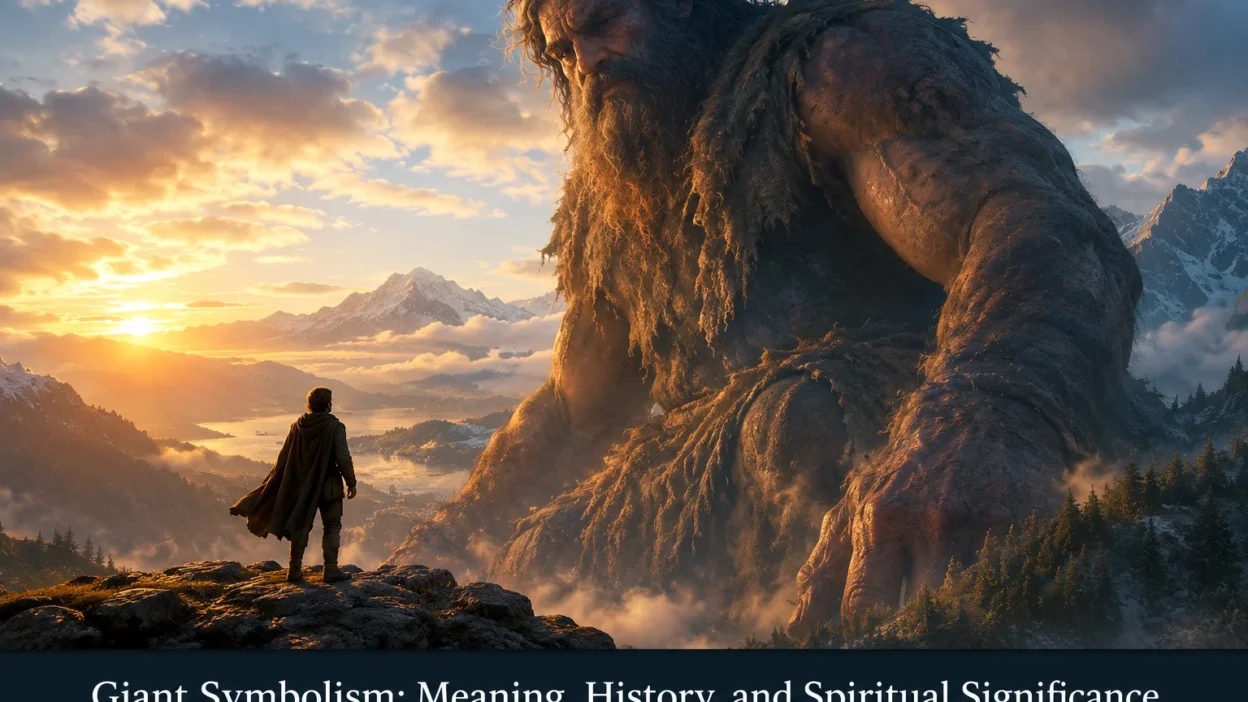
Giant symbolism explores what enormous humanlike beings represent in mythology, folklore, religion, literature, and modern culture. Giants often appear as powerful figures with extraordinary strength, towering bodies, and a presence that makes ordinary people feel small. Depending on the story, they can represent protection, wisdom, danger, pride, or forces beyond human control.
In 2026, giants are familiar through fairy tales, fantasy movies, children’s stories, and legendary creatures. Some appear as frightening monsters, while others become gentle guardians who help people overcome difficult challenges. Their enormous size makes them memorable symbols of power and the unknown.
However, giants aren’t always symbols of evil. They can represent personal potential, overwhelming emotions, natural forces, or the courage needed to face something bigger than yourself. Understanding their symbolism reveals how people use extraordinary beings to explore familiar human experiences, from ambition and fear to kindness and responsibility.
Quick Answer: What Does Giant Symbolism Mean?
Giant symbolism in the United States commonly represents strength, power, overwhelming challenges, ambition, and the unknown. Depending on the story or tradition, giants can also symbolize protection, wisdom, pride, destruction, or the struggle between human limitations and extraordinary forces.
TL;DR: Giant Symbolism at a Glance
- Giants commonly represent immense strength, power, and influence.
- Ancient myths often portray giants as challengers to gods and heroes.
- American folklore uses giants to explore wilderness, danger, and extraordinary achievement.
- Friendly giants can symbolize protection, generosity, and hidden kindness.
- Frightening giants may represent fear, arrogance, oppression, or uncontrolled power.
- Modern stories use giants to explore identity, ambition, and personal growth.
What Is Giant Symbolism?
Giant symbolism refers to the meanings people attach to beings much larger than ordinary humans. These figures appear in myths, religious narratives, folktales, paintings, novels, films, and dreams. Their size immediately distinguishes them from everyday people and gives them symbolic importance.
How Giants Usually Appear
Giants are commonly depicted as oversized humans, muscular warriors, ancient beings, or enormous creatures with unusual features. Their appearance often influences how audiences understand their character.
- Massive bodies: Suggest strength, influence, or overwhelming power.
- Rough skin and rugged clothing: Connect giants with wilderness and ancient worlds.
- Gentle faces and open hands: Suggest kindness, protection, and generosity.
- Dark shadows and threatening weapons: Create associations with danger and destruction.
- Mountainlike proportions: Connect giants with nature, permanence, and forces beyond human control.
However, appearance doesn’t determine meaning by itself. A giant with frightening features might protect a vulnerable person, while a beautiful giant might become a dangerous ruler.
Why Size Matters Symbolically
Human beings often associate physical size with authority and importance. A towering figure can appear powerful even before speaking or acting.
Therefore, giants make useful symbols for experiences that feel larger than life. These might include a difficult responsibility, an influential leader, an overwhelming fear, or an ambitious dream.
Historical Origins of Giant Symbolism
Giants appear in ancient stories from many parts of the world. Their origins aren’t limited to one civilization, and their meanings developed differently across cultures.
Giants in Ancient Mythology
Ancient Greek mythology includes several groups of enormous beings, including the Titans and Gigantes. These groups aren’t interchangeable, although modern storytelling sometimes treats them as similar figures.
The Titans belonged to an older divine generation associated with the origins of the cosmos. The Gigantes fought the Olympian gods in a conflict known as the Gigantomachy. These stories explored order, authority, conflict, and the dangers of challenging established power.
In Norse mythology, the jötnar are often translated as giants. However, they include a broad range of beings connected with nature, cosmic forces, and relationships with the gods. They aren’t simply oversized monsters.
Giants in Biblical Traditions
The Bible includes accounts of unusually large or powerful figures, including Goliath in the story of David. Although Goliath is commonly portrayed as a giant in art and popular culture, the central conflict concerns a seemingly weaker individual confronting a formidable opponent.
Genesis also mentions the Nephilim, a group whose identity and origins have inspired different interpretations. They shouldn’t automatically be treated as identical to giants in every later tradition.
These stories influenced Western art, literature, and popular ideas about extraordinary beings. They also helped establish the enduring image of a smaller hero overcoming a much stronger opponent.
From Ancient Myths to Fairy Tales
Over time, giants appeared in medieval legends, European folktales, and children’s stories. Some became cruel man-eaters, while others guarded treasures, lived in remote mountains, or helped heroes complete difficult tasks.
This variety gave giants more flexible meanings. They could represent the dangers of unfamiliar places, the rewards of courage, or the possibility that appearances conceal a different nature.
Giant Symbolism in the United States
In American culture, giants represent both extraordinary possibility and overwhelming danger. Their meanings developed through inherited European folklore, religious storytelling, frontier legends, entertainment, and the country’s fascination with scale.
Giants in American Folklore
American tall tales often celebrate characters whose strength and accomplishments exceed ordinary limits. Paul Bunyan, for example, is a legendary lumberjack portrayed as a giant in many popular retellings.
Stories about Paul Bunyan and his enormous companion, Babe the Blue Ox, turn the challenges of logging and wilderness life into exaggerated adventures. These stories celebrate ingenuity, hard work, humor, and the human desire to master difficult environments.
However, tall tales aren’t the same as ancient religious myths. They often use deliberate exaggeration to entertain audiences and celebrate larger-than-life characters.
Giants in American Media
American movies, television shows, comics, and video games frequently use giants to represent enormous threats or extraordinary heroes. Their scale makes conflicts visually dramatic and helps audiences understand the stakes immediately.
A giant attacking a city may symbolize destruction or humanity’s vulnerability. In contrast, a giant defending a village can embody courage, loyalty, and protection.
Giants also appear in stories about scientific experiments, unexplored worlds, and powerful beings beyond human understanding. These interpretations reflect modern concerns about technology, authority, and the limits of human control.
Giants and American Ideals
Giants sometimes symbolize ambition, success, and the desire to achieve something extraordinary. Expressions such as a “giant leap” or “giant achievement” use size as a metaphor for importance.
Yet the same image can carry a warning. A giant corporation, for example, may suggest influence and success, but it can also raise concerns about concentrated power.
The meaning depends on whether that power serves people or overwhelms them.
Spiritual Meaning of Giants
Giants can carry spiritual meanings involving strength, pride, transformation, protection, and the relationship between human beings and greater forces. However, no single spiritual interpretation applies to every culture or belief system.
Giants as Symbols of Greater Forces
In spiritual storytelling, giants may represent forces that humans cannot easily control. These forces might include nature, divine authority, fate, or the consequences of human actions.
Their enormous size creates a sense of distance between ordinary people and something more powerful. Depending on the story, this difference may inspire humility, courage, reverence, or resistance.
Giants and Inner Growth
Some modern spiritual interpretations treat giants as symbols of personal challenges. A giant may represent a fear that seems impossible to overcome or a responsibility that feels too large.
In this reading, confronting a giant becomes a metaphor for personal development. The important lesson isn’t always defeating the giant; sometimes it’s understanding it, cooperating with it, or learning how to respond wisely.
These are contemporary symbolic interpretations rather than universal religious teachings.
Giants as Guardians
Some fictional and folkloric giants protect people, land, or hidden treasures. Such figures can symbolize a powerful presence that uses strength responsibly.
Their protective role reminds readers that power doesn’t have to produce harm. Strength can also support generosity, loyalty, and care for others.
Positive Meanings of Giant Symbolism
Giants can represent admirable qualities when their strength serves a constructive purpose. These positive meanings appear in legends, fantasy stories, personal symbolism, and everyday expressions.
Strength, Courage, and Protection
A giant may symbolize the ability to withstand pressure or defend someone vulnerable. Its size suggests that it can face dangers that ordinary people might struggle to confront.
Common positive associations include:
- Strength: The ability to endure difficult situations.
- Courage: Facing challenges despite uncertainty or fear.
- Protection: Using power to keep others safe.
- Generosity: Sharing resources or helping people without expecting rewards.
- Great potential: Recognizing abilities that exceed current expectations.
- Leadership: Accepting responsibility and guiding others through challenges.
These meanings are especially clear when a giant chooses compassion instead of domination.
Giants as Symbols of Achievement
A giant can also represent a goal that requires extraordinary effort. In this sense, becoming a giant means developing confidence, skill, or influence rather than gaining physical size.
For example, a person might describe a major career breakthrough as a giant step forward. The expression turns a physical image into a metaphor for progress.
However, genuine greatness doesn’t necessarily require dominance. A person can achieve remarkable things while remaining humble and considerate.
Negative Meanings of Giant Symbolism
Giants can also represent dangerous power, arrogance, oppression, and the fear of being overwhelmed. These darker meanings are common in stories where enormous characters use their strength selfishly.
Pride and Abuse of Power
A giant who believes nobody can challenge them may become a symbol of arrogance. Their physical advantage encourages the mistaken belief that strength makes them superior to everyone else.
This interpretation connects giants with tyrants, bullies, and leaders who misuse authority. The giant becomes frightening not simply because of size, but because of the choices made with that size.
Fear and Overwhelming Challenges
Giants often embody problems that seem too large to solve. A threatening giant might represent financial pressure, social expectations, personal uncertainty, or an intimidating opponent within a fictional narrative.
Common negative associations include:
- Oppression: Power used to control or silence others.
- Arrogance: Believing strength makes someone invulnerable.
- Destruction: Uncontrolled force that damages people or communities.
- Intimidation: Making others feel powerless through size or authority.
- Excess: Growing so powerful that balance and responsibility disappear.
Nevertheless, these meanings aren’t automatic. A giant can be dangerous in one story and helpful in another.
Giant Symbolism Across Cultures
Giant-like beings appear in many cultural traditions, although their appearances and roles differ. Comparing them helps explain why enormous figures can inspire both fear and admiration.
Greek and Norse Traditions
Greek mythology presents Titans and Gigantes within stories about divine conflict and cosmic order. Norse mythology includes jötnar, whose relationships with gods and the natural world are complex.
In both traditions, enormous beings can challenge established power. However, their individual roles differ, so it’s misleading to classify every giant as evil or destructive.
Other Cultural Traditions
Japanese folklore includes the oni, supernatural beings often portrayed as large and frightening. Although some resemble giants visually, oni are a distinct category of beings and shouldn’t simply be treated as giants.
Other traditions feature giant ancestors, powerful guardians, or enormous beings associated with mountains and the creation of landscapes. Their meanings depend on local stories, religious beliefs, and cultural history.
A Respectful Comparison
| Cultural context | Common portrayal | Possible symbolic meaning | Important distinction |
| Ancient Greek mythology | Titans and Gigantes | Conflict, cosmic order, rebellion | These are different groups of beings |
| Norse mythology | Jötnar | Nature, power, cosmic tension | Not all are evil or identical |
| Biblical storytelling | Goliath and Nephilim traditions | Strength, mystery, formidable opponents | Their identities and interpretations differ |
| American tall tales | Paul Bunyan and other oversized figures | Humor, ambition, extraordinary achievement | Exaggeration is central to the genre |
| Japanese folklore | Oni and other supernatural beings | Danger, punishment, supernatural power | Oni aren’t simply another name for giants |
The shared theme is extraordinary power, but the cultural meaning changes with each story. Respecting those differences prevents a complex tradition from becoming a single, oversimplified definition.
Psychological Meaning of Giants
From a psychological perspective, giants offer a vivid way to explore how people experience power, vulnerability, and uncertainty. Their size makes abstract feelings easier to imagine.
Giants as Inner Fears
A frightening giant may represent a problem that seems bigger than your ability to manage it. This could be a difficult decision, an intimidating person, or a change that feels beyond your control.
However, symbolic interpretation isn’t an exact science. A giant in a story or dream doesn’t have one fixed meaning for everyone.
Giants and Personal Confidence
A friendly or heroic giant can represent confidence, inner strength, or the desire to protect others. It might also reflect admiration for someone whose abilities seem exceptional.
The emotional tone matters. If the giant feels safe, it may suggest reassurance; if it feels threatening, it may highlight vulnerability or uncertainty.
The Importance of Context
When interpreting giant imagery, consider what the giant does and how you respond to it. Ask whether it protects, threatens, guides, or challenges the people around it.
Your personal associations also matter. Someone who loves fantasy adventures may view giants as exciting, while another person may associate them with danger or childhood fears.
Giant Symbolism in Dreams
Dreams about giants can feel powerful because they combine familiar human forms with extraordinary scale. Their possible meanings depend on the dream’s setting, emotional tone, and personal associations.
Seeing a Giant in a Dream
A giant might represent an intimidating responsibility, a powerful person, or an ambition that feels difficult to reach. However, it could also reflect recent exposure to books, movies, games, or other imagery.
Rather than assuming the dream predicts an event, consider how the giant behaved and how you felt.
Friendly and Frightening Giants
A friendly giant may symbolize support, reassurance, or confidence in someone’s ability to help you. A threatening giant might reflect a situation that feels overwhelming.
If you defeat a giant in a dream, you might associate the experience with determination or overcoming an obstacle. Still, dreams don’t have universal meanings, and no single interpretation can establish what a dream must represent.
Giant Symbolism in Tattoos and Modern Art
Giant imagery remains popular in fantasy art, tattoos, illustrations, and character design. Artists use enormous figures to communicate strength, mystery, vulnerability, or the relationship between individuals and larger forces.
Giant Tattoos
A giant tattoo may express a personal interest in mythology or a desire to represent strength. The chosen character and artistic style usually provide more meaning than size alone.
Common design approaches include:
- Mythological giants: Interest in ancient stories and heroic struggles.
- Protective giants: Loyalty, family bonds, and responsibility.
- Dark fantasy giants: Confronting fear or accepting personal complexity.
- Mountain-sized figures: Connection with nature and the vastness of existence.
- Gentle giants: Kindness, patience, and strength without aggression.
These meanings are personal possibilities, not fixed rules.
Giants in Digital Culture
Social media and online communities frequently use the word “giant” to describe extraordinary achievements, oversized objects, or impressive personalities. Fantasy illustrations also use scale to make characters immediately recognizable.
Meanwhile, video games often portray giants as powerful opponents or rare allies. Their presence can communicate difficulty, reward, or a dramatic change in the player’s journey.
Misunderstandings and Controversies About Giants
Giant symbolism can be misunderstood when different traditions are blended together or when a metaphor is treated as a universal truth. A careful reading considers the original story, its cultural setting, and the character’s actions.
Are All Giants Evil?
No. Some giants threaten heroes or destroy communities, while others provide shelter, guidance, or protection.
Their moral character depends on the narrative. Assuming that every giant represents evil overlooks stories that use these beings to explore compassion and responsible strength.
Are Giants Always Spiritual Symbols?
No. Giants can serve religious, mythological, psychological, comic, or purely entertaining purposes. A giant in a fantasy game doesn’t necessarily communicate a spiritual belief.
Likewise, modern interpretations about inner strength or personal transformation should be recognized as interpretations rather than established meanings shared by every tradition.
Cultural Context and Oversimplification
Problems arise when distinct beings are treated as interchangeable or when sacred narratives are reduced to decorative fantasy. For example, Titans, Norse jötnar, biblical figures, and Japanese oni belong to different traditions.
Understanding their differences doesn’t prevent creative reinterpretation. Instead, it helps artists and readers engage with cultural material more thoughtfully.
How Giant Symbolism Has Changed Over Time
The meaning of giants has changed as storytelling traditions, social values, and entertainment have evolved. Their enormous size remains central, but the qualities attached to that size vary by era.
From Cosmic Threats to Folklore Characters
In ancient mythology, giant-like beings often participated in stories about the origins of the world, conflicts among powerful beings, and the boundaries of divine authority.
Later folklore gave giants more recognizable personalities. They could become greedy villains, foolish creatures, hidden guardians, or opponents whom clever heroes outsmarted.
From Fear to Friendship
Modern children’s books and films often portray gentle giants who appear frightening but behave kindly. This approach challenges the idea that outward appearance reveals someone’s character.
It also makes giants useful for stories about empathy, prejudice, friendship, and acceptance. Their enormous bodies contrast with their gentle actions, creating a memorable lesson about looking beyond appearances.
Read More: Fairy Symbolism: Meaning, History, and Spiritual Significance
Giants as Modern Metaphors
Today, giant imagery frequently describes extraordinary success, major obstacles, and powerful institutions. A “giant leap” suggests progress, while “facing a giant” can describe confronting an intimidating challenge.
These expressions show how an ancient image can remain relevant without requiring belief in literal giants. The symbol survives because people continue to experience situations that feel larger than themselves.
FAQs
What does a giant symbolize spiritually?
A giant may represent strength, overwhelming forces, pride, protection, or personal transformation. The interpretation depends on the tradition and the story rather than a universal spiritual rule.
Are giants a symbol of good luck?
Giants aren’t widely recognized as universal good-luck symbols. In particular stories, however, a helpful giant may represent opportunity, protection, or the arrival of unexpected assistance.
What does a friendly giant symbolize?
A friendly giant commonly represents kindness, generosity, protection, and strength guided by compassion. This character challenges the assumption that a powerful appearance must signal danger.
What does fighting a giant symbolize?
Fighting a giant often represents confronting a difficult challenge or standing up to a powerful opponent. The outcome may suggest victory, sacrifice, or the importance of courage, depending on the story.
What does a giant symbolize in dreams?
A giant in a dream may reflect a person, responsibility, fear, or ambition that feels unusually significant. Your emotions and recent experiences provide more useful context than any universal dream dictionary.
What is the difference between giants and Titans?
Titans are a specific group of divine beings in Greek mythology, associated with an older generation of gods. Giants appear in many traditions, and Greek Gigantes are distinct from the Titans despite similarities in modern portrayals.
Conclusion
Giant symbolism represents the powerful forces that shape human experience, from strength and ambition to fear and vulnerability. In American culture, giants appear in folklore, fantasy, and everyday expressions that celebrate extraordinary achievement or describe overwhelming challenges. Their meanings also extend beyond physical size. A giant can be a threatening opponent, a caring protector, a symbol of unchecked authority, or a reminder of hidden potential. The surrounding story determines which interpretation makes the most sense. When you encounter a giant in a myth, dream, tattoo, or movie, consider its actions and your emotional response. You may discover that the most meaningful part of the symbol isn’t how enormous the giant appears, but what its power reveals about the people facing it.