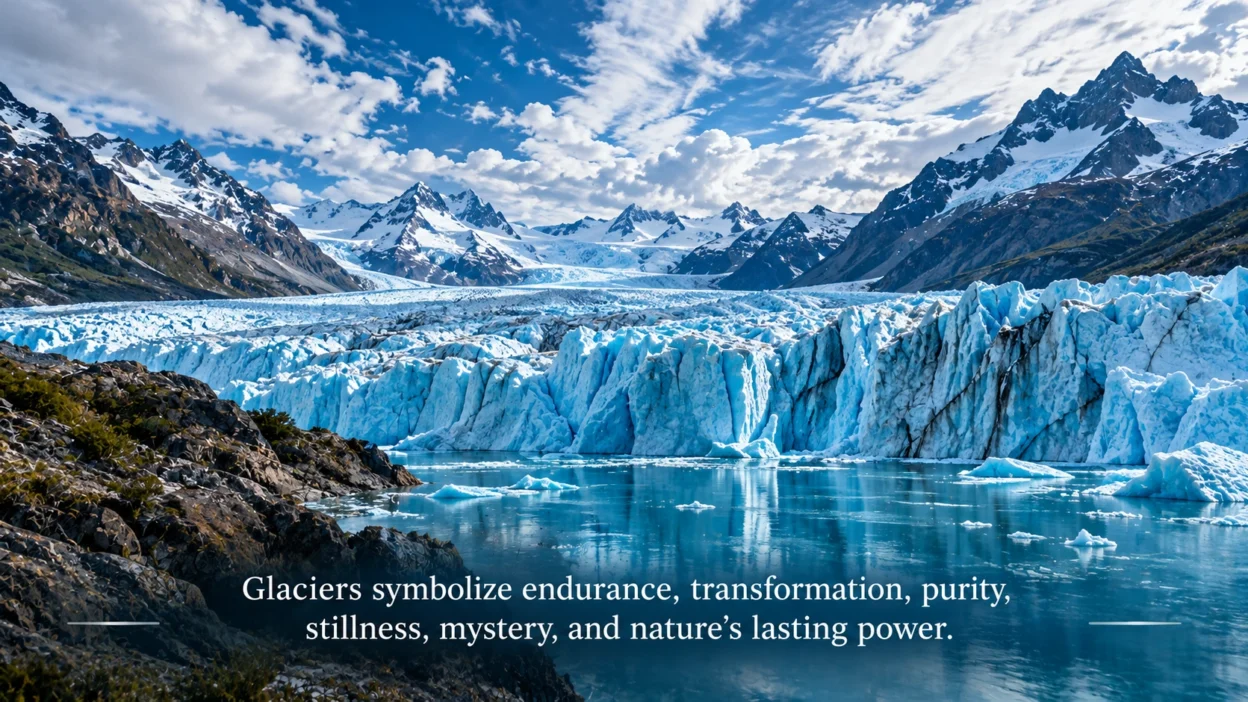
Glacier symbolism connects one of nature’s most powerful forms with ideas of endurance, stillness, transformation, mystery, and strength. A glacier may look quiet and frozen, yet it slowly moves across the landscape.
However, glaciers also carry a deeper symbolic message. They show that change doesn’t always happen quickly. Sometimes, transformation happens so slowly that you notice it only after years have passed.
Today, glacier imagery appears in photography, tattoos, environmental art, outdoor branding, social media, and home decor. Its meaning often depends on context, but the central idea remains powerful: something can appear still while changing underneath.
Quick Answer
Glacier symbolism commonly represents endurance, resilience, purity, stillness, transformation, mystery, and nature’s immense power in the United States. More broadly, glaciers can symbolize patience, hidden movement, emotional distance, and gradual change.
TL;DR
- Glaciers symbolize strength, endurance, patience, and slow transformation.
- In America, they often represent wilderness and untouched natural beauty.
- Their ice and blue tones can suggest purity, calmness, and mystery.
- Their movement represents change that happens gradually.
- Modern glacier imagery appears in tattoos, art, photography, and outdoor culture.
- Melting glaciers can also symbolize environmental loss and changing conditions.
What Does a Glacier Symbolize?
Glaciers are more than frozen landscapes. Their appearance creates several natural associations that people easily connect with human experiences.
For American audiences, a glacier can represent something powerful that doesn’t need to be loud. Its enormous size and slow movement create an image of quiet strength.
Endurance and Strength
A glacier survives through extreme conditions. It can therefore represent resilience and persistence.
Common symbolic associations include:
• Endurance through difficult conditions
• Quiet strength without aggression
• Patience during long periods of change
• Resilience against powerful natural forces
• Stability combined with constant movement
Stillness and Hidden Movement
A glacier looks motionless from a distance. Yet glaciers can flow, crack, shrink, and reshape the land.
Because of this contrast, glacier symbolism can represent hidden activity. It reminds us that appearances don’t always reveal what is happening beneath the surface.
How Do Glaciers Appear as Symbols?
The physical appearance of a glacier strongly influences its symbolic meaning. Its colors, shapes, textures, and surroundings all contribute to the message.
For Americans, these visual details often connect glaciers with remote wilderness and dramatic landscapes. Photography has made those associations especially familiar.
Colors and Textures
Glaciers commonly appear in shades of white, pale blue, deep blue, gray, and turquoise. These colors can create feelings of calmness, purity, distance, and mystery.
Cracks and crevasses add another layer. They show that something seemingly solid can contain hidden tension and movement.
Mountains and Wilderness
Glaciers rarely appear alone in symbolic imagery. They often sit among mountains, forests, rivers, and open skies.
This setting strengthens associations with:
• Wilderness and freedom
• Isolation and solitude
• Adventure and exploration
• Natural power and scale
• Beauty untouched by development
Historical Roots of Glacier Symbolism
Unlike symbols from ancient religions, glaciers don’t have one fixed symbolic tradition. Their meanings developed largely from human encounters with powerful frozen landscapes.
As people explored mountainous regions, glaciers became associated with difficult journeys, dangerous terrain, survival, and the unknown.
Early Human Encounters
Long before modern tourism, people living near glaciers understood them as physical forces shaping their surroundings. Glacial landscapes affected travel routes, water supplies, hunting areas, and settlement patterns.
However, the symbolic language surrounding glaciers became especially strong during later periods of exploration and scientific study.
Exploration and Discovery
During the nineteenth and early twentieth centuries, exploration helped turn remote glaciers into symbols of adventure. Mountaineers and explorers traveled through difficult environments to study or cross them.
In this setting, glaciers represented challenges that demanded preparation, courage, patience, and physical endurance.
From the Sublime to the Scientific
Western art also developed a strong fascination with enormous natural landscapes. Mountains, ice fields, waterfalls, and storms could create feelings often described as awe or the sublime.
A glacier fits this idea well. It can appear beautiful while also reminding people of nature’s enormous power.
Glacier Symbolism in America
In the United States, glaciers are closely connected with wilderness and national landscapes. Their presence in famous protected areas has strengthened their cultural meaning.
Glaciers can therefore represent an idealized version of nature that exists beyond cities and daily routines.
National Parks and Wilderness
Glaciers appear prominently in several American national parks and protected landscapes. Their presence helps define ideas of remote wilderness.
For many visitors, seeing a glacier represents an encounter with something much larger than ordinary human life.
It can symbolize:
• Untouched wilderness
• American exploration and adventure
• Freedom from urban routines
• Respect for natural forces
• Preservation of remarkable landscapes
The American Frontier Imagination
American culture has long included stories about exploration and difficult landscapes. Glaciers fit naturally into this tradition.
Unlike the traditional image of a fast-moving frontier journey, however, a glacier introduces patience. It suggests that nature can shape the land over periods far longer than a human lifetime.
Glacier Symbolism and Nature’s Power
A glacier demonstrates how enormous changes can happen without dramatic speed. This makes it a useful symbol for understanding natural power.
For American readers, the idea can also connect personal resilience with the strength of the natural world.
Slow Power
A glacier doesn’t need to move quickly to reshape its surroundings. Over time, its movement can carve valleys and transport enormous amounts of rock.
Symbolically, this can suggest that persistence may matter more than speed.
Strength Without Noise
Glacier imagery rarely communicates aggression. Instead, it creates a sense of quiet force.
That distinction matters because strength doesn’t always appear as action. Sometimes, strength appears as the ability to continue.
Spiritual and Cross-Cultural Meanings of Ice and Glaciers
Glaciers don’t have one universal spiritual meaning. Different cultures have developed distinct relationships with snow, ice, mountains, water, and cold environments.
Therefore, glacier symbolism should not be treated as a single spiritual tradition.
Ice as Stillness
Across different symbolic traditions, frozen water can naturally suggest stillness or suspended activity. However, specific interpretations depend heavily on cultural context.
A glacier may therefore be used as an image of silence, reflection, solitude, or a temporary state.
Mountains and Sacred Landscapes
In many cultures, mountains have spiritual importance. Glaciers sometimes exist within these mountain environments.
Still, it’s important not to automatically transfer the meaning of a sacred mountain tradition onto glaciers themselves. The symbolism can overlap, but the traditions are not interchangeable.
What Does a Glacier Mean Emotionally?
Glacier imagery can create strong emotional reactions because it combines beauty with distance and power.
For some people, a glacier feels peaceful. For others, its scale and coldness create a sense of loneliness or mystery.
Common Emotional Associations
People may associate glaciers with:
• Calmness and quiet reflection
• Emotional distance or reserve
• Strength during hardship
• Wonder and deep curiosity
• Solitude away from crowds
• Mystery and the unknown
The “Ice-Cold” Association
Ice sometimes symbolizes emotional coldness in everyday language. Someone may describe a person as “cold” when they seem distant or unemotional.
However, glacier symbolism is broader than that metaphor. A glacier can represent calm strength without suggesting a lack of emotion.
Glacier Symbolism and Personal Growth
Glaciers provide an interesting metaphor for personal development. Their movement is slow, but the results can be enormous.
This makes them useful for people who value patience and long-term growth.
Slow Progress Still Matters
A glacier reminds us that movement doesn’t have to be obvious to be meaningful.
Someone might use glacier imagery to represent a period of gradual improvement, recovery, learning, or personal change.
Transformation Over Time
Glaciers also reshape the land around them. This makes them a natural metaphor for experiences that slowly change someone’s identity.
The transformation may not be visible immediately. Later, however, the difference can become unmistakable.
Glacier Symbolism in Tattoos
Glacier tattoos can communicate several different ideas. The meaning usually depends on the design and the person’s personal story.
A realistic glacier might represent a connection to wilderness. An abstract glacier may focus more on resilience, solitude, or transformation.
Popular Design Ideas
Common approaches include:
• Glacier peaks beneath a night sky
• Ice combined with mountain landscapes
• Blue-white geometric glacier shapes
• Melting ice representing personal transformation
• Glaciers paired with rivers or forests
A melting glacier can carry an additional meaning. It may represent impermanence, environmental awareness, loss, or acceptance of change.
Glaciers in Art, Photography, and Decor
Glacier imagery works particularly well in visual art because of its dramatic colors and shapes.
The contrast between bright ice and dark mountains creates a strong composition. It can also make a room or image feel quiet and spacious.
Modern Visual Meaning
In American photography, glaciers often represent adventure, remote travel, and wilderness. They can also appear in environmental artwork.
In home decor, glacier-inspired imagery may create a cool, peaceful atmosphere. Blue and white tones can reinforce feelings of cleanliness and calm.
Glacier Symbolism and Environmental Change
Modern glacier imagery has gained another important meaning because glaciers are changing in many parts of the world.
This has affected how people interpret photographs of ice landscapes. A beautiful glacier can now represent both natural endurance and environmental vulnerability.
From Permanence to Impermanence
Older images may make glaciers appear almost permanent. Modern viewers increasingly understand that glaciers can change substantially over time.
That contrast creates a powerful symbolic tension.
A glacier can represent:
• The apparent permanence of nature
• The reality of environmental change
• Loss of familiar landscapes
• The passage of time
• Human awareness of ecological change
This doesn’t mean every glacier image is an environmental statement. Context determines the intended message.
Glacier Symbolism in American Culture
Glaciers have a strong place in American outdoor culture. They appear in travel photography, national park imagery, documentaries, educational materials, and adventure stories.
Their cultural meaning often depends on the setting.
| Context | Meaning in the USA | Common Associations | Notes |
| National parks | Wilderness and preservation | Nature, exploration | Often connected with protected landscapes |
| Tattoos | Endurance or personal change | Strength, patience | Personal meaning varies |
| Photography | Awe and natural beauty | Adventure, solitude | Often emphasizes scale |
| Environmental art | Change and vulnerability | Climate, loss | Usually depends on surrounding imagery |
| Home decor | Calm and spaciousness | Blue tones, purity | Often uses abstract ice imagery |
Misunderstandings and Misuse of Glacier Symbolism
Because glacier symbolism is flexible, people can sometimes oversimplify it.
A glacier doesn’t automatically mean emotional coldness, environmental activism, or spiritual purity. Those meanings depend on context.
Avoiding Oversimplification
Calling every glacier image “cold symbolism” misses its other qualities. Glaciers also represent persistence, beauty, movement, history, and transformation.
Likewise, treating glacier imagery as automatically spiritual can impose a meaning that the creator never intended.
Environmental Symbolism
A melting glacier can clearly communicate environmental concern. However, a glacier photograph used in travel content may simply celebrate natural beauty.
The surrounding words, design, and purpose help determine the intended meaning.
How Glacier Symbolism Has Changed Over Time
Glacier symbolism has shifted as people’s relationship with glaciers has changed.
Earlier interpretations often emphasized exploration, danger, isolation, and the grandeur of nature. Modern interpretations still include these ideas but increasingly add themes of environmental change and impermanence.
Read More: Ice Symbolism: Meaning, History, and Modern Uses
From Mystery to Knowledge
Remote glaciers were once difficult for many people to see or understand. Today, satellite imagery, photography, tourism, and scientific research have made them more familiar.
Yet their mystery hasn’t disappeared. Their size and age still create a powerful sense of wonder.
From Permanence to Change
One of the biggest modern shifts is the idea that glaciers aren’t simply permanent monuments.
They can now symbolize the passage of time more directly. Their changing condition reminds people that even enormous natural features can be temporary.
FAQs
What does glacier symbolism mean?
Glacier symbolism commonly represents endurance, patience, strength, stillness, and transformation. In modern America, it can also suggest wilderness and environmental change.
What does a glacier symbolize spiritually?
A glacier may suggest stillness, reflection, endurance, and the slow movement of life. However, there isn’t one universal spiritual meaning for glaciers.
What does a glacier tattoo symbolize?
A glacier tattoo can represent resilience, patience, solitude, adventure, or personal transformation. A melting glacier may emphasize impermanence or environmental awareness.
Why are glaciers associated with strength?
Glaciers are enormous and can reshape landscapes over long periods. Their slow movement creates a natural metaphor for quiet strength and persistence.
Do glaciers symbolize change?
Yes. Although glaciers look still, they are constantly changing and moving. This contrast makes them a useful symbol for gradual transformation.
What does a melting glacier symbolize?
A melting glacier can symbolize impermanence, loss, environmental change, or the passage of time. Its meaning depends on the surrounding imagery and personal context.
Conclusion
Glacier symbolism brings together ideas of endurance, patience, mystery, transformation, and natural power. Its most interesting quality is the contrast between stillness and movement. Whether you encounter a glacier in a national park, photograph, tattoo, or artwork, its meaning can be deeply personal. The ice may look still, but its story is always moving.