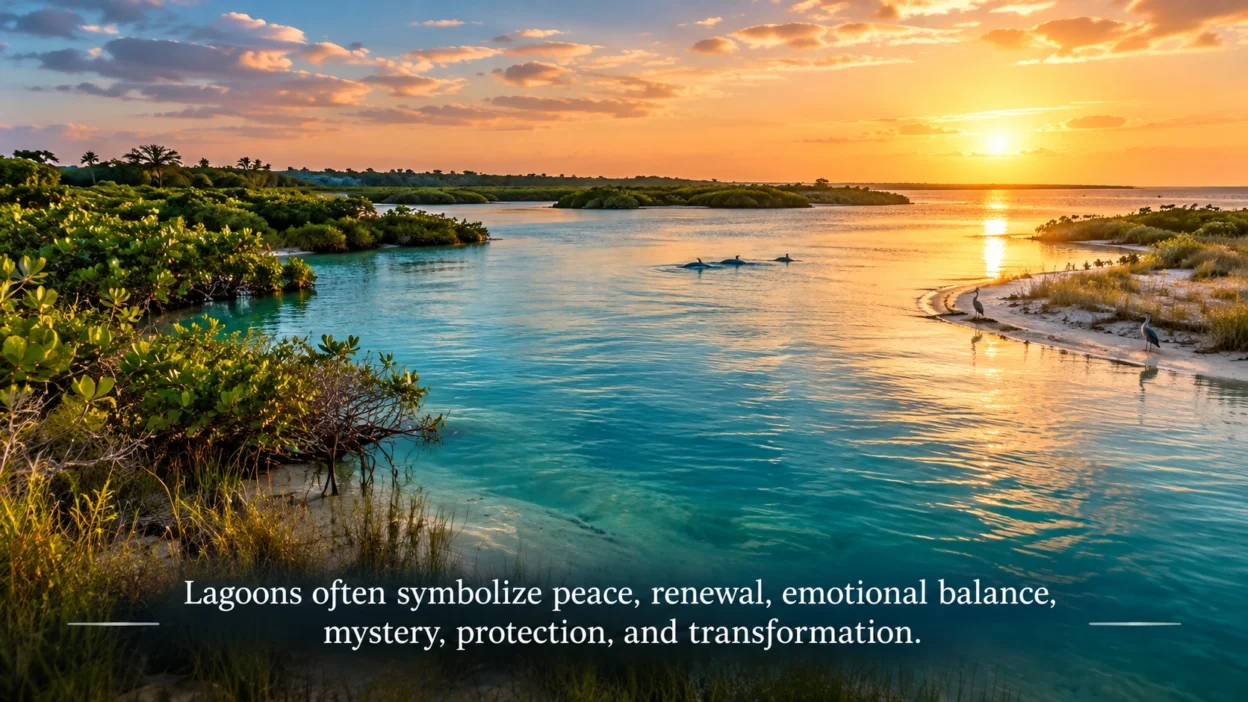
A lagoon is a body of shallow water partly separated from a larger body of water. It may appear beside an ocean, behind a barrier island, or within a coastal landscape. Lagoon Symbolism grows from this unusual position between land and open water.
In the 21st century, lagoons often suggest peace, escape, natural beauty, and emotional calm. However, their meaning can go deeper. Their sheltered water can represent protection, while their connection to the sea can suggest change, freedom, and hidden possibilities.
Quick Answer
Lagoon Symbolism commonly represents peace, renewal, emotional balance, protection, mystery, and transformation in the USA. Because lagoons exist between land and open water, they can also symbolize boundaries, transition, and the meeting of different worlds.
TL;DR
- Lagoons often symbolize calmness, balance, renewal, and natural beauty.
- Their sheltered waters can represent protection and emotional safety.
- Their connection with oceans suggests freedom, movement, and transformation.
- American culture often links lagoons with vacations, escape, and peaceful landscapes.
- Spiritually, lagoons can suggest reflection, transition, and hidden depth.
What Does a Lagoon Represent?
A lagoon is more than a scenic body of water. Its physical position gives it several symbolic qualities that people can easily connect with human experience.
Because it is partly protected from the open sea, a lagoon can feel peaceful and safe. At the same time, its connection to larger waters reminds us that calm places can still lead toward change.
Peace and Stillness
Still lagoon water often creates an immediate feeling of quiet. Therefore, artists and photographers may use lagoon scenes to represent rest, solitude, or emotional calm.
Protection and Shelter
A barrier may protect a lagoon from strong waves. Symbolically, this can represent a safe space where something vulnerable can grow.
Transition and Connection
A lagoon sits between different environments. It can therefore represent transitions, boundaries, and connections between contrasting parts of life.
The Natural Appearance of a Lagoon
The visual features of a lagoon strongly influence how people interpret it. Water color, surrounding plants, weather, and landscape can change its emotional impression.
For example, bright turquoise water may suggest tropical beauty and freedom. In contrast, a dark lagoon surrounded by reeds may create associations with mystery and hidden knowledge.
Colors and Their Meanings
Blue and blue-green waters commonly suggest calmness, trust, openness, and emotional depth. Green vegetation adds associations with growth, life, and renewal.
However, muddy brown water can communicate a different feeling. It may suggest change, earthiness, natural cycles, or uncertainty rather than idealized beauty.
Shape and Setting
A lagoon often has an enclosed or curved appearance. This natural boundary can symbolize containment, protection, and separation.
At the same time, openings toward the sea suggest connection. The lagoon therefore visually expresses the idea of being sheltered without being completely isolated.
Ancient Roots and Water Symbolism
Lagoons themselves weren’t always treated as separate symbolic categories in ancient societies. Instead, people often gave symbolic meaning to water, wetlands, springs, rivers, lakes, and seas.
Across ancient cultures, water frequently appeared in creation stories, purification practices, fertility traditions, and myths about crossing between worlds. However, these meanings differed widely between societies.
Water Before Modern Lagoon Symbolism
Ancient Egyptian culture connected the Nile and its waters with fertility, agriculture, and renewal. Mesopotamian traditions also gave major importance to water as a source of life and order.
In Greek and Roman traditions, seas, rivers, springs, and other waters appeared in mythology. Water could represent beauty, danger, transformation, birth, or divine power.
The Lagoon as a Natural Boundary
The lagoon’s position makes it especially interesting symbolically. It isn’t fully isolated like a lake, yet it isn’t completely exposed like the open ocean.
That middle position creates a natural metaphor for transition. It can represent a person standing between two stages, identities, choices, or emotional states.
Lagoon Symbolism in the USA
American interpretations of lagoons are strongly connected with landscapes, recreation, travel, and ideas of escape. Coastal lagoons appear in photographs, tourism imagery, parks, resorts, and environmental discussions.
Today, many Americans encounter lagoon imagery through vacations and outdoor experiences. As a result, the lagoon can suggest a temporary break from busy routines.
American Ideas of Escape
A quiet lagoon can represent getting away from traffic, work, screens, and crowded city life. Its calm surface creates a visual opposite to fast-paced modern living.
For example, travel photography may show a person beside still water to communicate relaxation. The lagoon becomes a symbol of having space to breathe.
Nature and Conservation
Lagoons also have ecological importance. Coastal wetlands can support fish, birds, plants, and other wildlife.
Therefore, lagoon imagery can represent environmental awareness and respect for natural systems. In this context, the lagoon isn’t simply a beautiful vacation setting.
Common American Associations
| Context | Meaning in the USA | Common Associations | Notes |
| Coastal travel | Escape and relaxation | Vacations, beaches, leisure | Often idealized in tourism imagery |
| Nature photography | Peace and beauty | Wildlife, sunsets, reflections | Emphasizes visual calm |
| Environmental awareness | Protection of ecosystems | Wetlands, wildlife, conservation | Focuses on living habitats |
| Personal reflection | Emotional balance | Solitude, meditation, quiet | Uses still water as a metaphor |
| Art and design | Mystery and elegance | Blue-green colors, reflections | Often creates a peaceful mood |
Spiritual and Cross-Cultural Meanings of Lagoons
Water has spiritual importance in many cultures, although lagoon symbolism isn’t universal. Meanings depend heavily on the specific tradition and its relationship with water.
Some traditions connect water with cleansing, renewal, life, or spiritual transition. Others emphasize its power, unpredictability, or connection with the sacred.
Renewal and Cleansing
Water is frequently associated with washing away what came before. A lagoon can therefore become a gentle image of starting again.
However, this interpretation should remain broad. Different religions and cultures use water in distinct ways, so one meaning shouldn’t be applied to every tradition.
Reflection and Inner Awareness
Still water naturally reflects the sky and surrounding landscape. Symbolically, this makes it a useful image for self-reflection.
A lagoon may therefore represent looking inward before moving forward. Its quiet surface becomes a metaphor for emotional awareness.
Emotional and Psychological Meaning
People often respond strongly to calm water environments. The sound of water, open horizons, reflections, and natural colors can create associations with relaxation.
However, emotional responses aren’t identical for everyone. Someone who enjoys adventurous oceans may find open water exciting, while another person may find it unsettling.
What a Lagoon Can Communicate
Lagoon imagery may suggest:
• Emotional calm after a stressful period
• A desire for privacy and personal space
• Hope for renewal and a fresh beginning
• Comfort within a protected environment
• Curiosity about hidden emotional depths
The Meaning of Still Water
Still water can suggest emotional control because it doesn’t appear chaotic. Yet its depth remains hidden beneath the surface.
That contrast makes lagoon imagery especially useful for expressing quiet complexity. Someone may appear peaceful while still carrying deeper thoughts and feelings.
Lagoon Symbolism in Tattoos
Lagoon tattoos can communicate a personal connection with nature, travel, water, or emotional renewal. The meaning often depends more on the surrounding design than the lagoon alone.
For example, mountains may add ideas of strength and endurance. A moon can introduce mystery, intuition, cycles, or nighttime solitude.
Popular Design Elements
• Turquoise water can emphasize peace and tropical freedom.
• Reeds and grasses can suggest resilience and natural growth.
• Mountains can add strength, stability, and endurance.
• Birds can introduce freedom, movement, and independence.
• Reflections can emphasize self-awareness and emotional depth.
A lagoon tattoo may also commemorate a meaningful place. In that case, its symbolism becomes personal rather than universal.
Lagoons in Home Decor and Visual Culture
Lagoon imagery works naturally in American home decor because it creates a relaxed atmosphere. Blue-green water, palms, sand, and soft light can make rooms feel connected with coastal environments.
Today, similar imagery appears in wall art, wallpapers, digital backgrounds, travel photography, and lifestyle content. The lagoon often becomes shorthand for peaceful living.
Social Media and Digital Imagery
On social platforms, lagoon photographs commonly communicate travel, relaxation, adventure, or escape. A calm lagoon can visually suggest a life away from everyday pressure.
However, social media can simplify natural places. A lagoon may appear perfect online even when the real ecosystem faces pollution, erosion, storms, or development pressure.
Lagoons, Mystery, and the Unknown
Not every lagoon symbolizes peace. Some have dark water, dense vegetation, fog, unusual wildlife, or isolated surroundings.
These features can create a stronger association with mystery. In stories and visual art, a secluded lagoon may become a setting where something unknown waits beneath the surface.
Hidden Depth
A lagoon can look shallow and peaceful while still containing unseen life. This creates a useful metaphor for hidden emotions and undiscovered knowledge.
Therefore, lagoon imagery can represent the idea that appearances don’t reveal everything. Calmness and mystery can exist together.
Storytelling and Fiction
Writers and filmmakers can use secluded water to create anticipation. The lagoon can serve as a boundary between familiar land and an unknown environment.
Because of this, it can symbolize adventure as well as tranquility.
Lagoon Symbolism and Transformation
The lagoon’s connection to changing tides gives it another symbolic layer. Water levels, currents, weather, and sediment can change its appearance over time.
This makes the lagoon a natural image of impermanence. A peaceful scene today may look completely different under another season or weather pattern.
A Symbol of Life Changes
People often experience similar transitions. Childhood becomes adulthood, relationships change, careers shift, and familiar places disappear.
The lagoon can represent the space between what was and what comes next. It suggests that change doesn’t always have to be violent or dramatic.
Misunderstandings and Misuse
Lagoon symbolism doesn’t have one fixed definition. Meanings depend on context, personal experience, artistic choices, and cultural background.
It can therefore be misleading to claim that every lagoon automatically represents one specific spiritual message.
Avoiding Universal Claims
A travel photograph may simply show a beautiful landscape. A tattoo may represent a specific vacation rather than emotional healing.
Likewise, a religious interpretation should be connected to the tradition where it actually appears. Broad water symbolism shouldn’t automatically be presented as a universal religious belief.
Beauty and Environmental Reality
Another important tension involves idealized lagoon imagery. Tourism often presents lagoons as untouched paradises.
In reality, many coastal lagoons are living ecosystems affected by development, pollution, storms, changing water conditions, and human activity. Their symbolism can therefore include both beauty and vulnerability.
How Lagoon Meanings Have Changed
The symbolic meaning of water has existed for thousands of years, but modern lagoon imagery developed through newer cultural settings.
Ancient societies often emphasized water’s role in life, agriculture, mythology, and ritual. Modern American culture frequently adds recreation, tourism, photography, conservation, and personal escape.
From Sacred Water to Lifestyle Imagery
Older traditions could treat water as sacred or connected with powerful natural forces. Modern advertising and social media often turn similar landscapes into symbols of relaxation.
However, older ideas haven’t disappeared. Contemporary people still use water imagery when discussing renewal, reflection, emotional healing, and transformation.
A Symbol That Remains Flexible
The lagoon has no single permanent interpretation. Its meaning changes with its setting.
A quiet lagoon can symbolize peace. A mysterious lagoon can suggest the unknown. A damaged lagoon can represent environmental vulnerability. A beloved lagoon can simply represent home.
Why Lagoons Continue to Matter
Lagoons combine several qualities that people naturally find meaningful. They are sheltered but connected, peaceful but alive, beautiful but changeable.
For American audiences, this combination makes lagoon imagery especially useful in travel, art, environmental awareness, personal symbolism, and everyday design.
Read More: Glacier Symbolism: Meaning, History, and Modern Uses
A Symbol Between Worlds
Perhaps the strongest idea is the lagoon’s position between environments. It connects land and sea without completely becoming either one.
That makes it a powerful metaphor for transition. It can represent finding balance while remaining open to change.
FAQs
What does a lagoon symbolize spiritually?
A lagoon can symbolize renewal, reflection, peace, and transition. However, spiritual meanings vary between traditions and shouldn’t be treated as universal beliefs.
What does a lagoon symbolize in dreams?
A calm lagoon may be interpreted as emotional peace or reflection, while turbulent water may suggest uncertainty. Dream symbolism is personal rather than scientifically fixed.
What does blue lagoon water symbolize?
Blue lagoon water commonly suggests calmness, freedom, clarity, and emotional depth. The surrounding landscape can change the overall meaning.
Are lagoons symbols of peace?
They can be. Sheltered, quiet water naturally creates associations with safety, stillness, relaxation, and emotional balance.
What does a lagoon tattoo mean?
A lagoon tattoo can represent peace, travel, renewal, emotional balance, or a meaningful connection with a particular place. Personal memories often determine its strongest meaning.
Are lagoons important in American culture?
Lagoons appear in American travel culture, coastal recreation, nature photography, conservation, art, and lifestyle imagery. Their symbolism often centers on relaxation, beauty, nature, and escape.
Conclusion
Lagoon Symbolism brings together ideas of peace, protection, renewal, emotional balance, mystery, and transformation. Its meaning comes naturally from the lagoon’s position between sheltered land and open water. In the USA, lagoon imagery often represents relaxation and escape, yet it can also suggest environmental care and personal reflection. Whether you encounter a lagoon in nature, art, photography, or a tattoo, its quiet boundary between worlds offers a simple reminder: calm places can still connect us with change.