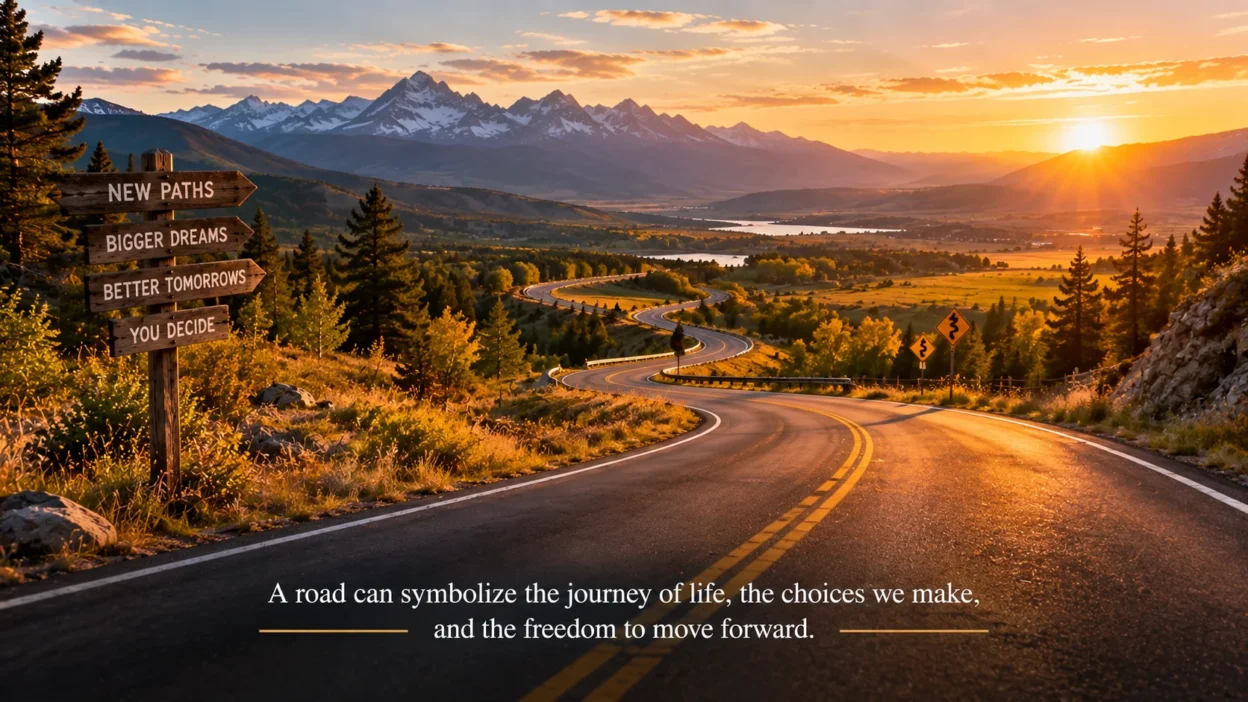
Road symbolism appears whenever a road represents more than a way to travel. A road can suggest a journey, a decision, a new beginning, or an unknown future. In stories and everyday life, the road often becomes a simple picture of where we have been and where we are going.
In the 2026, roads carry especially strong meanings. American history includes westward travel, migration, road trips, exploration, and the search for opportunity. Because of this, roads often connect ideas of freedom, independence, movement, and personal discovery.
However, a road can also represent uncertainty. A straight road may suggest direction, while a winding road can suggest a complicated life. A crossroads can represent a difficult choice, and an empty road can symbolize solitude or a fresh start.
Quick Answer
Road symbolism commonly represents journey, freedom, choice, change, and personal growth in the United States. More broadly, roads can symbolize the passage through life, movement between stages, and the unknown path ahead.
TL;DR
- Roads often represent life journeys and personal growth.
- American roads strongly connect with freedom and independence.
- Crossroads can symbolize choices, uncertainty, and turning points.
- Winding roads may suggest challenges or complicated life paths.
- Empty roads can represent solitude, possibility, or new beginnings.
- Today, road imagery appears in tattoos, art, photography, and stories.
What Does a Road Symbolize?
A road is one of the simplest symbols because almost everyone understands movement. When a person travels from one place to another, the road becomes a visible connection between two points.
However, symbolism adds another layer. The beginning can represent the past, while the destination can represent a goal or future.
Journey and Progress
The most common meaning is the journey itself. A road can represent the experiences that happen between a starting point and a destination.
For example, a person might describe education, career development, or personal change as a “road.” The expression suggests that progress happens over time rather than all at once.
Choice and Direction
Roads also represent decisions. When several roads lead in different directions, each path can suggest a different possibility.
Common associations include:
• Choosing between different life directions
• Moving toward a personal goal
• Leaving familiar surroundings behind
• Accepting uncertainty and change
• Discovering an unexpected opportunity
Historical Roots of Road Symbolism
Road symbolism is much older than modern highways. Ancient societies depended on paths and roads for trade, travel, migration, military movement, and religious journeys.
Because roads connected distant places, people naturally began connecting them with movement through life.
Ancient Roads and Sacred Journeys
In the ancient world, roads could have practical and sacred roles. Pilgrims traveled toward temples, shrines, sacred landscapes, and important religious centers.
The journey itself could therefore become meaningful. Reaching a destination mattered, but the experience of traveling there could also represent devotion, transformation, or preparation.
Roads in Myth and Story
Stories from many cultures use journeys as a way to describe personal change. A character leaves home, faces obstacles, meets unfamiliar people, and eventually returns changed.
This pattern helped create a lasting connection between roads and personal development. The physical journey becomes a picture of an inner journey.
Road Symbolism in American History
In the United States, roads developed powerful cultural meanings through exploration, migration, settlement, commerce, and transportation.
The road became more than infrastructure. It became part of the American imagination.
Westward Movement
During different periods of American history, roads and trails connected established communities with new territories. Travel westward became associated with opportunity, movement, and uncertainty.
However, this history also involved Indigenous displacement, conflict, environmental change, and unequal experiences. Road symbolism should therefore not reduce this complicated history to a simple story of adventure.
The American Road Trip
The automobile transformed road symbolism during the twentieth century. Long-distance driving became a familiar part of American culture.
Road trips often suggest independence because travelers can choose their route, stops, companions, and destination. As a result, the open road became strongly connected with freedom and self-discovery.
What Does the Open Road Symbolize?
The open road usually represents possibility. When a road stretches into a wide landscape without obvious barriers, it can create a feeling of freedom and movement.
This image became particularly powerful in American culture through travel writing, photography, music, movies, and everyday road-trip experiences.
Freedom and Independence
An open road can suggest that the future remains open. You may not know exactly where you will end up, but you have room to choose your direction.
For many Americans, this imagery connects with independence and the desire to create a personal path.
Escape and New Beginnings
The open road can also symbolize leaving something behind. A person driving away from an old home may represent a fresh start.
However, this meaning isn’t always positive. Leaving can involve loneliness, uncertainty, financial pressure, or emotional loss.
What Does a Crossroads Symbolize?
A crossroads is one of the clearest forms of road symbolism. It shows several possible directions meeting in one place.
Because of this, crossroads often represent decisions and turning points.
Choice and Uncertainty
A crossroads can appear when someone must make an important decision. Each direction represents a possible future.
The symbol works well because the choice is visible. You can imagine standing there and asking which path to follow.
Spiritual and Cultural Meanings
Crossroads have also appeared in religious traditions, folklore, myths, and spiritual practices. Their meanings vary greatly between cultures.
Some traditions connect crossroads with transformation, encounters, protection, or spiritual boundaries. These meanings shouldn’t be treated as universal because different cultures interpret the symbol differently.
Straight Roads, Winding Roads, and Curves
The physical shape of a road can change its symbolic meaning. A straight road usually feels predictable, while a winding road creates a stronger sense of uncertainty.
This makes road shape useful in art, photography, tattoos, and storytelling.
Common Road Shapes and Meanings
| Road Form | Meaning in the USA | Common Associations | Notes |
| Straight road | Direction and progress | Focus, certainty, goals | Often suggests a clear path |
| Winding road | Complexity and change | Growth, challenge, discovery | The destination may remain uncertain |
| Crossroads | Choice and transition | Decisions, opportunity, turning points | Often represents competing possibilities |
| Empty road | Freedom or solitude | Escape, independence, reflection | Meaning depends strongly on context |
| Broken road | Difficulty and recovery | Struggle, resilience, healing | Can suggest an interrupted journey |
The Winding Road
A winding road often represents a life that doesn’t follow a simple plan. Its curves can suggest unexpected experiences and changing circumstances.
Because you can’t see the entire route, the image also encourages patience. You only need to understand the section directly ahead.
The Straight Road
A straight road often suggests purpose and determination. It can represent someone who knows where they want to go.
Still, a straight road doesn’t always mean an easy journey. Obstacles can exist even when the direction appears clear.
The Spiritual Meaning of Roads
Roads can have spiritual meanings because journeys often represent transformation. A person may begin with one understanding of life and finish with another.
In spiritual traditions, pilgrimage provides one important example. Traveling toward a meaningful destination can represent devotion, reflection, discipline, or renewal.
A Path Through Life
Many spiritual teachings use the idea of a path to describe how a person lives. The road becomes a metaphor for choices, values, lessons, and personal responsibility.
However, the exact meaning depends on the tradition. There isn’t one universal spiritual interpretation of a road.
Cross-Cultural Perspectives
Road and path imagery appears in many parts of the world. Some traditions emphasize moral direction, while others focus on pilgrimage, fate, transformation, or the relationship between people and the natural world.
These similarities show how travel can become a powerful human metaphor. At the same time, each cultural interpretation deserves its own context.
Emotional and Psychological Meaning of Roads
Road imagery can trigger strong emotions because people naturally connect travel with change. A familiar road may feel safe, while an unfamiliar one can create excitement or anxiety.
Therefore, the same road can mean different things to different people.
Positive Associations
A bright road leading toward a wide horizon often suggests hope. It can create feelings of freedom, confidence, curiosity, and possibility.
Common emotional associations include:
• Hope for a different future
• Excitement about discovering something new
• Confidence about moving forward
• Relief after leaving a difficult period
• Curiosity about what lies ahead
More Difficult Associations
Roads can also symbolize loneliness or uncertainty. A dark, empty road may create an entirely different emotional response from a sunny highway.
The surrounding environment matters. Weather, lighting, road condition, and destination can completely change the message.
Road Symbolism in Tattoos and Personal Identity
Road tattoos often represent personal journeys. Someone may choose a road because it reflects growth, independence, travel, or an important period of change.
The design can become more personal when combined with other symbols.
Common Tattoo Combinations
A road may appear with mountains, trees, compasses, sunsets, vehicles, or meaningful words. Each addition changes the overall message.
For example, a road toward mountains can suggest ambition and endurance. A road disappearing into a sunset may emphasize endings, reflection, or a new chapter.
Why Road Tattoos Feel Personal
Unlike a symbol with one fixed meaning, a road can represent an individual’s own story. The person can decide what the starting point and destination mean.
That flexibility makes road imagery useful for marking major life transitions.
Roads in Photography, Art, and Popular Culture
Roads are powerful visual subjects because they naturally create depth. Lines on the pavement guide the viewer’s eyes toward the distance.
As a result, roads frequently appear in landscape photography, movie scenes, album artwork, posters, and personal travel photos.
The Road as a Story Device
In stories, a road can introduce movement. A character leaves one place and enters another, creating opportunities for conflict and discovery.
The road can also represent the story itself. Every stop becomes another chapter.
Social Media and Travel Imagery
Today, road photographs often appear alongside messages about adventure, freedom, motivation, and personal change.
However, social media can simplify complex experiences. A beautiful highway photograph may suggest effortless freedom even when real travel involves stress, cost, fatigue, and uncertainty.
Roads in American Decor and Everyday Life
Road imagery also appears in American homes, offices, garages, travel spaces, and recreational settings.
Vintage road signs, highway-inspired artwork, maps, and landscape prints can create feelings of nostalgia and adventure.
Nostalgia and Memory
For many people, a road is connected to childhood vacations, family trips, college moves, or visits to relatives.
Therefore, road decor doesn’t always symbolize freedom. Sometimes it represents memory and connection.
Rural and Western Associations
Open roads can also evoke rural landscapes, ranches, deserts, mountains, and small towns. In American visual culture, these settings often reinforce ideas of independence and wide-open space.
Still, these associations are cultural patterns rather than rules. Individual experiences can produce very different meanings.
Negative Meanings and Misunderstandings
Road symbolism is usually flexible, but its meaning can become darker depending on context.
An abandoned or damaged road may represent loss, isolation, failure, or uncertainty. A dangerous road may suggest risk or poor choices.
When Context Changes Meaning
A road at sunrise usually creates a different impression from a road during a storm. Likewise, a crowded highway suggests a different experience from an empty rural route.
The most useful approach is to examine the entire image rather than assigning one fixed meaning.
Historical and Cultural Context
Some road imagery may also connect with specific historical events, migrations, conflicts, or cultural movements. In these cases, context matters more than a general dictionary-style definition.
Road symbolism should therefore be interpreted alongside the people, place, and period involved.
Read More: Journey Symbolism: Meaning, History, and Modern Uses
How Road Symbolism Has Changed Over Time
The meaning of roads has evolved as transportation and American society changed.
Ancient paths were often linked to survival, trade, pilgrimage, and migration. Later, roads became connected with exploration, commerce, automobiles, tourism, and personal freedom.
From Survival to Self-Discovery
For early travelers, reaching another settlement could be essential for food, trade, safety, or community.
Today, people may travel simply for experience. Because of this shift, roads increasingly represent leisure, adventure, independence, and self-discovery.
The Digital Age
Modern technology has changed how people experience roads. Navigation apps can show routes instantly, while social media allows travelers to share journeys immediately.
Yet the symbolic idea remains familiar. Even with digital maps, people still describe life as a path and major decisions as crossroads.
Why Road Symbolism Still Matters Today
Roads remain powerful because movement is part of ordinary human life. People change jobs, move homes, start relationships, leave communities, travel, and begin new stages.
The road provides a simple image for all these changes.
A Symbol of Possibility
A road doesn’t tell you exactly what the future will bring. Instead, it suggests that movement is possible.
That openness explains why road imagery can feel hopeful without promising a particular outcome.
A Reminder of the Journey
Road symbolism also shifts attention away from the destination. Sometimes the important part is what happens along the way.
For many modern readers, this makes the road a useful symbol of patience, growth, uncertainty, and continued movement.
FAQs
What does a road symbolize spiritually?
A road can symbolize a spiritual journey, personal transformation, pilgrimage, or movement toward greater understanding. However, spiritual meanings vary across traditions.
What does an open road symbolize?
An open road commonly represents freedom, independence, possibility, and adventure. It can also represent uncertainty because the destination may not be visible.
What does a road symbolize in dreams?
Roads in dreams are often interpreted as images of direction, choices, or life changes. The road’s condition and the dreamer’s feelings can change the interpretation considerably.
What does a crossroads symbolize?
A crossroads commonly symbolizes an important choice or turning point. It can suggest that several possible futures are available.
What does a winding road symbolize?
A winding road can represent an unpredictable life journey, challenges, discovery, and personal growth. Its curves suggest that the entire path isn’t visible at once.
Why are roads important in American symbolism?
Roads connect strongly with American ideas of travel, independence, migration, exploration, and the open road. The automobile and road-trip traditions strengthened these associations during the twentieth century.
Conclusion
Road symbolism brings together some of the most familiar experiences of human life: movement, choice, change, uncertainty, and discovery. In the United States, roads also carry strong associations with freedom, independence, travel, and the search for new possibilities. A road can mean different things depending on its shape, setting, direction, and emotional context. A straight highway may suggest purpose, while a winding trail may represent discovery. A crossroads may capture a difficult decision, while an empty road may invite reflection. Ultimately, Road Symbolism works because everyone has a journey of some kind. Whether the road represents a physical adventure or a personal turning point, its meaning often comes from where you’ve been, where you are now, and where you hope to go next.