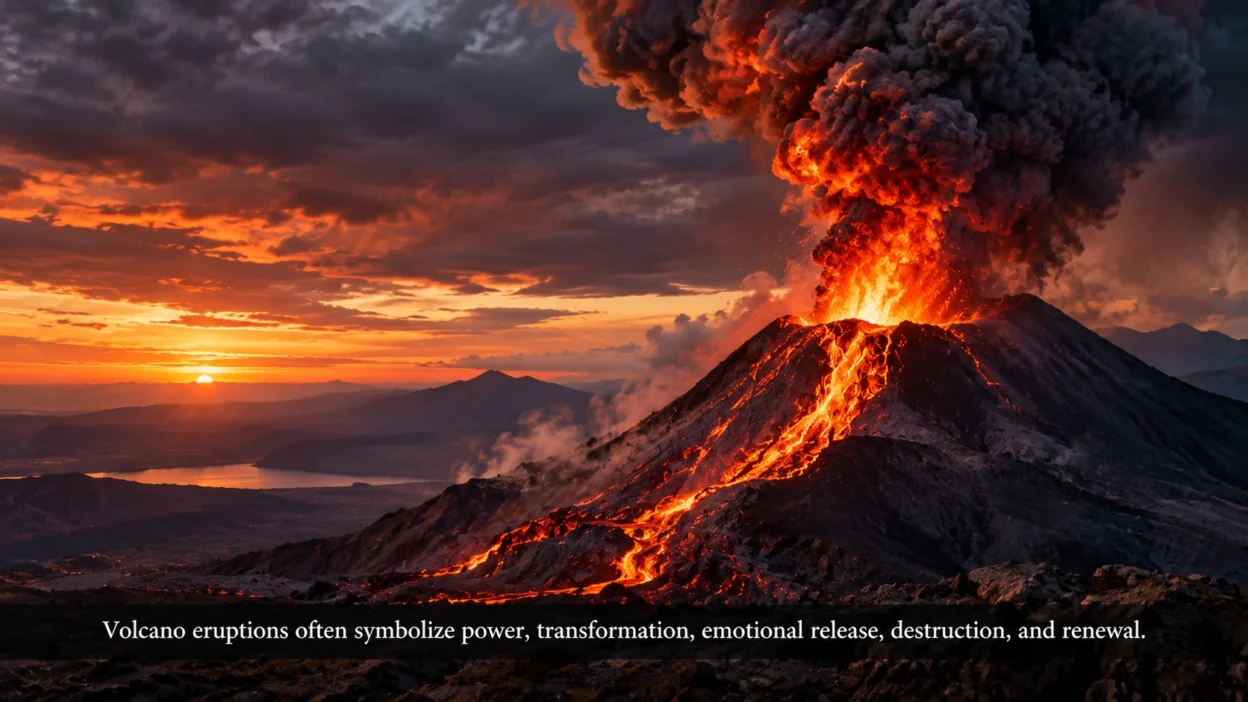
A volcano can look like nature breaking its own rules. Volcano Eruption Symbolism often connects this dramatic event with power, transformation, release, destruction, and rebirth. Lava rises from deep underground, breaks through solid rock, and changes the landscape around it.
In the United States, volcanoes also carry strong ideas about wilderness and natural power. Places such as Hawaii, Alaska, and the Pacific Northwest have helped shape American views of volcanic landscapes.
However, an eruption can mean more than danger. It can represent emotions that remain hidden until they finally surface. It can also suggest the end of one stage and the beginning of another.
Quick Answer
Volcano Eruption Symbolism in the USA commonly represents power, sudden change, emotional release, destruction, transformation, and renewal. More broadly, volcanoes can symbolize the tension between hidden forces and visible change.
TL;DR
- Volcanoes symbolize powerful forces that remain hidden beneath the surface.
- Eruptions can represent emotional release after long periods of pressure.
- Lava often suggests destruction followed by transformation and new growth.
- American volcano imagery connects strongly with wilderness and natural power.
- Ancient traditions often linked volcanoes with gods, fire, creation, and destruction.
- Today, volcano imagery appears in tattoos, art, media, and personal symbolism.
What Does a Volcano Eruption Symbolize?
A volcanic eruption combines several powerful images into one event. Fire, smoke, mountains, darkness, movement, and molten rock all contribute to its meaning.
For American readers, the symbol can feel especially connected to dramatic landscapes and uncontrollable natural forces. At the same time, its meaning often becomes personal.
The Main Symbolic Meanings
Common interpretations include:
- Power that cannot remain hidden forever
- Transformation through intense change
- Release after pressure builds
- Destruction that clears the way for something new
- Renewal after a difficult ending
- Passion expressed with unusual force
The meaning depends heavily on context. A peaceful volcano in artwork may suggest strength, while an explosive eruption may suggest anger or upheaval.
The Ancient Roots of Volcano Symbolism
Long before modern geology, people saw eruptions as mysterious supernatural events. They could hear explosions, see glowing rock, and watch smoke rise from mountains.
Because people lacked scientific explanations, many cultures connected volcanic activity with powerful beings or sacred forces. These stories helped communities understand frightening landscapes.
Fire, Mountains, and Sacred Power
Mountains often had symbolic importance because they seemed to connect earth and sky. A mountain that suddenly produced fire could therefore appear especially sacred or powerful.
Ancient stories from Mediterranean cultures associated volcanic landscapes with divine or supernatural activity. In Greek mythology, the god Hephaestus was connected with fire, metalworking, and volcanic imagery.
However, volcano traditions were never limited to one culture. Indigenous peoples in volcanic regions developed their own stories and relationships with mountains, land, fire, and natural forces.
From Mystery to Natural Science
Over time, scientific knowledge changed how people understood eruptions. Volcanic activity became associated with magma, pressure, gases, tectonic movement, and geological processes.
Yet scientific explanations didn’t completely remove symbolism. Instead, they added another layer.
Today, people can understand why an eruption happens while still seeing it as an image of dramatic change.
Volcano Symbolism in the United States
The United States contains several important volcanic regions. Hawaii, Alaska, and parts of the western mainland have especially strong volcanic landscapes.
As a result, American culture often presents volcanoes through a mixture of science, adventure, wilderness, danger, and awe.
American Wilderness and Natural Power
In the USA, volcanoes can represent the idea that nature remains larger than human control. This fits a broader American fascination with vast landscapes.
National parks and protected volcanic areas also turn volcanoes into symbols of exploration and natural heritage.
For many people, seeing a volcano isn’t only frightening. It can create wonder because it reveals forces normally hidden beneath ordinary ground.
Hawaii and Volcanic Identity
Hawaii has especially strong connections with volcanic landscapes. Its islands were shaped by volcanic activity over immense periods.
However, Hawaiian cultural traditions should not be reduced to a simple “volcano equals destruction” idea. Volcanoes exist within broader relationships involving land, ancestry, nature, place, and cultural tradition.
Therefore, visitors should treat Hawaiian volcanic symbolism with respect rather than using sacred traditions as decorative shortcuts.
Volcanoes in Mythology and Spiritual Traditions
Volcanic imagery appears in many spiritual and mythological settings. The details differ widely, so no single meaning applies everywhere.
Some traditions emphasize creation and fertility. Others focus on danger, divine power, destruction, purification, or the relationship between humans and the natural world.
Creation and Destruction
A volcano can destroy homes and landscapes. Yet volcanic material can eventually contribute to fertile soil and new ecosystems.
This creates one of the strongest symbolic contrasts.
Something can destroy one form of life while helping create conditions for another. Because of this, volcanoes often represent cycles rather than simple endings.
Fire as Transformation
Fire frequently represents change. It consumes, reshapes, and produces heat.
A volcanic eruption intensifies this idea because the fire comes from beneath the earth itself. Symbolically, that can suggest transformation beginning deep inside before becoming visible.
The Emotional Meaning of a Volcano Eruption
Volcanoes can serve as powerful metaphors for human emotions. Pressure may build quietly for a long time before becoming visible.
For that reason, an eruption often represents feelings that have been suppressed, ignored, or delayed.
Anger and Emotional Release
A person may describe intense anger as “erupting.” This everyday expression shows how naturally people connect volcanoes with emotional pressure.
The image can suggest a moment when someone can no longer contain what they feel.
However, volcanic symbolism doesn’t always represent anger. It can also describe excitement, passion, creativity, grief, or relief.
Inner Pressure
The mountain appears calm from the outside while tremendous forces exist underneath.
That contrast makes it a useful symbol for hidden emotions.
Someone using volcano imagery may be expressing the idea that their inner world is much more intense than it appears.
The Psychological Meaning of Volcano Imagery
Volcano symbols can also reflect personal experiences of change. Their meaning often depends on whether the viewer focuses on danger, release, destruction, or renewal.
A person recovering from a difficult period may see an eruption differently from someone experiencing emotional instability.
A Symbol of Breaking Through
An eruption breaks through the surface. Symbolically, this can represent finally confronting something that has been hidden.
It may suggest speaking honestly, changing direction, or leaving an unhealthy situation behind.
A Symbol of Controlled Power
Volcano imagery can also express strength without suggesting aggression.
A quiet volcanic mountain may communicate potential. The eruption then represents that potential becoming visible.
| Context | Meaning in the USA | Common Associations | Notes |
| Erupting volcano | Sudden power and major change | Energy, danger, transformation | Often emotionally intense |
| Glowing lava | Passion and movement | Fire, creativity, desire | Can suggest strong emotions |
| Dormant volcano | Hidden potential | Patience, pressure, possibility | Focuses on what lies beneath |
| Volcanic mountain | Strength and endurance | Wilderness, stability, nature | Often appears in landscape art |
| New land after eruption | Renewal and recovery | Growth, rebirth, resilience | Highlights transformation |
Volcano Eruption Symbolism in Tattoos
Volcano tattoos often carry deeply personal meanings. Some people choose them because an eruption represents surviving pressure and becoming stronger afterward.
Others use the image to express passion, independence, or a major life transformation.
Common Tattoo Designs
Volcano tattoos can appear in many styles, including:
- A mountain releasing bright lava into a dark sky
- Small volcanic landscapes representing personal growth
- Lava flowing into flowers, trees, or new vegetation
- Minimalist volcano outlines representing quiet inner strength
- Explosive designs symbolizing freedom from emotional pressure
The surrounding imagery can change the message significantly.
For example, flowers may emphasize renewal, while smoke and flames may emphasize emotional intensity.
Volcanoes in Art, Media, and Social Media
Volcano imagery works well in visual culture because it creates immediate drama. The contrast between dark mountains and glowing lava is especially striking.
In American movies, games, illustrations, and online posts, eruptions often represent danger or an approaching crisis.
The Metaphor of “Erupting”
Social media users sometimes use volcanic language to describe emotions or events. Someone may describe creativity, excitement, anger, or public attention as “erupting.”
However, these uses are usually metaphorical rather than references to traditional cultural symbolism.
Pop Culture Associations
Modern entertainment often portrays volcanoes as symbols of disaster. This can make the destructive meaning more familiar than the regenerative one.
Still, artists and writers frequently return to the deeper contrast between destruction and renewal.
The Meaning of Lava, Smoke, and Fire
A volcano isn’t one symbol. Its individual elements can carry different meanings.
The glowing lava, rising smoke, mountain shape, and surrounding darkness each contribute to the overall emotional effect.
Lava Symbolism
Lava commonly suggests energy that has become visible.
Because it moves slowly but remains extremely powerful, it can symbolize determination, passion, or unstoppable change.
Smoke Symbolism
Smoke can suggest uncertainty because it hides what is happening inside the mountain.
It may also represent mystery, confusion, aftermath, or the transition between destruction and recovery.
Fire Symbolism
Fire often adds emotional intensity.
In volcano imagery, it can suggest passion, courage, anger, creativity, purification, or transformation.
What Does a Volcano Mean in Dreams?
Volcano dreams are often interpreted symbolically rather than as fixed predictions. The dreamer’s personal experience matters more than any universal dream dictionary.
A quiet volcano might represent potential or unresolved pressure. An eruption could represent overwhelming emotions or a major change.
Different Dream Images
A dream involving volcanic imagery might focus on:
- An eruption as emotional release
- Lava as intense passion or unstoppable change
- A dormant mountain as hidden potential
- Escaping an eruption as fear of sudden disruption
- New land as recovery after hardship
These interpretations aren’t rules. A volcano dream can also simply reflect recent memories, media, travel, or personal experiences.
Volcano Symbolism in Nature and Renewal
One of the most interesting parts of volcanic symbolism is its connection with renewal. An eruption can radically change an environment, yet volcanic landscapes can later support new life.
This creates a powerful metaphor for recovery.
Destruction Before Growth
People often prefer symbols that represent growth without acknowledging difficulty. Volcanoes offer a different message.
They suggest that transformation can be messy. Sometimes an old landscape must change before a new one can develop.
Resilience
For American audiences, this can connect with ideas of rebuilding after natural disasters and personal hardship.
The volcano therefore becomes more than a symbol of destruction. It can represent endurance after disruption.
Misunderstandings and Controversies
Volcano imagery itself is generally not a hateful or inherently controversial symbol. However, problems can appear when people borrow sacred cultural traditions without understanding them.
This is particularly important with Indigenous and Hawaiian cultural traditions.
Avoiding Oversimplification
It isn’t accurate to claim that every culture sees volcanoes in exactly the same way.
Meanings vary according to community, history, religion, geography, and personal experience.
Similarly, describing a culturally important volcano only as a tourist attraction can ignore deeper relationships with land and tradition.
Symbolism Versus Reality
Another common misunderstanding is treating symbolic interpretations as scientific explanations.
A volcano can symbolize anger or rebirth without literally representing those concepts. Symbolism describes human meaning, not geological processes.
How Volcano Symbolism Has Changed Over Time
The meaning of volcanoes has shifted as human knowledge has changed.
Ancient communities often viewed eruptions through mythology, religion, and sacred geography. Later societies increasingly explained them through geology.
From Divine Mystery to Natural Wonder
Scientific knowledge transformed the way people understand volcanic activity.
However, the emotional response remained remarkably strong. Awe, fear, curiosity, and respect still shape how people view erupting volcanoes.
From Destruction to Transformation
Modern symbolism also gives more attention to recovery.
Instead of seeing an eruption only as disaster, many people now use it as a metaphor for personal transformation. This shift makes volcano imagery useful in stories about change and resilience.
Why Volcano Eruption Symbolism Still Matters Today
Volcanoes remain powerful symbols because they combine opposites. They are mountains, yet they move. They can destroy, yet they can contribute to renewal.
For American readers, they also connect with wilderness, exploration, environmental awareness, disaster stories, and dramatic landscapes.
A Symbol of Hidden Energy
A volcano reminds us that visible calm doesn’t always mean nothing is happening.
Underneath a quiet surface, powerful forces may be changing the landscape.
Read More: Fireplace Symbolism: Meaning, History, and Modern Use
A Symbol of Personal Change
For someone facing a major transition, the eruption can represent a breaking point or breakthrough.
It can say, in simple terms, that change may be frightening while still creating a new beginning.
FAQs
What does a volcano symbolize spiritually?
A volcano can symbolize transformation, powerful natural forces, creation, destruction, and renewal. Spiritual interpretations vary greatly between cultures and individual beliefs.
What does an erupting volcano symbolize in dreams?
An erupting volcano may represent intense emotions, pressure, sudden change, or emotional release. However, dream meaning depends strongly on the person’s circumstances and feelings.
What does lava symbolize?
Lava often symbolizes passion, energy, transformation, and unstoppable movement. Its meaning can become more positive when it appears alongside new growth or rebuilding.
What does a dormant volcano symbolize?
A dormant volcano can represent hidden potential, restrained power, patience, or emotions beneath the surface. It suggests that something powerful exists even when nothing appears to be happening.
Are volcanoes symbols of destruction or rebirth?
They can represent both. An eruption destroys existing landscapes, while volcanic environments can eventually support new ecosystems and growth.
Why are volcanoes popular in tattoos?
Volcano tattoos can express personal power, emotional release, survival, passion, transformation, or overcoming pressure. The surrounding design often determines which meaning becomes strongest.
Conclusion
Volcano Eruption Symbolism brings together ideas of power, pressure, emotional release, destruction, transformation, and renewal. Its strongest message often comes from the contrast between what happens beneath the surface and what eventually becomes visible. Today, the symbol can become deeply personal. Whether it represents a breakthrough, a difficult transition, intense creativity, or a fresh beginning, the volcano reminds us that change can reshape the landscape without ending the story.