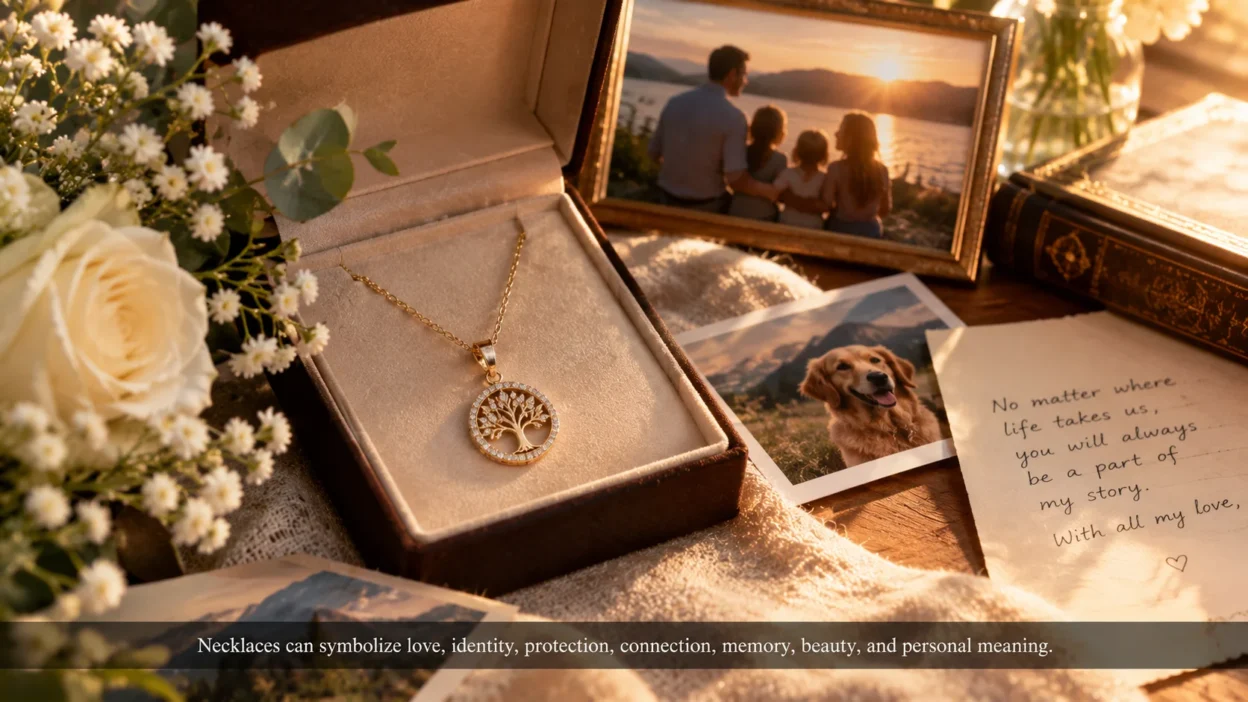
A necklace is more than an ornament worn around the neck. Necklace symbolism can express love, identity, family connection, protection, memory, status, beauty, or personal beliefs.
In 21st century , necklaces appear in everyday fashion and important life moments. People give them as birthday gifts, wedding presents, graduation keepsakes, and family heirlooms. Because they sit close to the heart and body, they can also feel deeply personal.
However, the meaning of a necklace depends on its design, material, and context. A simple chain can suggest elegance, while a pendant may carry a religious, emotional, cultural, or personal message.
Quick Answer
Necklace symbolism in the USA commonly represents love, connection, identity, beauty, remembrance, and protection. Across cultures, necklaces can also express spirituality, social status, family heritage, or belonging.
TL;DR
- Necklaces often symbolize love, connection, identity, and personal expression.
- Ancient necklaces served decorative, social, protective, and spiritual purposes.
- American culture connects necklaces with gifts, milestones, family, and fashion.
- Pendants often make a necklace’s meaning more specific.
- Materials such as gold, silver, pearls, and stones add symbolic layers.
- Today, necklaces can preserve memories while expressing individual identity.
What Does a Necklace Symbolize?
A necklace usually symbolizes something personal because it stays close to the body. Its meaning can come from the necklace itself or from the reason someone wears it.
For example, a heart pendant often suggests romantic love. A family pendant may represent heritage, while a cross or other sacred symbol can express religious identity.
Common Necklace Meanings
Several meanings appear repeatedly in American culture:
• Love and affection between romantic partners or family members.
• Connection between people, generations, communities, or shared experiences.
• Personal identity expressed through symbols, materials, and design.
• Protection represented through meaningful pendants or traditional charms.
• Remembrance of a person, place, event, or important period.
• Beauty and self-expression through fashion and personal style.
The context matters just as much as the design. A necklace purchased for yourself can communicate something different from one inherited from a grandparent.
History of Necklace Symbolism
Necklaces have an extremely long history. Archaeological evidence shows that humans wore personal ornaments thousands of years before modern jewelry existed.
Early necklaces could contain shells, teeth, bones, stones, seeds, beads, or other natural materials. These objects were not always purely decorative. They could communicate status, group identity, spiritual beliefs, or connections with the natural world.
Ancient Roots
In ancient societies, jewelry often marked social position. Precious materials could demonstrate wealth, authority, or access to resources.
However, necklaces could also have protective purposes. Amulets and pendants were worn close to the body because people in many cultures believed meaningful objects could offer spiritual protection or good fortune.
From Status to Personal Meaning
Over time, necklaces became increasingly connected with fashion and individual expression. European jewelry traditions later influenced American styles through migration, trade, manufacturing, and changing fashion trends.
Today, expensive materials can still communicate wealth. However, a handmade necklace or inexpensive pendant can carry just as much emotional meaning.
Necklace Symbolism in American Culture
In the United States, necklaces appear in both ordinary life and major personal milestones. Their meaning often depends on relationships, memories, and individual style.
Gift-giving plays an especially important role. A necklace may mark a birthday, anniversary, graduation, engagement, Mother’s Day, or another meaningful occasion.
What Necklaces Can Represent in America
| Context | Meaning in the USA | Common Associations | Notes |
| Romantic gift | Love and affection | Hearts, initials, birthstones | Often connected with relationships |
| Family heirloom | Heritage and remembrance | Lockets, pearls, inherited jewelry | Meaning can span generations |
| Graduation gift | Achievement and transition | Pendants, initials, gemstones | Marks an important life change |
| Religious necklace | Faith and identity | Crosses, stars, sacred symbols | Meaning depends on tradition |
| Everyday fashion | Beauty and self-expression | Chains, charms, layered necklaces | Often reflects personal style |
American media and popular culture have also made necklaces familiar symbols of romance and status. A pendant may become memorable because it appears in a film, music video, photograph, or celebrity fashion trend.
Still, people don’t need a famous design to give a necklace meaning. Personal experience often matters more than public popularity.
Spiritual Meaning of Necklaces
Necklaces can carry spiritual meanings in many cultures and religious traditions. However, there isn’t one universal spiritual meaning for every necklace.
A pendant may represent faith, protection, devotion, remembrance, or a connection with a sacred tradition. The meaning usually comes from the symbol placed on the necklace.
Religious and Sacred Pendants
Crosses, sacred names, religious figures, stars, and other spiritual symbols can be worn as expressions of faith or identity.
In some traditions, jewelry may also function as a reminder of religious teachings. Wearing it close to the body can create a personal connection with those beliefs.
Protective Traditions
Amulets and protective pendants appear throughout human history. Different cultures have used particular shapes, materials, inscriptions, or sacred images for this purpose.
These traditions should be understood within their own cultural settings. A symbol that represents protection in one community may have a different meaning elsewhere.
Necklace Symbolism by Material
The material of a necklace can strongly influence its symbolism. Gold, silver, pearls, gemstones, wood, shells, and beads all carry different associations.
Gold Necklaces
Gold is commonly associated with wealth, achievement, warmth, luxury, and lasting value. In American culture, gold jewelry can also mark weddings, anniversaries, and major milestones.
Because gold resists corrosion, people have long connected it with durability and permanence. That association makes it especially suitable for heirlooms and meaningful gifts.
Silver Necklaces
Silver often suggests elegance, simplicity, clarity, and modern style. Its cooler appearance gives silver jewelry a different visual character from warm-toned gold.
Today, silver necklaces are common in casual and formal fashion. Their versatility can make them symbols of understated personal expression.
Pearl Necklaces
Pearls commonly symbolize beauty, purity, wisdom, femininity, and refinement. In the USA, pearl necklaces are especially associated with formal events, weddings, classic fashion, and family jewelry.
Because pearls develop inside living oysters, they can also suggest patience and transformation. Their smooth appearance contrasts with their natural origin.
Gemstone Necklaces
Gemstones can add another layer of personal symbolism. Birthstones, for example, can connect jewelry with birthdays, family relationships, and individual identity.
The meaning also depends on the stone. Emeralds can suggest renewal, while rubies often represent passion and courage. Amethyst is commonly associated with peace and spirituality.
Necklace Symbolism in Relationships
Necklaces frequently become symbols of relationships because they are easy to personalize. Initials, names, dates, birthstones, and photographs can transform ordinary jewelry into a personal keepsake.
Romantic Relationships
A necklace can represent affection, commitment, devotion, or intimacy. Heart pendants and engraved pieces make these meanings especially direct.
However, a necklace doesn’t automatically prove the nature of a relationship. Its meaning comes from the people involved and the circumstances surrounding the gift.
Family Connections
Family necklaces can represent belonging and shared history. Lockets are especially meaningful because they can hold photographs or other tiny keepsakes.
An inherited necklace can become a physical reminder of someone who has passed away. In this way, jewelry can connect the present with earlier generations.
Friendship and Shared Memories
Friends may exchange necklaces to celebrate long-lasting connections. Matching charms or personalized pendants can represent shared experiences without carrying romantic meaning.
For many people, the emotional value comes from the story behind the jewelry rather than its monetary worth.
Emotional and Psychological Meaning
Necklaces can carry strong emotional associations because people often attach memories to objects they wear repeatedly.
A necklace received during an important moment may later remind someone of that experience. As a result, ordinary jewelry can become a personal memory object.
Why Necklaces Feel Personal
Several qualities make necklaces emotionally significant:
• They remain physically close to the wearer throughout the day.
• Gifts can connect the object with a specific person or moment.
• Personalized designs can reinforce individual identity and belonging.
• Familiar jewelry can provide a sense of comfort and continuity.
• Heirlooms can create emotional links between different generations.
However, these responses vary between individuals. One person may see a necklace as sentimental, while another may view it mainly as fashion.
Necklace Symbolism in Fashion and Identity
Modern necklaces offer countless ways to communicate personal style. People can choose delicate chains, bold pendants, layered pieces, chokers, pearls, beads, or minimalist designs.
Self-Expression
A necklace can complement clothing while also communicating interests or values. Initials may highlight identity, while cultural or religious symbols can communicate belonging.
Layered necklaces can also combine different stories. Someone might wear a family pendant with a birthstone and a simple everyday chain.
Social Media and Modern Style
Necklaces are highly visible in photographs and videos. As a result, fashion trends can quickly influence popular necklace styles.
However, social media can also encourage highly personalized jewelry. Name necklaces, zodiac designs, birthstones, initials, and symbolic charms allow people to create recognizable personal styles.
Necklace Symbolism in Tattoos, Art, and Media
Necklaces appear beyond physical jewelry. Artists, filmmakers, writers, and tattoo designers often use them as storytelling devices.
A necklace in a story may identify a character’s family history or reveal a hidden connection. A lost necklace can symbolize separation, while an inherited piece may represent memory.
Necklace Tattoos
A necklace tattoo can create the appearance of permanent jewelry. Some designs use chains, beads, flowers, gemstones, or meaningful pendants.
For some people, this represents identity or permanence. For others, it simply offers a decorative alternative to traditional jewelry.
Symbolism in Stories
A necklace can function as a powerful object in fiction because it can move between characters. Its physical journey can represent relationships, secrets, inheritance, or personal transformation.
This makes necklaces useful symbols even when the object itself has little monetary value.
Necklace Symbolism and Important Life Events
Necklaces often become meaningful during major transitions. A gift can turn jewelry into a marker of a particular moment.
Graduations, birthdays, weddings, anniversaries, and family celebrations are common occasions for meaningful necklaces in the United States.
Milestones and Memory
A necklace given at graduation can represent achievement and a new beginning. An anniversary necklace can symbolize years of shared experiences.
Similarly, a necklace passed through a family may represent continuity. Its meaning can grow as each generation adds another chapter to its story.
Cross-Cultural Meanings of Necklaces
Necklaces have appeared across societies for thousands of years, but their meanings aren’t identical everywhere.
In some cultures, jewelry communicates marriage, age, social position, family heritage, or community identity. Elsewhere, necklaces may have stronger religious or protective associations.
Shared Human Themes
Despite cultural differences, several themes appear repeatedly:
• Jewelry can communicate belonging within a community.
• Precious materials can represent value, achievement, or social position.
• Protective objects can connect jewelry with spiritual traditions.
• Heirlooms can preserve family stories across generations.
• Personal ornaments can communicate beauty and individual identity.
These similarities don’t mean every culture interprets necklaces in the same way. Context remains essential.
Misunderstandings and Changing Meanings
A necklace usually doesn’t have one fixed meaning. The same design can communicate different things depending on the wearer, culture, and situation.
For example, a cross may represent Christian faith for one person. Another person may wear it because of family heritage, fashion, or a personal connection.
Symbols Can Be Misread
Some symbols have meanings that change across communities. Jewelry associated with a particular culture may also be misunderstood when removed from its original context.
Appropriation concerns can arise when culturally important designs are used commercially or casually without understanding their significance. However, the meaning of a particular piece depends on its history and circumstances.
Read More: Earring Symbolism: Meaning, History, and Modern Uses
Fashion Changes Meaning
A necklace that once signaled social status may later become an everyday fashion accessory. Likewise, an older style can return decades later with a new cultural meaning.
This constant change is one reason necklace symbolism remains flexible.
How Necklace Symbolism Has Changed Over Time
The history of necklaces shows a gradual movement from practical and social signaling toward increasingly personal forms of expression.
Ancient necklaces could communicate status, protection, identity, and spiritual beliefs. Later jewelry traditions continued these functions while adding stronger connections with fashion and wealth.
Today, those older meanings still exist alongside new ones. A modern necklace can simultaneously be fashionable, sentimental, spiritual, cultural, and deeply personal.
From Public Status to Private Memory
In earlier societies, jewelry could visibly communicate someone’s position within a community. Modern Americans still use jewelry to communicate status, but personal meaning has become especially important.
A modest necklace may have little financial value yet remain priceless to its owner. Its importance comes from the memory attached to it.
FAQs
What does a necklace symbolize in a relationship?
A necklace can symbolize love, affection, commitment, or emotional connection. Its exact meaning depends on the relationship and the design chosen.
What does wearing a necklace symbolize?
Wearing a necklace can express personal style, identity, faith, belonging, memory, or emotional attachment. Some people simply wear necklaces as decorative fashion.
What does a necklace symbolize spiritually?
Spiritually, a necklace may represent faith, devotion, protection, remembrance, or connection with a sacred tradition. The specific meaning depends on the symbol and religious context.
What does a necklace symbolize as a gift?
A gifted necklace often represents thoughtfulness, affection, appreciation, or remembrance. Personalized jewelry can make the emotional connection even stronger.
What does a necklace symbolize in dreams?
Dream symbolism varies greatly between individuals and traditions. A necklace might be interpreted as connection, identity, value, attachment, or something personally meaningful.
Why are necklaces important in American culture?
Necklaces combine fashion with personal meaning in American life. They frequently appear as gifts, heirlooms, milestone markers, religious expressions, and everyday accessories.
Conclusion
Necklace symbolism connects an ordinary piece of jewelry with ideas such as love, identity, protection, memory, beauty, family, and belonging. Its meaning can come from the material, pendant, history, occasion, or person who wears it. From ancient ornaments to modern personalized jewelry, necklaces have continued to evolve. Yet their central power remains familiar: they allow people to carry something meaningful close to themselves. The next time you see a necklace, look beyond its appearance. Its real story may be found in who gave it, why it was chosen, and what it means to the person wearing it.