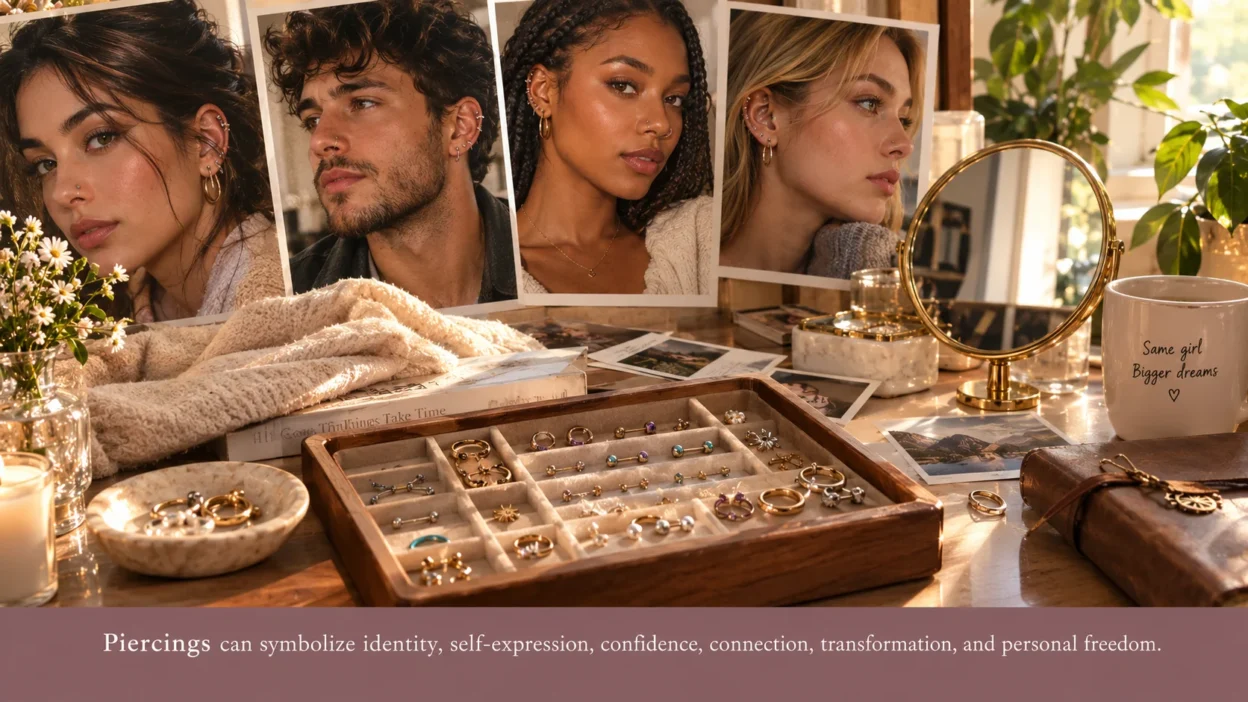
Piercing symbolism explores the meanings people attach to pierced ears, noses, lips, eyebrows, and other forms of body jewelry. In the United States, piercings often represent identity, self-expression, confidence, individuality, and personal choice.
However, piercing has never had just one meaning. Across history, people have used body jewelry to mark status, adulthood, beauty, belonging, spirituality, or cultural identity. Today, the same piercing can mean something deeply personal to one person and simply look fashionable to another.
For many people, getting pierced can also feel like a small act of control over the body. It may mark a new chapter, celebrate independence, honor a memory, or simply express personal style.
Quick Answer
Piercing symbolism in the USA commonly represents self-expression, individuality, confidence, identity, and personal freedom. In broader cultural traditions, piercings have also represented beauty, status, adulthood, spirituality, protection, and community belonging.
TL;DR
- Piercings can symbolize individuality and personal expression.
- Ancient societies used body jewelry for beauty, status, and identity.
- American culture often connects piercings with independence and personal style.
- Ear piercings commonly carry social and fashion meanings.
- Some traditions give piercings spiritual or protective meanings.
- Modern piercing culture continues to change with fashion and identity.
What Does Piercing Symbolism Mean?
Piercing symbolism depends heavily on the person, placement, jewelry, and cultural setting. A small gold stud can communicate something very different from a large decorative septum ring.
In America, people often choose piercings because they enjoy the look. However, appearance can also become a way to communicate personality without words.
Common Symbolic Meanings
Piercings can express:
- Individuality through a distinctive personal appearance.
- Confidence through visible control over personal style.
- Freedom through independent choices about appearance.
- Identity through jewelry connected to personal values.
- Transformation after entering a new stage of life.
- Belonging through shared styles within a community.
The meaning isn’t fixed. Instead, context gives the piercing its strongest message.
History of Piercing and Body Jewelry
Body piercing has a long history that reaches far beyond modern fashion. Archaeological evidence shows that humans have modified their bodies with jewelry and ornaments for thousands of years.
Ancient people used materials such as bone, shell, stone, wood, and metal. These objects could communicate social position, beauty, age, community membership, or spiritual ideas.
Ancient Roots
In ancient Egypt, jewelry could communicate wealth and social position. Earrings and other ornaments also became important forms of personal decoration.
Across parts of Asia, Africa, Europe, and the Americas, body ornaments developed in different ways. Their meanings depended on local traditions rather than one universal symbolism.
From Status to Style
Over time, piercing moved between cultural practice, ritual, fashion, and personal decoration. In some societies, particular piercings carried strong social meanings.
Modern Western culture gradually separated many piercings from their original cultural settings. By the twentieth century, piercing increasingly became associated with fashion, youth culture, music scenes, and alternative identities.
Piercing Symbolism in America
American piercing culture reflects a mixture of fashion, individuality, youth culture, and personal identity. The meaning can change depending on generation, community, location, and workplace.
Ear piercing became especially common as mainstream fashion expanded. Later, nose, eyebrow, lip, and multiple-ear piercings became more visible through music, entertainment, and changing beauty standards.
American Ideas of Individuality
The United States often places strong cultural value on personal expression. Piercings can therefore become a visible statement of individual choice.
For some people, a piercing says, “This is how I want to present myself.” For others, it simply complements clothing, hairstyles, or jewelry.
Different American Contexts
| Context | Meaning in the USA | Common Associations | Notes |
| Ear piercing | Beauty and self-expression | Fashion, tradition, femininity, style | Extremely mainstream |
| Nose piercing | Individuality and style | Creativity, independence | Increasingly visible |
| Multiple piercings | Personal identity | Alternative fashion, customization | Often highly individualized |
| Facial piercing | Bold self-expression | Confidence, creativity | Social reactions vary |
| Meaningful jewelry | Personal memory | Relationships, milestones, identity | Depends on the wearer |
American interpretations also change over time. A style once considered unconventional can eventually become ordinary fashion.
What Do Ear Piercings Symbolize?
Ear piercings are among the most familiar forms of body modification in the United States. Because they are so common, their symbolism is often softer than that of less traditional piercings.
For many people, earrings represent beauty, personal style, or cultural tradition. However, they can also mark important memories.
Family and Milestones
Parents sometimes choose ear piercing as a childhood or teenage milestone. Adults may also get their ears pierced during birthdays, graduations, or other personal transitions.
Earrings can therefore become connected to memory. A particular pair might remind someone of a loved one, celebration, relationship, or important period of life.
Jewelry as Identity
Different earrings can change the impression created by the same piercing. Hoops, studs, gemstones, and handmade pieces can communicate very different styles.
Because of this flexibility, ear piercing often represents personal expression rather than one fixed message.
What Do Nose Piercings Symbolize?
Nose piercings can carry several meanings, especially because they have both long cultural histories and modern fashion associations.
In contemporary American culture, they may suggest individuality, creativity, independence, or alternative style. However, these interpretations aren’t universal.
Traditional and Modern Meanings
Nose jewelry has deep roots in several South Asian and other cultural traditions. In some communities, nose jewelry has been connected with marriage, beauty, family traditions, or cultural identity.
Today, an American wearer may choose a nose piercing for completely different reasons. Fashion, aesthetics, self-expression, and personal preference are common motivations.
This difference matters because modern fashion can sometimes separate an object from the cultural history behind it.
Spiritual and Cross-Cultural Piercing Meanings
Piercing does not have one universal spiritual meaning. Different cultures and religions have used body modification in different ways, while some traditions have discouraged or rejected it.
In several cultural settings, body jewelry has been connected with rites of passage, beauty, social identity, or community traditions. Some practices also carry spiritual significance.
Symbolism Across Cultures
Meanings have included:
- Adulthood through physical markers of life transitions.
- Beauty through decorative jewelry and body adornment.
- Belonging through recognizable community traditions.
- Protection through objects believed to carry special significance.
- Status through expensive or distinctive materials.
- Tradition through practices passed between generations.
These meanings should be understood within their own cultural settings. A modern fashion choice shouldn’t automatically be treated as equivalent to a traditional ritual.
The Emotional Meaning of Piercing
Getting pierced can feel more meaningful than simply changing appearance. The experience may create a sense of achievement, control, or renewal.
For some people, the decision represents taking ownership of their appearance. For others, it marks a personal transition after a difficult or important period.
Why Piercings Can Feel Empowering
Body modification can provide a visible sense of choice. A person decides what to change and how that change should appear.
That sense of agency can make a piercing emotionally meaningful. The jewelry then becomes a reminder of a decision rather than merely an accessory.
Piercing as a New Chapter
People sometimes choose piercings after major life changes. Graduation, moving away, ending a relationship, starting a career, or reaching a personal goal can inspire a new style.
The piercing becomes a small visual marker of change. In this sense, it can symbolize transformation and a fresh beginning.
Piercing Symbolism and Personal Identity
Identity is one of the strongest modern connections to piercing. Jewelry can help people communicate aspects of themselves without making a verbal statement.
However, appearance shouldn’t be treated as a perfect guide to personality. Two people can wear identical jewelry while attaching completely different meanings to it.
Self-Expression Without Words
A piercing can communicate:
- Creativity through unusual combinations of jewelry.
- Minimalism through small and subtle pieces.
- Boldness through highly visible jewelry.
- Elegance through refined metals and gemstones.
- Individuality through unusual placement or combinations.
- Personal history through meaningful jewelry.
For many Americans, the important message is simply ownership of personal appearance.
Piercings in Fashion and Popular Culture
Fashion has played a major role in changing attitudes toward piercing. Music artists, actors, athletes, designers, and social media creators have all helped make different styles more visible.
As a result, piercings that once seemed unusual can become familiar. The process can happen quickly when a style spreads through entertainment and online communities.
Social Media and Digital Identity
Social platforms have also changed how people display body jewelry. Close-up photographs can make earrings, nose rings, and facial jewelry part of a carefully created personal image.
However, online appearance doesn’t always reveal personal meaning. Someone may choose jewelry because it photographs well, follows a trend, or matches an outfit.
Piercing Symbolism in Tattoos and Body Art
Piercings and tattoos often appear together within modern body-art culture. Both can become forms of long-term personal expression.
Yet they have different visual qualities. A piercing is removable and changeable, while many tattoos are intended to remain permanently.
Shared Symbolic Themes
Both forms of body art can represent:
- Individuality
- Transformation
- Memory
- Identity
- Confidence
- Personal freedom
Some people combine meaningful tattoos with specific jewelry to create a larger story about their identity.
Misunderstandings and Controversies
Piercing can sometimes attract assumptions that don’t match the wearer’s intentions. Older social attitudes have occasionally associated visible piercings with rebellion, irresponsibility, or particular subcultures.
Those assumptions have changed considerably as piercing has entered mainstream American fashion.
Avoiding Stereotypes
A piercing doesn’t reliably reveal someone’s character, beliefs, profession, or lifestyle. The same jewelry can appear in very different social settings.
There can also be cultural concerns when traditional forms of body adornment are copied without understanding their history. Respectful use requires recognizing that some designs carry meanings beyond fashion.
How Piercing Meanings Have Changed
Piercing symbolism has shifted dramatically over time. Practices once connected with tradition or status can later become ordinary decoration.
Likewise, styles once associated with alternative communities can become mainstream. This pattern shows how symbols gain new meanings as societies change.
From Tradition to Individual Choice
Historically, a piercing could communicate community membership or social position. Today, many Americans interpret piercing through the lens of personal choice.
That doesn’t erase older meanings. Instead, several meanings can exist at the same time.
Changing Ideas About Professional Appearance
Workplace attitudes toward piercings have also changed. Some industries and organizations now treat visible jewelry as ordinary appearance, while others maintain more conservative expectations.
Therefore, the social meaning of a piercing depends partly on context. What looks ordinary in one environment may stand out in another.
What Does Piercing Symbolize in Modern Life?
Today, piercing can symbolize the freedom to shape one’s appearance. It can also express confidence, creativity, beauty, belonging, or a personal milestone.
For some people, the symbolism is deeply intentional. For others, there is no symbolic message at all.
Read More: Necklace Symbolism: Meaning, History, and Modern Uses
Personal Meaning Matters Most
The wearer usually gives the piercing its strongest meaning. A simple stud may represent a childhood memory, while another person’s identical stud may simply be fashionable.
This flexibility explains why piercing remains such a powerful form of personal expression. Its symbolism can change without changing the jewelry itself.
FAQs
What does a piercing symbolize?
A piercing can symbolize individuality, self-expression, confidence, identity, or personal freedom. Its meaning depends heavily on the wearer and cultural context.
What does an ear piercing symbolize?
Ear piercings commonly symbolize beauty, fashion, personal expression, or tradition in the United States. They can also mark childhood milestones or carry sentimental meaning.
What does a nose piercing symbolize?
A nose piercing may represent individuality, creativity, beauty, or personal style. In some cultures, nose jewelry also has traditional meanings connected with family, marriage, or identity.
Do piercings symbolize rebellion?
Sometimes, but this association has become less universal. In contemporary America, many piercings are mainstream fashion choices rather than deliberate acts of rebellion.
Are piercings spiritual?
They can be spiritual in particular cultural or religious contexts. However, many modern piercings have no spiritual purpose and are chosen for appearance or personal expression.
What does getting a piercing symbolize emotionally?
It can represent confidence, independence, transformation, or control over personal appearance. For some people, it also marks an important life event.
Conclusion
Piercing symbolism has moved through many meanings, from traditional body adornment and social identity to modern fashion and personal expression. In the United States, piercings commonly communicate individuality, confidence, beauty, identity, and freedom of choice. However, there is no single meaning behind every piercing. Its significance comes from the person wearing it, the jewelry selected, the cultural setting, and the story behind the choice. For many people, that personal story is what makes a small piece of jewelry meaningful.